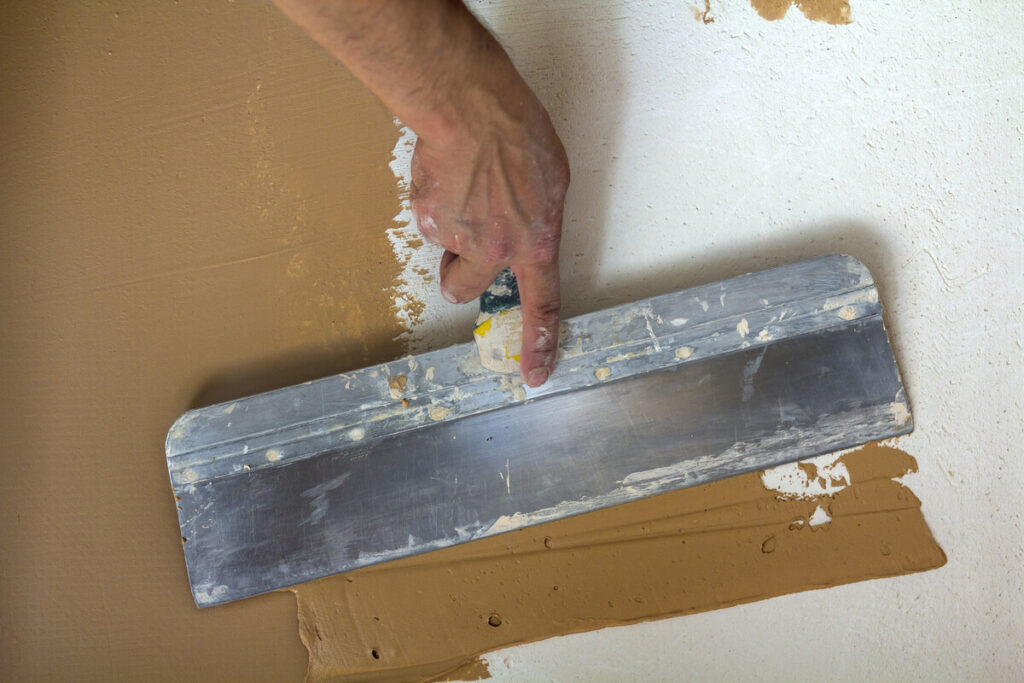
Standing in front of a cracked wall with three bags labeled “plaster” and no idea which one to pick? They are not interchangeable. One sets in under an hour, another needs about a month to cure, and the third is built for masonry. Here is what actually separates them, plus the simple formula to work out how much you need.
Three products, three different chemistries
“Plaster” is a family name, not a single material. The three types you will run into are made in completely different ways.
Gypsum plaster, also known as Plaster of Paris, is a powder of calcium sulfate hemihydrate. It is made by heating natural gypsum in a kiln to roughly 120 to 180 °C. Add water and it turns back into a solid.
Lime plaster is a mix of calcium hydroxide with sand or other inert fillers. The lime itself comes from limestone heated to more than 850 °C, a much hotter process than gypsum.
Cement plaster combines plaster, sand, Portland cement and water. It is the one applied to masonry, both indoors and outdoors.
Setting time: the difference that changes your schedule
This is where the choice really matters for a weekend project. Gypsum plaster starts to set about 10 minutes after mixing and is fully set in roughly 45 minutes. That speed is great for quick repairs, but it also means you should only mix what you can apply in that short window.
Lime plaster is the opposite. It needs a curing time of about a month. If you plan to paint or hang anything on a freshly limed wall the next day, you will be disappointed.
A quick way to remember it:
- Gypsum: set in under an hour
- Lime: cure in about a month
- Cement plaster: the masonry option, inside or out
The formula for how much plaster you need
Whatever type you choose, the quantity math is the same. You are filling a thin, flat layer over a surface, so you only need two numbers:
Plaster volume = surface to cover × thickness of the layer
In plain words: measure the area of the wall, decide how thick your coat will be, and multiply. The only trap is units. Area is usually in square meters, while thickness is usually given in millimeters, so convert the thickness to meters first (divide by 1,000).
A worked example you can reuse
Say you are plastering a wall section of 10 square meters, and you have decided on a coat 12 mm thick (the right thickness depends on your wall and product, so treat 12 mm as an example, not a rule).
- Thickness in meters: 12 ÷ 1,000 = 0.012 m
- Volume: 10 × 0.012 = 0.12 cubic meters
- In liters: 0.12 × 1,000 = 120 liters of plaster
Now a smaller job: a wall 3 meters wide and 2.5 meters high is 7.5 square meters. At the same 12 mm, that gives 7.5 × 0.012 = 0.09 cubic meters, or 90 liters. Notice how fast the volume grows with thickness: double the coat to 24 mm and you double the plaster.
If you would rather skip the unit conversions, the TheCalcMaster plaster calculator runs the same area times thickness logic for you.
Common mistakes to avoid
Assuming every plaster dries at the same speed
Planning a lime plaster job on a gypsum timeline (or the reverse) is the classic error. One is measured in minutes, the other in weeks.
Underestimating the heat
Setting gypsum plaster is an exothermic reaction, which means it releases heat. The temperature can climb above 60 °C while it hardens. That is hot enough to be a genuine safety issue, especially if plaster is setting in contact with skin, so never treat it as a harmless craft material.
Mixing up the three types
Gypsum, lime and cement plaster are three different chemical compositions with different uses. Grabbing the wrong bag because they all say “plaster” can leave you with a repair that sets too fast, cures too slowly, or is simply the wrong product for the surface.
The bottom line: pick the type for the job and the timeline, then let the area times thickness formula tell you how much to buy.