For centuries, mathematics has been used to transform complex situations into precise reasoning. It has enabled the construction of monuments, the measurement of the Earth, the prediction of celestial movements, and more recently, the development of computing and the technologies around us. However, its value can also be found in much simpler exercises. Sometimes, just a few numbers are enough to test our attention and logic.
One of the most important lessons is to understand that the order in which calculations are performed is as crucial as the calculations themselves. Two people applying the same rules correctly should arrive at the same result.
“Mathematics is the music of reason.” — James Joseph Sylvester
It often happens that an equation seems so simple that we start calculating immediately from left to right. It is precisely in these moments that errors occur. A good habit is to observe the equation for a few seconds, identify the priority operations, and only then begin the calculation.
What This Challenge Allows You To Work On:
- Operational priorities;
- Multiplication and division;
- Addition and subtraction;
- Mental calculation;
- Attention to signs;
- Speed of reasoning;
- Verification of results.
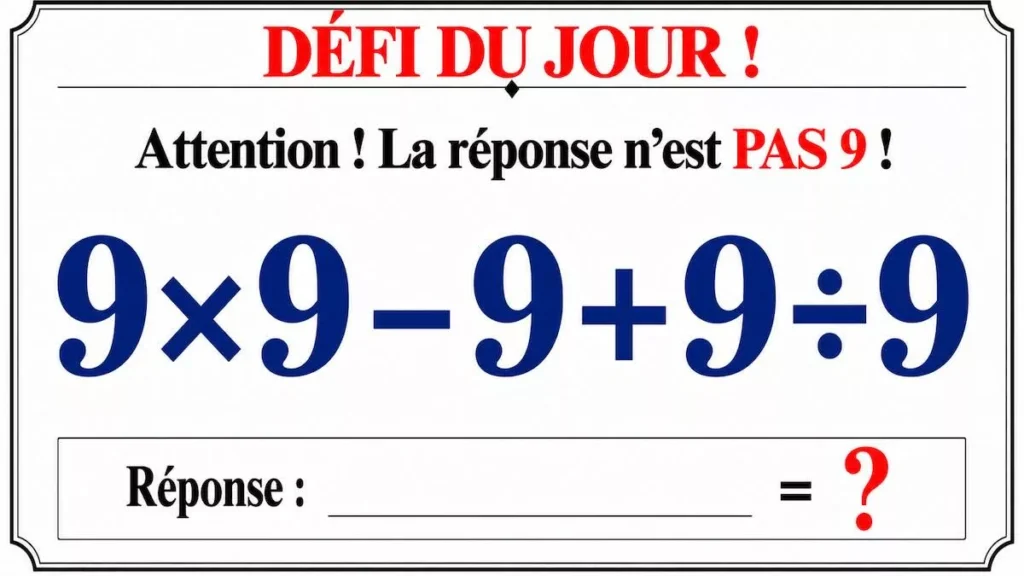
Challenge of The Day!
Attention: the answer is NOT 9!
What is the value of the following equation?
You have 10 seconds to find the correct answer.
The Countdown Begins
10…
9…
8…
7…
6…
5…
4…
3…
2…
1…
Time’s up!
What Your Performance Can Reveal
If you found the result quickly and correctly, you have excellent logic and analytical skills.
If you found the result after some reflection, you know how to structure your reasoning and verify your steps.
If the result was incorrect or not found, no worries; this type of exercise is perfect for improving methods and precision.
Detailed Solution We Found (Not Necessarily the Only One, Sometimes Even the Correct One)
We do not start with subtraction or addition. Multiplication and division take priority.
So let’s calculate:
9 × 9 = 81
and:
9 ÷ 9 = 1
The equation then becomes:
81 − 9 + 1
There remain additions and subtractions, which have the same priority. Thus, we calculate from left to right:
81 − 9 = 72
Then:
72 + 1 = 73
Answer: 73
Conclusion
The trap in this challenge does not lie in the difficulty of the operations: each one is very simple. The real challenge is to respect their order.
This is precisely what makes this type of test interesting. It shows that in mathematics, being quick does not necessarily mean calculating immediately. Sometimes, it is essential to start by observing, identifying priorities, and organizing your reasoning.
The correct answer is therefore 73, not 9.
A short equation can thus verify an essential skill: knowing the order of reasoning before calculating.
And before you get lost in the depths of the web, explore other games and tests by clicking here.