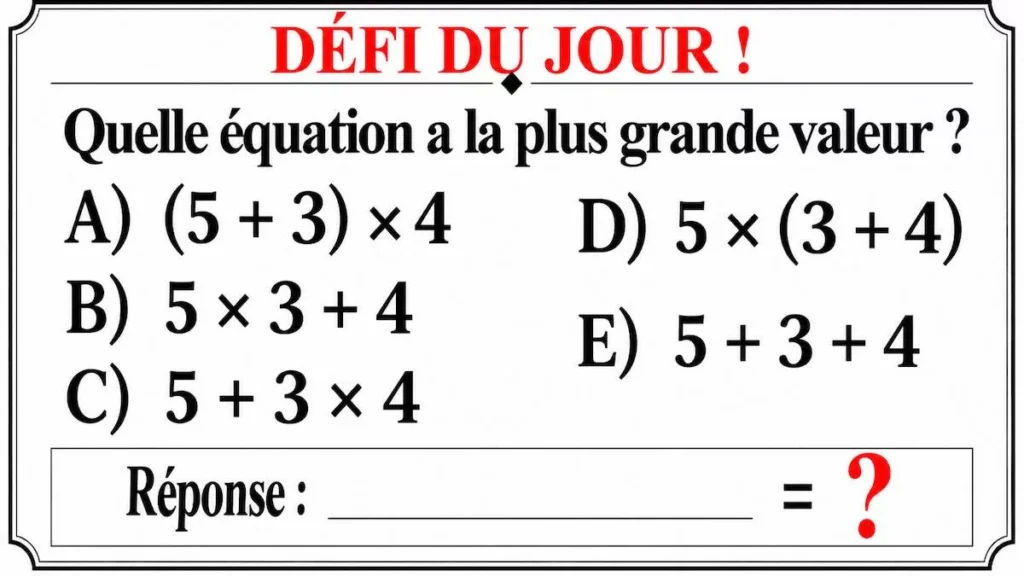
Since humans began trading, measuring land, and constructing buildings, mathematics has been used to compare quantities. Later, this ability to determine what is larger, smaller, or equivalent became essential in astronomy, engineering, economics, and the sciences. Therefore, correctly comparing calculations is not just about finding results; it’s about learning to analyze several possibilities before making a choice.
This challenge embodies that very concept. The same numbers appear multiple times, but their arrangement changes. A parenthesis or the position of a multiplication can completely alter the outcome.
“Mathematics is a gymnastics of the mind and a preparation for philosophy.” — Isocrates
In this type of problem, it’s easy to assume that equations using the same numbers will yield similar or even identical values. However, when calculated one by one while respecting the order of operations, differences become immediately apparent. It’s a good habit to adopt: don’t rely on intuition; check every possibility.
What This Challenge Allows You to Work On:
- Order of operations;
- The role of parentheses;
- Multiplication and addition;
- Mental calculation;
- Comparison of multiple equations;
- Speed of reasoning;
- Verification of results.
CHALLENGE OF THE DAY!
Which equation has the highest value?
You have 40 seconds to find the correct answer.
The Countdown Begins
40…
30…
25…
20…
15…
10…
5…
4…
3…
2…
1…
Time’s up!
What Your Performance Can Reveal
If you found the result quickly and correctly, you have excellent logic and analytical skills.
If you found the result after some reflection, you know how to structure your reasoning and verify your steps.
And if your result was incorrect or not found, no worries; this type of exercise is perfect for improving your method and accuracy.
Detailed Solution We Found (Not Necessarily the Only One, and Sometimes Even the Correct One)
To ensure our choice, let’s calculate each equation.
A) (5 + 3) × 4
We start with the parentheses:
8 × 4 = 32
So A = 32.
B) 5 × 3 + 4
Multiplication is prioritized:
15 + 4 = 19
So B = 19.
C) 5 + 3 × 4
We perform multiplication before addition:
5 + 12 = 17
So C = 17.
D) 5 × (3 + 4)
We start with the parentheses:
5 × 7 = 35
So D = 35.
E) 5 + 3 + 4
8 + 4 = 12
So E = 12.
Now we can compare:
32, 19, 17, 35, and 12
The highest value is 35.
Answer: D) 5 × (3 + 4) = 35
Conclusion
This challenge highlights something particularly interesting: the same numbers can yield very different results depending on their arrangement.
Here, it’s not the numbers 5, 3, and 4 that make the problem challenging; it’s the parentheses and the order of operations that determine the outcome of each equation.
Thus, proposition D is the winner with 35.
Ultimately, this test serves as a valuable reminder in mathematics: before comparing answers, ensure that each calculation has been performed in the correct order.
And before you get lost in the depths of the web, explore other games and tests by clicking here.