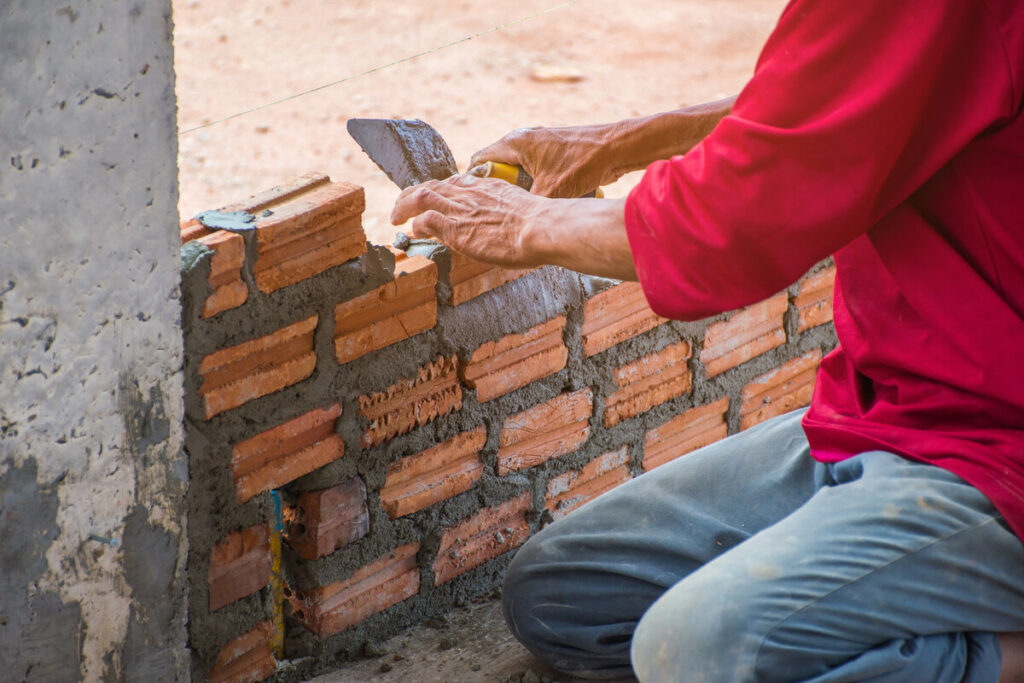
Every bag of mortar mix hides the same simple recipe: a few parts cement, some lime, and a lot of sand. Once you know the five standard ratios and one small formula, you can work out exactly how much of each ingredient your next brick or block job needs.
What mortar actually is
Mortar is the paste that bonds bricks and blocks together. Modern mortar is made of powdered Portland cement, fine aggregate (sand) and water, a formulation patented by Joseph Aspdin on 21 October 1824. Many mixes also include lime, which makes the mortar softer and easier to work.
The key difference with concrete is the aggregate. Mortar contains only sand, never gravel. Concrete uses sand and gravel together, which is why the two are not interchangeable even though both start from the same cement.
The five standard mortar types
American ASTM standards define five mortar types, ranked from strongest to weakest. Each one is a ratio of cement to lime to sand:
- Type M: 1 part cement, 1/4 part lime, 3½ parts sand, about 2,500 psi
- Type S: 1 part cement, 1/2 part lime, 4½ parts sand, about 1,800 psi
- Type N: 1 part cement, 1 part lime, 6 parts sand, about 750 psi
- Type O: 1 part cement, 2 parts lime, 9 parts sand, about 350 psi
- Type K: 1 part cement, 3 parts lime, 12 parts sand, about 75 psi
The psi figure is compressive strength, meaning how much pressure the hardened mortar can take before it crushes. Notice the pattern: as you move from M to K, the amount of lime per part of cement goes up and the strength goes down.
The formula: turn a ratio into real quantities
A ratio like 1:1:6 does not tell you how much to buy. To get real quantities, you need one extra step:
Size of one part = total volume of mortar needed ÷ total number of parts in the ratio
Then multiply that “one part” by each number in the ratio. In plain words: add up the numbers in the ratio, split your total volume into that many equal slices, and hand out the slices to cement, lime and sand according to the recipe.
A real example with Type N mortar
Say your project needs 0.08 cubic meters of Type N mortar (that is 80 liters).
- Add up the parts: 1 + 1 + 6 = 8 parts
- Size of one part: 0.08 ÷ 8 = 0.01 m³, or 10 liters
- Cement: 1 part = 0.01 m³ (10 liters)
- Lime: 1 part = 0.01 m³ (10 liters)
- Sand: 6 parts = 0.06 m³ (60 liters)
Now switch the same 80 liters to the stronger Type S (1 : 1/2 : 4½). The parts add up to 6, so one part is 0.08 ÷ 6 ≈ 0.0133 m³. That gives about 13.3 liters of cement, 6.7 liters of lime and 60 liters of sand.
Look at the sand: 60 liters in both cases. That is not a coincidence. In Types N, S, O and K, sand is exactly three quarters of the mix, and in Type M it is just under (3½ out of 4¾, roughly 74%). What really changes from one type to another is the balance between cement and lime, not the amount of sand. So if you already know your total volume, you can estimate your sand order almost instantly: about 75% of the mortar you need.
Mistakes people make with mortar ratios
Assuming the strongest mortar is always the best
Type M is the strongest, but that does not make it the right choice for every wall. Type K, the weakest of all, is valued precisely for its flexibility on certain historic walls. The right type depends on the job, not on picking the highest number.
Using cement mortar to repair an old lime wall
Lime mortar is still important for historic buildings because it is more flexible than cement mortar and it “breathes”, letting moisture move through and evaporate. Repointing an old lime-mortar building with modern Portland cement mortar creates a mismatch in flexibility and breathability that can lead to structural cracks.
Treating mortar like concrete
Because mortar has no gravel, you cannot borrow a concrete recipe and simply leave out a step. Use a mortar ratio from the list above, and measure every part with the same container so the proportions stay true.
Where the mortar volume comes from
Mortar quantities always start with the bricks. Standard joints are about 10 mm thick in the UK and 3/8 inch in the US, and that joint is built into the “nominal” brick size used for estimating. If you have not counted your bricks yet, the TheCalcMaster brick calculator is a good first step before you plan your mortar batches.