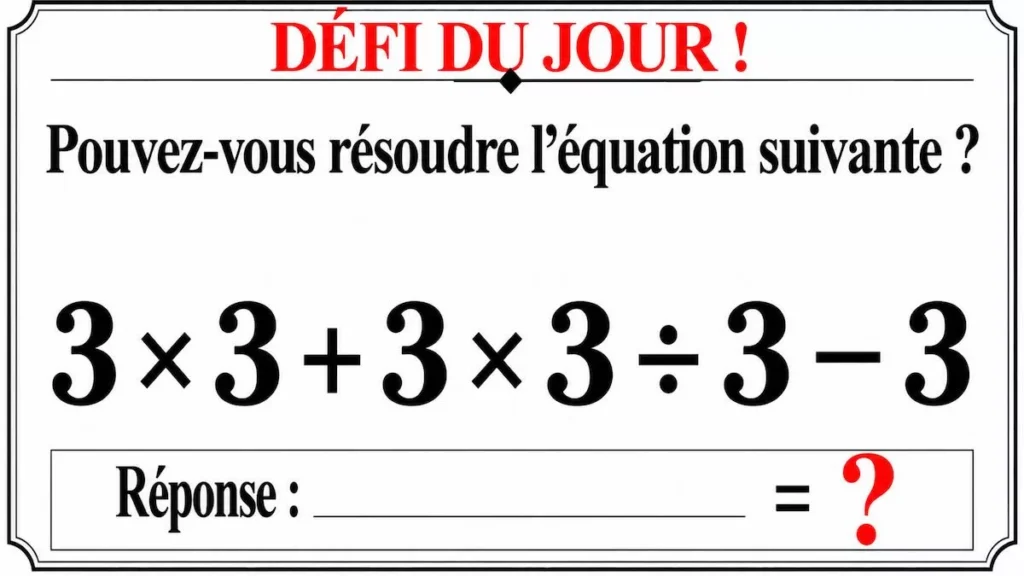
Mathematics has a peculiar sense of humor. It presents us with calculations that seem so straightforward that we rush in, and that’s exactly when it traps us! A simple change in the order of operations can completely alter the outcome. From the earliest numeral systems to modern mathematics, the rules of calculation have created a common language. Thanks to these rules, we can design buildings, program computers, launch satellites into space, organize transportation networks, and perform thousands of scientific calculations without ambiguity.
Behind these impressive achievements often lies something very simple: Respecting the rules in the correct order.
“The essence of mathematics is freedom.” — Georg Cantor
I remember a little challenge where all the numbers were the same. I thought to myself, “With only 8s, this will be quick!” And indeed, that feeling of ease pushed me to rush. I started adding before completing the multiplications and divisions. Since then, when I see an equation like that, I no longer just look at the numbers. I first examine the operations that connect them.
What This Challenge Helps You Work On:
- Order of operations;
- Multiplication and division before addition and subtraction;
- Calculating from left to right for operations of the same priority;
- Mental calculation;
- Concentration;
- Speed without sacrificing accuracy;
- Verification of the result.
CHALLENGE OF THE DAY!
Can you solve the following equation?
No calculators allowed! Take a few seconds to observe the equation before starting.
The countdown begins
30…
25…
20…
15…
10…
5…
4…
3…
2…
1…
Time’s up!
What Your Performance May Reveal
If you found the result quickly and correctly, you have excellent logic and analytical skills.
If you found the result after some thought, you know how to structure your reasoning and check your steps.
And if your result was incorrect or not found, no worries, this type of exercise is great for improving your method and accuracy.
Detailed Solution We Found (Not Necessarily the Only One, or Even the Correct One)
Let’s revisit the equation:
3 × 3 + 3 × 3 ÷ 3 − 3
We start with the multiplications and divisions.
The first multiplication gives:
3 × 3 = 9
For the next part, multiplication and division have the same priority. We calculate from left to right:
3 × 3 = 9
then:
9 ÷ 3 = 3
The equation then becomes:
9 + 3 − 3
We are left with addition and subtraction, which we perform from left to right:
9 + 3 = 12
then:
12 − 3 = 9
Answer: 9
Conclusion
This challenge is fun because the number 3 appears everywhere, giving the impression that the result can be found almost instantly. However, it’s not the numbers that constitute the real difficulty: it’s the order of operations.
The equation confirms a fundamental rule:
Multiplications and divisions first, then additions and subtractions.
And when two operations have the same priority, we proceed from left to right.
Thus:
3 × 3 + 3 × 3 ÷ 3 − 3 = 9
A very short equation can be an excellent exercise in attention. In mathematics, knowing how to calculate is important, but knowing in what order to calculate is just as crucial.
And before you lose yourself in the depths of the web, explore other games and tests by clicking here.