
Mathematics originated from very concrete needs. Long before calculators and modern formulas, early civilizations had to measure land, construct buildings, share harvests, and calculate distances. This is how geometry gradually developed: observing a shape, knowing certain dimensions, and determining the missing ones. Even today, area calculations are prevalent: in architecture for designing spaces, in construction for determining surfaces, in agriculture for measuring plots, or simply at home to estimate the amount of paint or tiles needed. Thus, behind a geometric figure often lies a very concrete situation.
“Mathematics is the alphabet with which God has written the universe.” — Galileo
I remember that, when faced with certain geometric figures, my first instinct was to immediately search for a formula. However, with experience, I learned that it is often better to start by observing the information already present in the drawing. A known area can help find a length, and then that length can reveal another. The problem becomes like a small puzzle where each result opens the door to the next.
What This Challenge Allows You to Work On:
- Calculating the area of a rectangle;
- Calculating the area of a triangle;
- Finding a dimension from an area;
- Identifying the base and height;
- Observing a geometric figure;
- Reasoning in multiple steps;
- Mental calculation and logic.
Challenge of the Day!
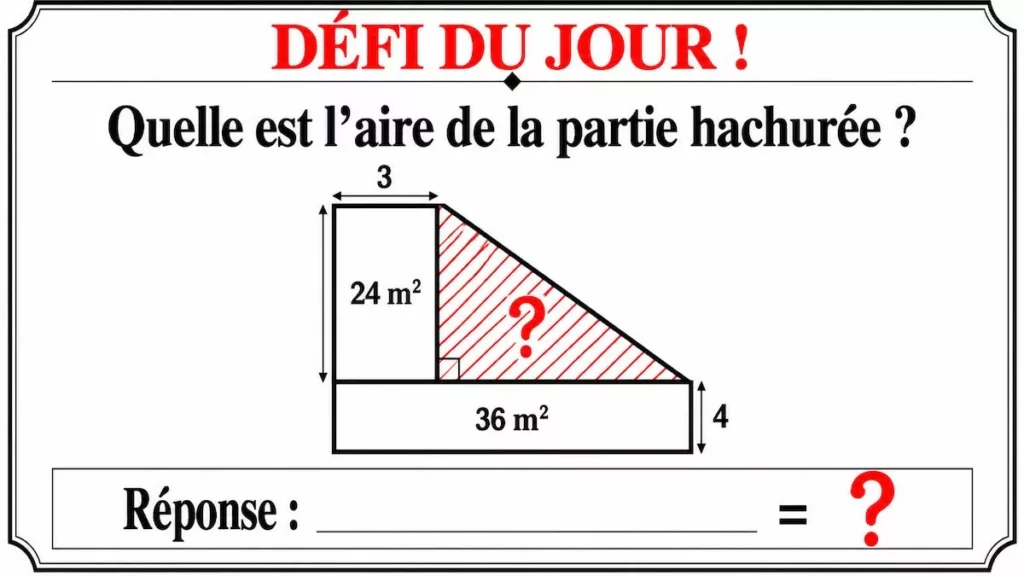
What is the area of the shaded part?
Carefully observe the figure.
Now, use this information to find the necessary dimensions and calculate the area of the shaded triangle.
You have 50 seconds!
The Countdown Begins
50…
40…
30…
25…
20…
15…
10…
5…
4…
3…
2…
1…
Time’s up!
What Your Performance Can Reveal
If you found the result quickly and correctly, you have excellent logic and analytical skills.
If you found the result after some thought, you know how to structure your reasoning and verify your steps.
And if the result was incorrect or not found, don’t worry; this type of exercise is perfect for improving your method and precision.
Detailed Solution We Found (Not Necessarily the Only One, Sometimes Even the Correct One)
Let’s start with the vertical rectangle.
Its area is 24 m² and its width measures 3 m.
We can write the equation:
3 × h = 24
Thus:
h = 24 ÷ 3
h = 8 m
The height of the shaded triangle is therefore 8 m.
Now let’s move on to the horizontal rectangle.
Its area is 36 m² and its height measures 4 m.
We write:
4 × L = 36
Thus:
L = 36 ÷ 4
L = 9 m
But be careful: these 9 meters correspond to the entire length of the horizontal rectangle. The part below the vertical rectangle already measures 3 m.
The base of the shaded triangle is therefore:
b = 9 − 3
b = 6 m
Now we know the base and height of the triangle.
To find its area, we can set up the equation:
A × 2 = 6 × 8
2A = 48
A = 48 ÷ 2
A = 24 m²
Answer: 24 m²
Conclusion
This challenge illustrates an important idea in geometry: not all useful dimensions are necessarily given directly.
You first needed to utilize the areas of the two rectangles to find their dimensions, then understand that the triangle’s base only corresponded to a part of the length of the horizontal rectangle.
This is precisely what makes such challenges interesting: the final calculation is quite simple, but the real difficulty lies in correctly reading the figure and connecting the information together.
And before you get lost in the depths of the web, explore more games and tests by clicking here.