Well, we can already deduce that Sandra is pretty good at math. There are many other mathematical stories that seem almost unbelievable. In the 3rd century BCE, Erathosthenes successfully estimated the circumference of the Earth with remarkable accuracy, without satellites, GPS, or even traveling around the planet. By simply observing the shadow of the Sun in two cities and using geometry, he was able to transform a few measurements into an estimate of the Earth’s size. This story serves as a reminder of a crucial point: with numbers, observation, and well-structured reasoning, we can uncover far more than we might imagine.
Mathematics has since enabled extraordinary achievements: predicting eclipses, constructing bridges and skyscrapers, sending probes into space, developing computing, and allowing navigation systems to calculate our location. However, their significance also begins in much simpler situations: knowing the order in which to perform multiple operations.
“Where there is a number, there is beauty.” — Proclus
This kind of calculation might tempt you to start immediately with the first operation on the left. It’s often a reflex. However, when an equation contains multiple different operations, a few seconds of observation can often help you avoid mistakes: multiplications and divisions must be carried out before additions and subtractions.
What This Challenge Allows You to Work On:
- the order of operations;
- multiplication and division;
- subtraction;
- mental calculation;
- careful reading of an equation;
- speed of reasoning;
- concentration;
- verification of a result.
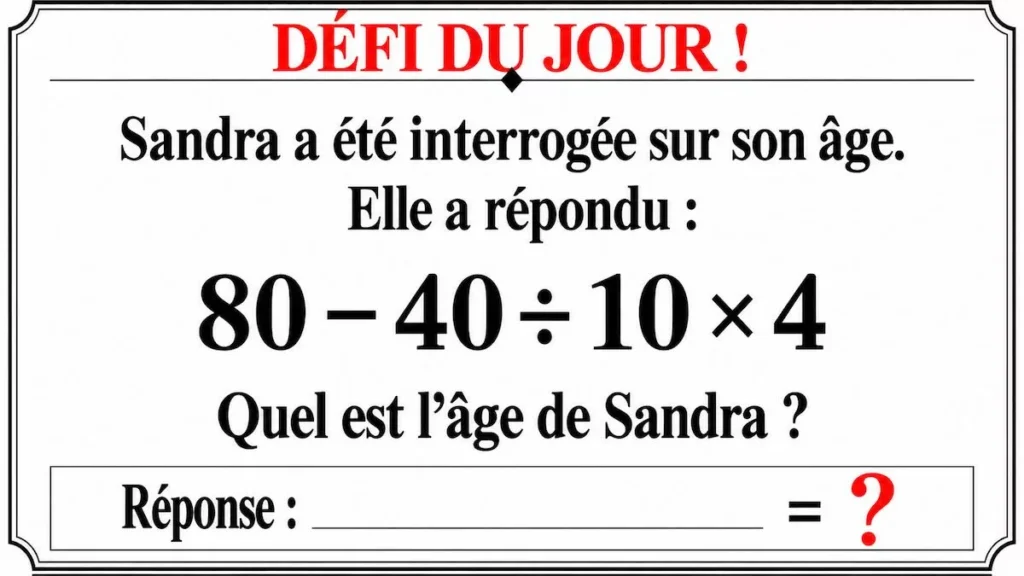
CHALLENGE OF THE DAY!
Sandra was asked about her age.
She replied with this equation:
So, what is Sandra’s age?
Be careful not to automatically perform the calculations from left to right. First, identify the priority operations.
You have 20 seconds!
The Countdown Begins
20…
15…
10…
5…
4…
3…
2…
1…
Time’s up!
What Your Performance Can Reveal
If you found the result quickly and correctly, you have excellent logic and good analytical skills.
If you found the result after some thought, you know how to structure your reasoning and check your steps.
And if your result was incorrect or not found, no worries; this type of exercise is perfect for improving your methods and precision.
Detailed Solution We Found (Not Necessarily the Only One, or Even the Correct One)
We have the equation:
80 − 40 ÷ 10 × 4 = ?
Division and multiplication take precedence over subtraction.
When a multiplication and division follow each other, they have the same level of priority. We perform them from left to right.
Let’s start with:
40 ÷ 10 = 4
The equation now becomes:
80 − 4 × 4 = ?
Next, we perform the multiplication:
4 × 4 = 16
We obtain:
80 − 16 = 64
Answer: Sandra is 64 years old (but she looks much younger)
Conclusion
The real trap of this challenge was not the difficulty of the calculations, but the order. An equation made up of very simple numbers can lead to an incorrect answer if operational priorities are not respected.
Here, one had to start with the division, followed by multiplication, and only then perform the subtraction. This little test perfectly illustrates a fundamental rule of mathematics: the correct answer depends as much on the method used as on the numbers present in the equation.
And before you get lost in the depths of the web, explore other games and tests by clicking here.