There is something incredible in the history of mathematics: rules that seem very simple today have enabled us to achieve things that were once unimaginable. Accurately calculating the trajectories of planets, constructing gigantic bridges, sending probes into space, or operating billions of computers all rely on one crucial principle: performing operations in a perfectly defined order.
Thus, mathematics is not just about finding numbers. It teaches us to organize our reasoning, to verify an intuition, and, above all, not to confuse speed with haste. An equation with just a few symbols can sometimes challenge this discipline more than a lengthy calculation.
“Where there is a number, there is beauty.” — Proclus
I remember those little calculations where everything seems so obvious that we think we know the answer even before we start. We mentally add the numbers one after the other, and the result seems logical. Then, upon revisiting the equation calmly, we discover that a multiplication or division should have been performed first. It is often in the shortest equations that attention makes all the difference.
What This Challenge Helps To Work On:
- Order of operations;
- Multiplication and division;
- Addition and subtraction;
- Mental calculation;
- Careful reading of an equation;
- Concentration;
- Speed of reasoning;
- Verification of the result.
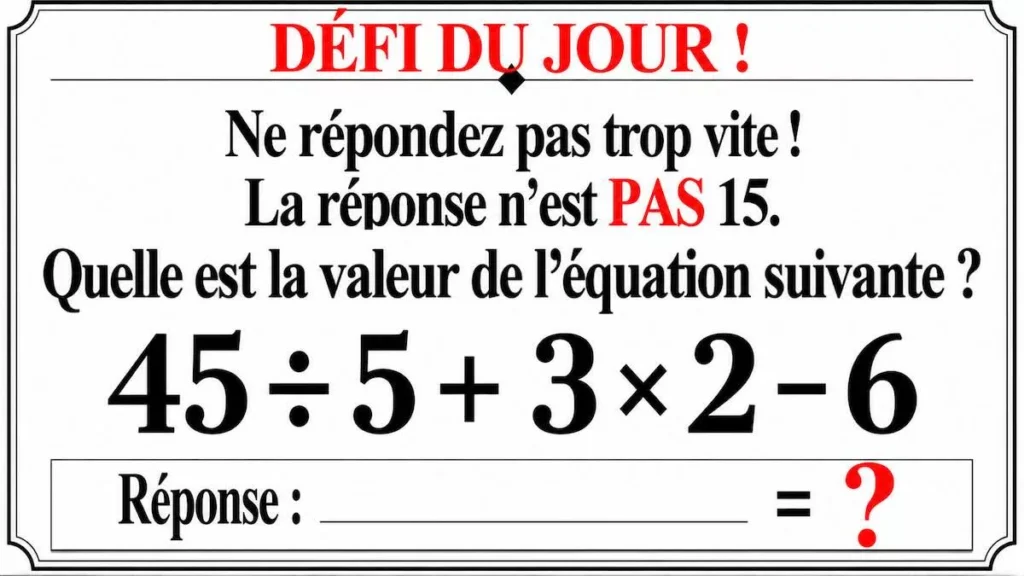
CHALLENGE OF THE DAY!
Don’t answer too quickly! The answer is NOT 15.
What is the value of the following equation?
Before calculating, take a close look at the equation: which operations should be performed first?
The Countdown Begins
30…
25…
20…
15…
10…
5…
4…
3…
2…
1…
Time’s up!
What Your Performance Can Reveal
If you found the result quickly and correctly, you have excellent logic and good analytical skills.
If you found the result after some reflection, you know how to structure your reasoning and verify your steps.
And if your result was incorrect or not found, no worries; this type of exercise is perfect for improving method and precision.
Detailed Solution We Found (Not Necessarily the Only One, Sometimes Even the Right One)
Let’s revisit the equation:
Division and multiplication take priority.
So we calculate:
45 ÷ 5 = 9
and:
3 × 2 = 6
The equation then becomes:
9 + 6 − 6
Now we perform addition and subtraction from left to right:
9 + 6 = 15
then:
15 − 6 = 9
Answer: 9
Conclusion
The trap of this challenge was precisely to see 15 appear in the middle of the calculation and to stop too early. However, an equation must be solved until its last operation.
45 ÷ 5 + 3 × 2 − 6 = 9
This little test serves as a reminder of an essential rule: multiplication and division come before addition and subtraction, then calculations are performed from left to right when operations have the same priority.
Mathematics rarely rewards those who simply go the fastest. It rewards those who observe, respect the rules, and verify their reasoning to the end.
And before you get lost in the depths of the web, explore other games and tests by clicking here.