There is something fascinating about the history of mathematics: long before the advent of calculators and computers, humans had to know how to measure areas. They needed to determine the size of land, divide plots, construct houses, or estimate the amount of materials required for a building. Geometry, therefore, largely arose from very concrete problems. Over the centuries, these measurement methods have contributed to extraordinary achievements, such as monuments, bridges, roads, cities, and engineering works.
Even today, calculating an area is not just a school exercise: architects, engineers, craftsmen, and surveyors use these principles daily.
I remember some exercises where a figure had so many measurements that I immediately looked for a complicated formula. However, by taking the time to simply name the unknown width and height, everything became much clearer. This is a lesson I enjoy finding in such challenges: a complex figure can sometimes conceal very simple equations.
“Simplicity is the ultimate sophistication.” — Leonardo da Vinci
This quote fits particularly well with today’s challenge. It is not necessary to multiply calculations; it is essential to understand how the different parts of the figure are related to each other.
What This Challenge Allows You to Work On:
- The calculation of the area of a rectangle,
- The relationship between length,
- Width and area,
- The formulation of a geometric figure
- The resolution of equations
It also develops observation, logic, the ability to utilize multiple pieces of information simultaneously, and especially the habit of not being misled by a figure whose dimensions are not directly indicated.
Today’s Challenge
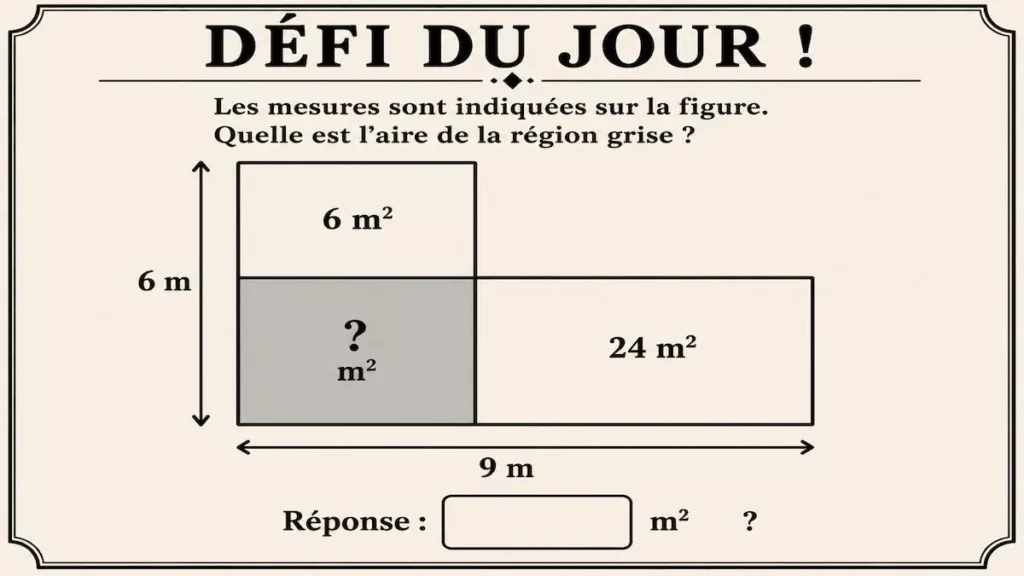
Observe the figure carefully.
Your mission is to determine:
What is the area of the gray region?
Take your time to observe the common dimensions among the various rectangles before you begin your calculations.
The Countdown Begins
90…
80…
70…
60…
50…
40…
30…
20…
10…
0…
Time’s up!
What Your Performance Can Reveal
If you found the result quickly and correctly, you have excellent logic and analytical skills.
If you found the result after some reflection, you know how to structure your reasoning and check your steps.
And if your result was incorrect or not found, no worries; this type of exercise is perfect for improving your method and accuracy.
Detailed Solution We Found (Not Necessarily the Only or Correct One)

To solve this challenge, let’s call:
h the height of the gray region,
and w its width.
The total height of the left part is 6 m.
Thus, the height of the upper rectangle is:
6 − h
Since its area is 6 m², we obtain the equation:
w × (6 − h) = 6
Now, let’s look at the rectangle on the right.
The total length of the figure is 9 m.
Since the gray region has a width of w, the width of the rectangle on the right is:
9 − w
Its height is the same as that of the gray region, which is h.
Since its area is 24 m², we have a second equation:
(9 − w) × h = 24
Solving these two equations leads to:
h = 4 m
and:
w = 3 m
We can now calculate the area of the gray region.
Area = width × height
So:
Area = 3 × 4
Area = 12 m²
Final Answer
The gray region has an area of 12 m².
Conclusion
The real challenge was not simply applying the area formula for a rectangle. It was essential to understand that the three rectangles share certain dimensions and that the total measurements of 6 m and 9 m allow us to connect all parts of the figure.
Once the height of 4 m and the width of 3 m were found through equations, the final calculation became immediate:
3 × 4 = 12 m².
This challenge perfectly illustrates an important idea in mathematics: when information is lacking, it can often be retrieved through the relationships it has with already known information.
And before you get lost in the web’s maze, explore other games and tests by clicking here.