Throughout the history of mathematics, there have been almost strange discoveries. For centuries, certain numbers were even considered “impossible.” When mathematicians began to work with negative numbers, many struggled to accept that a quantity could be less than nothing. Later, imaginary numbers caused the same astonishment. Yet, these ideas that were once deemed strange are now utilized in physics, electronics, computer science, and many modern technologies.
This is precisely what makes mathematics fascinating. An idea that seems odd or unnecessary at one time can become indispensable centuries later. Mathematics has enabled the construction of bridges, the prediction of astronomical phenomena, the development of telecommunications, and the design of the computer systems that surround us.
“Mathematics is the music of reason.” — James Joseph Sylvester
I remember a calculation where I immediately spotted a very simple division and an equally obvious multiplication. I was convinced that it would take just a few seconds. However, I had forgotten an essential detail. Multiplication and division have the same priority. When they appear sequentially, they are performed in the order they appear, from left to right. Since then, when faced with such equations, I always look at the entire line before starting.
What This Challenge Helps to Work On:
- Order of operations;
- The relationship between multiplication and division;
- Calculating from left to right when operations have the same priority;
- Mental calculation;
- Attention and concentration;
- Verification of results;
- The ability to resist giving an answer too quickly.
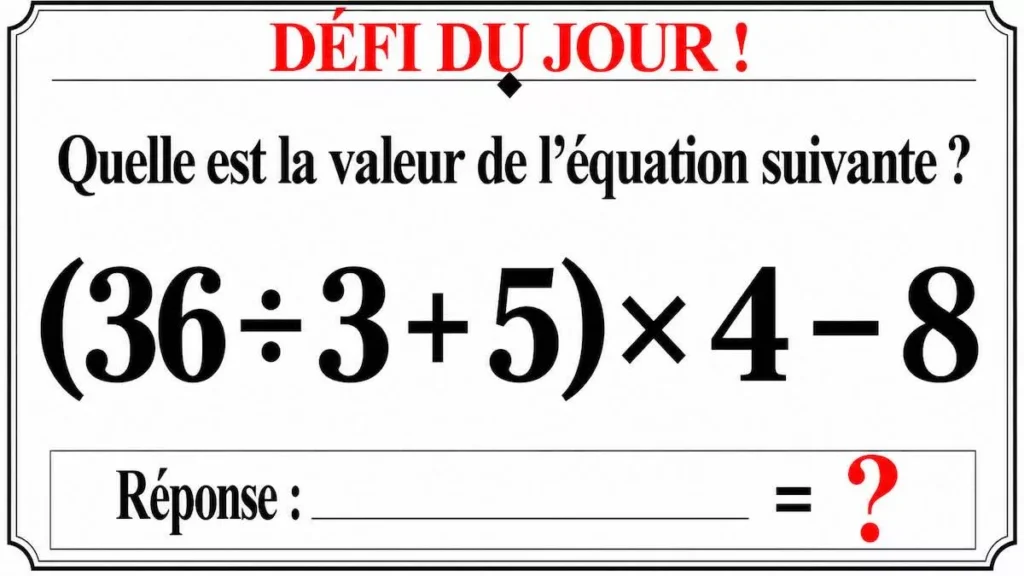
DAILY CHALLENGE!
What is the value of the following equation?
Warning: this challenge contains a little trap. Division and multiplication have the same priority.
You have 20 seconds to find the answer.
The Countdown Begins
20…
10…
9…
8…
7…
6…
5…
4…
3…
2…
1…
Time is up!
What Your Performance May Reveal
If you found the result quickly and correctly, you have excellent logic and good analytical skills.
If you found the result after some thought, you know how to structure your reasoning and check your steps.
And if your result was incorrect or not found, no worries, this type of exercise is perfect for improving your method and precision.
Detailed Solution We Found (not necessarily the only or even the correct one)
The equation is:
Division and multiplication have the same priority. Therefore, we perform them from left to right.
Let’s start with:
36 ÷ 3 = 12
The equation becomes:
12 + 5 = 17
Next, we perform the multiplication:
17 × 4 = 68
What remains is:
68 − 8 = 60
Answer: 60
Conclusion
This challenge is interesting because it does not require any complicated calculations. The real test lies in adhering to the order of operations.
Here, parentheses must be calculated first. So we start with 36 ÷ 3, then add 5:
36 ÷ 3 = 12
12 + 5 = 17
Next, we continue with the multiplication, followed by the subtraction:
17 × 4 = 68
68 − 8 = 60
Thus:
(36 ÷ 3 + 5) × 4 − 8 = 60
This is an excellent illustration of an essential rule in mathematics: respecting the order of operations helps avoid mistakes. A few seconds spent observing the parentheses and priorities is often enough to find the correct answer.
And before you get lost in the depths of the web, explore other games and tests by clicking here.