Several centuries ago, solving an equation could require pages of explanations. Mathematicians didn’t have access to our modern algebraic notation, often describing their calculations in words. Gradually, symbols and letters became the norm. A simple letter like a, b, or c could now represent an unknown number. This new way of writing mathematics opened up extraordinary possibilities. Equations became essential for understanding the movement of planets, constructing bridges, designing machines, developing electricity, programming computers, and sending spacecraft into space. Behind many great scientific achievements lie equations that someone managed to understand and solve.
I remember exercises where several letters were mixed in various equations. At first, I would directly search for the last value and end up going in circles. Then I realized that the initial equations should be viewed as clues. Once a was found, and then b, the final unknown became almost obvious. This is a method I still find effective: not trying to solve everything simultaneously, but progressing methodically.
“Mathematics is the alphabet with which God has written the universe.” — Galileo
This quote illustrates how mathematics can be seen as a language. Each number, symbol, and equation conveys information. The true challenge lies in learning to read this language and correctly connecting the clues.
What This Challenge Allows You to Work On:
- Understanding an equation;
- Finding an unknown;
- Algebraic reasoning;
- Mental calculation;
- Order of operations;
- Multiplication and division;
- Logic;
- Concentration and verification.
Challenge of the Day!
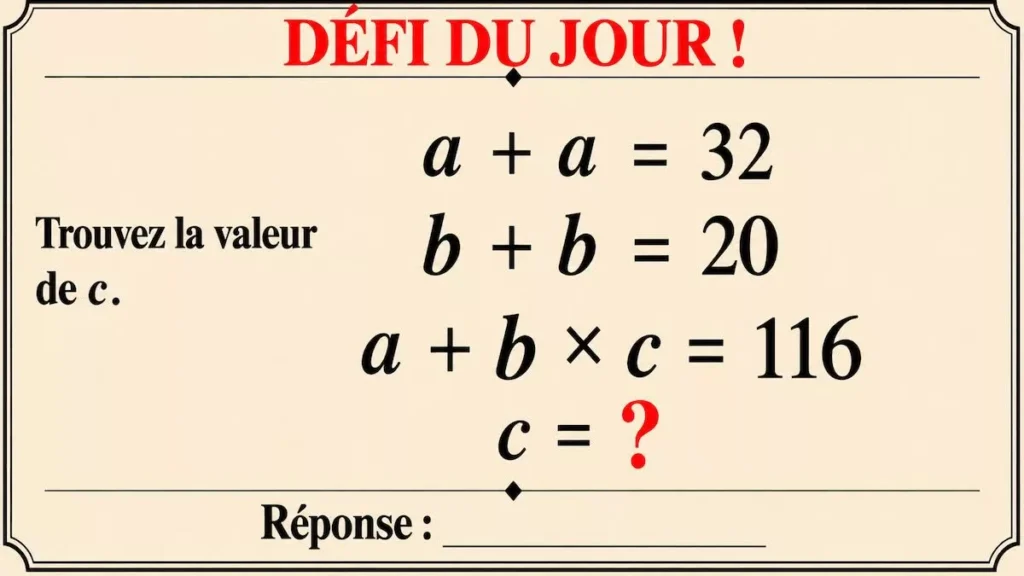
Today, three letters hide three numbers.
Here are the equations:
Can you find the value of c?
Note: In the last equation, remember that multiplication takes precedence over addition.
Look carefully before discovering the solution.
The Countdown Begins
50…
40…
30…
25…
20…
15…
10…
5…
4…
3…
2…
1…
Time’s up!
What Your Performance Can Reveal
If you found the result quickly and correctly, you have excellent logic and strong analytical skills.
If you found the result after some thought, you know how to structure your reasoning and verify your steps.
And if the result was incorrect or not found, no worries—this type of exercise is perfect for improving your method and accuracy.
Detailed Solution We Found (Not Necessarily the Only One)
Let’s start with the first equation:
a + a = 32
Two times a equals 32:
2a = 32
Therefore:
a = 16
Now let’s move on to the second equation:
b + b = 20
Two times b equals 20:
2b = 20
Therefore:
b = 10
We now have two essential pieces of information:
a = 16
b = 10
Let’s use these in the last equation:
a + b × c = 116
Substituting a and b:
16 + 10 × c = 116
This gives us:
16 + 10c = 116
Subtract 16 from both sides:
10c = 100
Now divide by 10:
c = 10
Let’s verify our result in the original equation:
16 + 10 × 10 = 116
Multiplication takes precedence:
10 × 10 = 100
Then:
16 + 100 = 116
The equation is perfectly verified.
Answer: c = 10
Conclusion
This challenge demonstrates that an equation that seems complicated becomes much more accessible when we use the information in the correct order.
We started by finding a = 16, then b = 10. These two results transformed the last equation into a very simple calculation, ultimately allowing us to find c = 10.
However, the essential point was also to respect the order of operations: in a + b × c, multiplication must be considered before addition.
This is one of the great strengths of mathematics: when faced with multiple pieces of information, it teaches us to organize our reasoning, to progress step by step, and most importantly, to verify that our answer actually works.
The sought value is therefore c = 10.
And before you get lost in the web’s labyrinth, explore other games and tests by clicking here.