Imagine for a moment that numbers could conceal a message. This is precisely what mathematicians have done for centuries: observing sequences, comparing results, and searching for the invisible rules that connect numbers to one another. Long before computers, this ability to recognize patterns allowed them to predict astronomical phenomena, organize calendars, and solve problems related to trade and construction.
Today, this same logic is found in computer science, cryptography, artificial intelligence, engineering, and numerous scientific discoveries. Mathematics is therefore not just about performing calculations: it trains us to seek what lies beyond appearances.
“Mathematics is the art of giving the same name to different things.” — Henri Poincaré
I recall small challenges where I would start by performing the indicated addition. Then I would realize that the initial results did not correspond at all to a traditional addition. It was necessary to momentarily forget the usual rules and ask myself what new rule could explain all the lines? This small moment of discovery makes such challenges particularly interesting.
What This Challenge Allows You To Work On:
- Observation of numbers;
- Searching for a hidden rule;
- Mental calculation;
- Multiplication and addition;
- Recognizing a pattern;
- Logic;
- Concentration;
- Verifying a hypothesis.
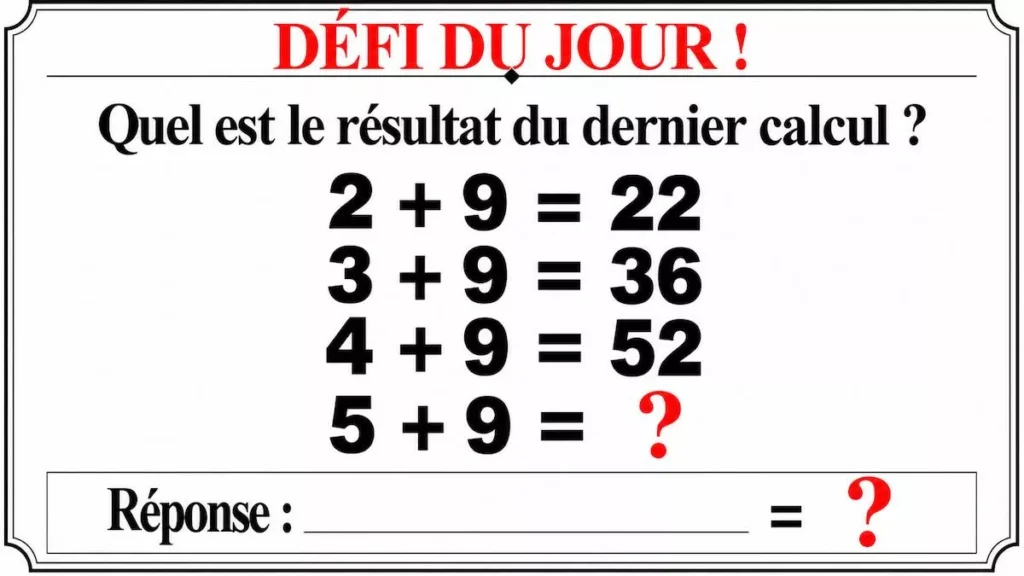
CHALLENGE OF THE DAY!
Can you discover the rule used in these equations and find the result of the last calculation?
Warning: these are obviously not ordinary additions.
The same rule must be able to explain 22, 36, and 52 before being applied to the last equation.
The Countdown Begins
30…
25…
20…
15…
10…
5…
4…
3…
2…
1…
Time’s up!
What Your Performance Can Reveal
If you found the result quickly and accurately, you have excellent logic and good analytical skills.
If you found the result after some reflection, you know how to structure your reasoning and verify your steps.
And if your result was incorrect or not found, no worries; this type of exercise is perfect for improving your method and precision.
Detailed Solution We Found (Not Necessarily the Only or Even the Correct One)
Let’s carefully observe the results.
For the first equation:
2 + 9 = 22
We can obtain 22 as follows:
2 × (9 + 2) = 2 × 11 = 22
Let’s check with the second:
3 × (9 + 3) = 3 × 12 = 36
It works.
Now let’s try the third:
4 × (9 + 4) = 4 × 13 = 52
The same rule works again.
We have thus discovered the rule:
a + 9 → a × (a + 9)
Let’s apply it now to the last equation:
5 + 9
becomes:
5 × (5 + 9)
First, we calculate:
5 + 9 = 14
Then:
5 × 14 = 70
Answer: 70
Conclusion
The trap of this challenge was to look at the symbol + and immediately want to perform a standard addition. However, the previous results indicated that a particular rule was being used.
The key was therefore not to settle for a rule that works only once, but to find one that explains all the given equations.
Thus:
2 → 2 × 11 = 22
3 → 3 × 12 = 36
4 → 4 × 13 = 52
5 → 5 × 14 = 70
The expected answer is therefore 70.
This challenge serves as a reminder of an essential quality in mathematics: observe before calculating. Good reasoning isn’t just about obtaining a result; it’s primarily about discovering a coherent rule and verifying that it works in all cases.
And before you get lost in the depths of the web, explore other games and tests by clicking here.