
There is something incredible about the history of mathematics. Problems that were once thought to be nearly impossible have become accessible through the use of symbols. For centuries, mathematicians have learned to transform complicated questions into equations, then methodically search for the numbers that can make them true. This way of thinking has profoundly changed our understanding of the world.
Equations are now everywhere, even when we don’t see them. They play a role in building construction, engineering calculations, scientific forecasts, computing, economics, and even the trajectories of satellites. Their significance lies not just in “finding x”: they primarily teach us to reason, break down a problem, and verify that an answer is indeed correct.
“Mathematics not only has truth but also a supreme beauty.” — Bertrand Russell
I remember certain exercises where I would quickly find a value that worked and think I was done. However, with quadratic equations, this instinct can make us overlook another solution. Since then, whenever an x² appears, I always keep in mind the question: “Have I really found all the solutions?”
What This Challenge Helps You Work On:
- solving a quadratic equation;
- putting it in standard form;
- factoring;
- finding two suitable numbers;
- the zero product property;
- mental calculation;
- verifying solutions;
- mathematical rigor and logic.
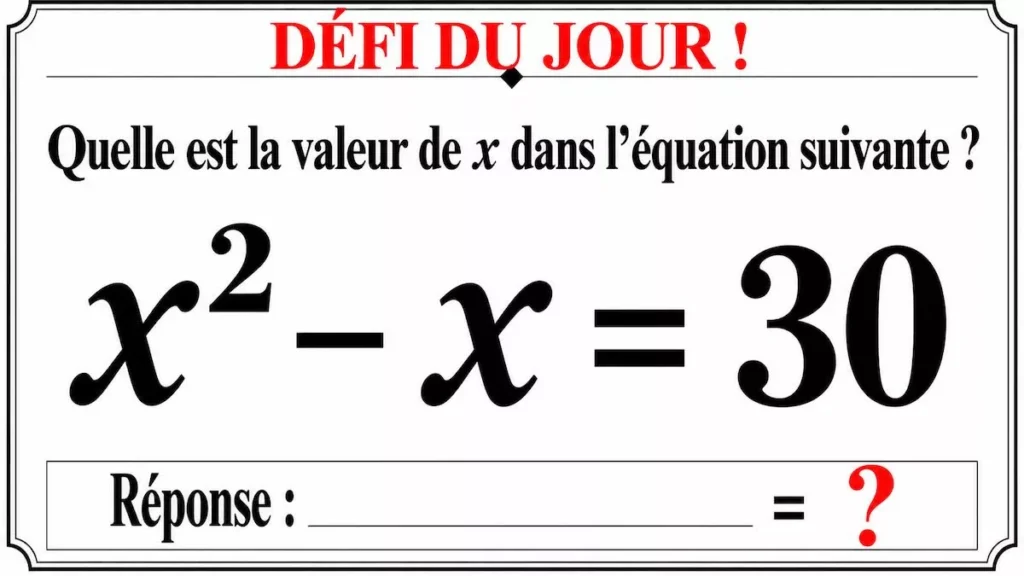
DAILY CHALLENGE!
What is the value of x in the following equation?
A small hint: even though the question refers to “the value of x,” there might actually be more than one answer.
The Countdown Begins
30…
25…
20…
15…
10…
5…
4…
3…
2…
1…
Time’s up!
What Your Performance Can Reveal
If you found the result quickly and correctly, you have excellent logic and analytical skills.
If you found the result after some reflection, you know how to structure your reasoning and check your steps.
And if your result was incorrect or not found, no worries, this type of exercise is perfect for improving your method and precision.
Detailed Solution We Found (Not Necessarily the Only One, Sometimes Even the Right One)
Let’s start with the equation:
We bring 30 to the left side:
x² − x − 30 = 0
Now we need to find two numbers whose product is −30 and whose sum is −1.
These two numbers are:
−6 and 5
We can then factor:
(x − 6)(x + 5) = 0
For a product to be equal to zero, at least one of the two factors must be zero.
First case:
x − 6 = 0
Thus:
x = 6
Second case:
x + 5 = 0
Thus:
x = −5
Answer: x = 6 or x = −5
Let’s verify.
For x = 6:
6² − 6 = 36 − 6 = 30
For x = −5:
(−5)² − (−5) = 25 + 5 = 30
Both solutions are therefore correct.
Conclusion
The trap in this challenge is quite subtle. One might quickly notice that 6 works and be tempted to stop there. But the quadratic equation has two solutions in this case.
Thus: x² − x = 30
gives: x = 6 or x = −5
This test reminds us of an important rule: in mathematics, finding a correct answer does not necessarily mean you have found all the answers. The best habit is to fully solve the equation and then verify each result. It is this rigor that transforms a simple calculation into true mathematical reasoning.
And before you get lost in the depths of the web, explore other games and tests by clicking here.