Imagine a man living over 2,200 years ago, in a time when satellites, airplanes, and computers did not yet exist. This man, named Eratosthenes, took on an extraordinary challenge: to calculate the circumference of the Earth without ever traveling around it. Through simple observations of the Sun, some measurements, and remarkable geometric reasoning, he managed to arrive at an astonishingly close estimation of reality. This story illustrates how mathematics can transform a simple observation into an exceptional discovery. Through mathematics, humanity learned to measure distances, understand the movements of planets, and build impressive monuments. Even today, they play a fundamental role in navigation, medicine, engineering, computer science, and space exploration.
What makes mathematics particularly fascinating is that it doesn’t always require complicated tools. Sometimes, just a few numbers, two letters, and a bit of logic are enough to solve a seemingly mysterious situation. It is this ability to uncover the unknown from known information that makes equations so powerful.
A small anecdote perfectly illustrates this idea. Imagine a student encountering two equations for the first time, containing the same letters, and thinking immediately that the problem is too difficult. Yet, by simply adding the two equations, they see one unknown disappear and suddenly realize that the solution was much more accessible than they imagined. This moment of discovery is one of the most beautiful aspects of learning mathematics. It reminds us that a difficulty can become simple when we adopt the right method. And this is precisely what we will experience with our challenge today.
Quote of the Day
“Mathematics is the queen of sciences, and arithmetic is the queen of mathematics.” Carl Friedrich Gauss
This quote underscores the importance of numbers and reasoning in understanding the world. Mathematics is not only for performing calculations: it allows us to discover relationships that are invisible at first glance. In our challenge, two equations will enable us to determine two unknown values, and then find a very precise result.
What This Challenge Allows You to Work On:
- Logical reasoning: understanding the relationships between two unknowns.
- Solving equations: learning to utilize multiple pieces of information to find a value.
- Concentration: carefully observing signs and numbers.
- Mental calculation: quickly performing additions, subtractions, and divisions.
- Elimination method: discovering how to remove an unknown by combining two equations.
- Verification: checking that the values found meet all conditions.
- Self-confidence: understanding that a seemingly complicated problem can be solved with a few simple steps.
Challenge of the Day!
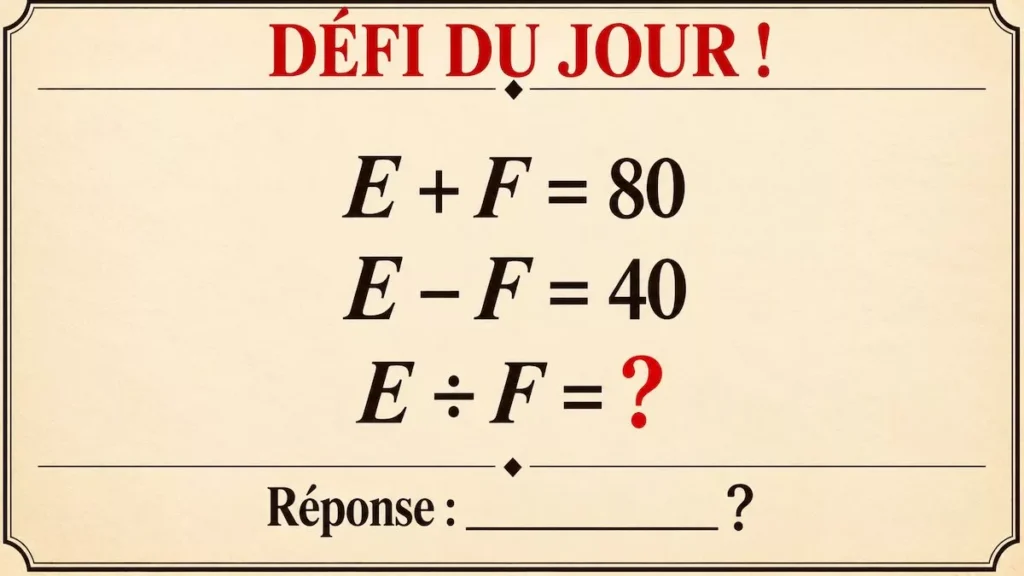
Today, we are going to exercise your logic with a small system of two equations. Two mysterious letters, E and F, represent numbers that you need to discover. Your goal will then be to calculate the result of their division.
Here are the three lines of our challenge:
Carefully observe these equations. We know that the sum of the two numbers equals 80 and that their difference equals 40. With this information, can you find out how much E divided by F is?
You have 40 seconds to solve this mathematical mystery. Try to find the values of E and F before calculating their quotient. Don’t rush: the right method can save you a lot of time.
The Countdown Begins
40…
30…
25…
20…
15…
10…
5…
4…
3…
2…
1…
Time’s up!
What Your Performance Can Reveal
If you found the result quickly and correctly, you have excellent logic and analytical skills.
If you found the result after some thought, you know how to structure your reasoning and check your steps.
And if the result was incorrect or not found, no worries, this type of exercise is perfect for improving method and precision.
Detailed Solution We Found (Not Necessarily the Only One, Sometimes Even the Right One)
Now let’s discover how to solve these equations step by step. The objective is to find the exact values of E and F, and then calculate their quotient. For this, we will use a very effective method: the addition of the two equations.
Step 1: Observe the first two equations
We have:
E + F = 80
E − F = 40
Note an important detail: in the first equation, we have + F, while in the second, we have − F. These two terms are opposites and can thus cancel each other out when we add the equations. This observation is the key to our resolution.
Step 2: Add the two equations
Let’s add the left-hand sides and the right-hand sides:
(E + F) + (E − F) = 80 + 40
Combining the terms, we get:
E + E + F − F = 120
Since F − F = 0, we are left with:
2E = 120
We now have a much simpler equation with only one unknown. We just need to divide both sides by 2 to find the value of E.
Step 3: Find the value of E
From:
2E = 120
We divide both sides by 2:
E = 120 ÷ 2
We obtain:
E = 60
We now know our first unknown. The number represented by the letter E is therefore equal to 60. We still need to find the value of F.
Step 4: Find the value of F
Let’s return to the first equation:
E + F = 80
Since we know that E = 60, we can replace E with its value:
60 + F = 80
To isolate F, we subtract 60 from both sides:
F = 80 − 60
We obtain:
F = 20
We have now found the