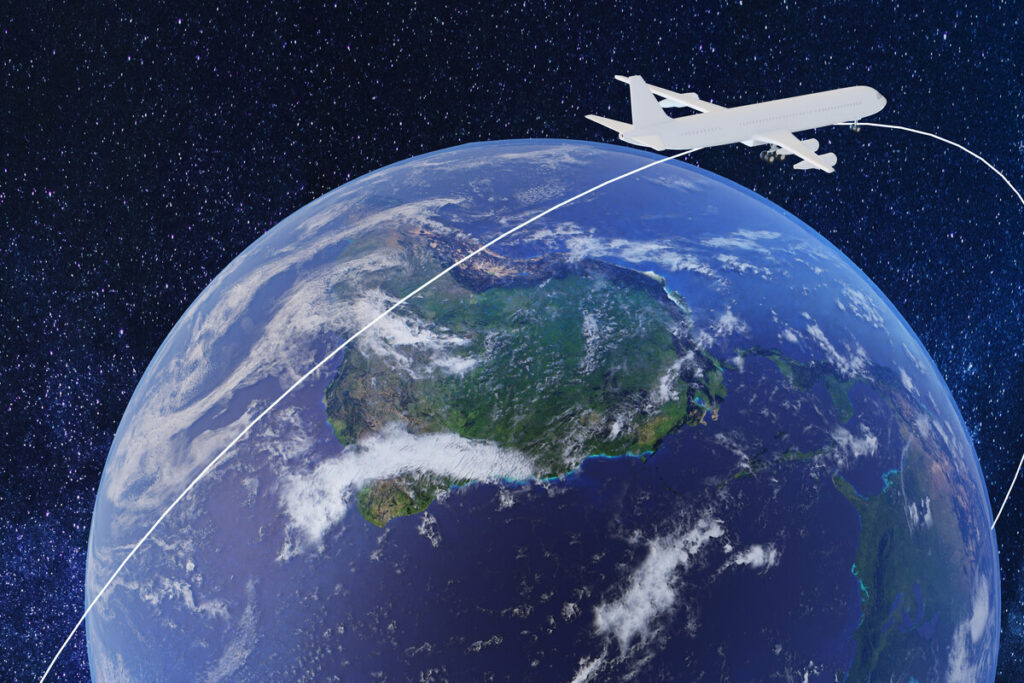
Draw a straight line between two cities on a flat world map and it looks like the shortest way to fly. It almost never is. On a round Earth, the shortest route follows a curve called a great circle, and with one formula you can work out that distance yourself.
Why the shortest route looks curved
The Earth is (almost) a sphere, and the shortest path between two points on a sphere runs along an arc of a great circle: a circle that cuts the globe into two equal halves, like the equator or any line of longitude. This is called the great-circle (or orthodromic) distance.
Flat maps distort that picture. On the common Mercator projection, the truly shortest route often appears curved, while the line that looks straight is usually a rhumb line: a route that keeps the same compass heading the whole way. A rhumb line is easy to steer, but it is almost always longer than the great circle.
The formula, in plain words
The idea is simple: find the angle between the two points as seen from the centre of the Earth, then multiply it by the Earth’s radius.
Distance = Earth’s radius × central angle (in radians), with an average radius of about 6,371 km.
The central angle comes from the spherical law of cosines:
cos(angle) = sin(lat1) × sin(lat2) + cos(lat1) × cos(lat2) × cos(difference in longitude)
In everyday terms: you plug in the two latitudes and the gap in longitude, take the arccos of the result, and you get the angle in radians. A central angle of 1 radian means about 6,371 km of travel; 0.1 radian means about 637.1 km. To convert degrees to radians, multiply by π and divide by 180.
A real example: two points at 60°N, 90° of longitude apart
Imagine two places that both sit at latitude 60°N, separated by 90° of longitude. On a Mercator map, the obvious route is to fly due east along the 60th parallel.
Route 1: following the line of latitude
A line of latitude is a smaller circle than the equator. Its length shrinks with the cosine of the latitude, so the distance is 6,371 × cos(60°) × 90° in radians, which gives 6,371 × 0.5 × 1.5708 ≈ 5,004 km.
Route 2: the great circle
- sin(60°) × sin(60°) = 0.75
- cos(60°) × cos(60°) × cos(90°) = 0.25 × 0 = 0
- cos(angle) = 0.75, so the angle ≈ 0.7227 radian
- Distance ≈ 6,371 × 0.7227 ≈ 4,604 km
The great-circle route is about 399 km shorter, roughly 8% less distance, even though it looks like a detour on a flat map. In reality it bends north towards the pole and comes back down.
The gap depends on latitude
Run the same 90° gap at other latitudes and the saving changes a lot:
- At 20°N: about 9,404 km along the parallel vs 9,261 km by great circle (143 km, about 1.5% shorter)
- At 45°N: about 7,076 km vs 6,672 km (405 km, about 5.7% shorter)
- On the equator: exactly the same, because the equator is itself a great circle
That is why the curve matters most on long east-west trips at high latitudes, and barely at all near the tropics.
Common mistakes and nuances
- Measuring with a ruler on a flat map. Map projections stretch distances, so the straight line on paper is neither the shortest route nor the right length.
- Confusing a constant heading with the shortest path. A rhumb line keeps the same compass direction, but the great circle is shorter on almost every trip.
- Using the cosine formula for very short hops. For tiny distances, computer rounding errors can throw off the law of cosines. The haversine formula is more stable for those cases, and the Vincenty formula stays accurate for all distances, even between opposite points of the globe.
- Expecting perfect precision. The Earth is not a perfect sphere, so these formulas are accurate to roughly 0.5%. For distances under about 500 km away from the polar regions, a simple flat (Euclidean) approximation is already accurate to around 0.1%.
Next time a flight tracker shows your plane arcing far north of the straight line you expected, you will know why: it is taking the shortest road on a round planet.