Imagine a small town where an old math professor discovers a chest sealed for over a hundred years in the back of an attic. On its lid, four mysterious letters are engraved: A, B, C, and D. Beside it, a message states: “Whoever finds the value of the last letter will uncover the secret of the chest.” Intrigued, the professor gathers some townspeople, but no one can immediately decipher the equations written on an old piece of paper. A young boy then suggests trying all possible combinations, while a lady proposes asking a computer for help. The professor smiles and explains that there is a much simpler method: start with the equation that provides the most information and then proceed step by step. A few minutes later, the letters reveal their values, and the mysterious chest can finally be opened. Inside, there is no treasure of gold, but a notebook filled with mathematical discoveries and this phrase: “True wealth is knowing how to understand what surrounds us.”
This imaginary story perfectly illustrates the importance of mathematics in our daily lives. For centuries, mathematics has enabled humans to construct impressive monuments, navigate the oceans, understand the movements of planets, and develop extraordinary technologies.
Today, it plays a crucial role in medicine, computer science, transportation, telecommunications, and even in the applications we use every day.
I remember an exercise where several letters were connected by equations. Initially, I focused on solving the first equation, then the second, without really considering their order. I eventually realized that it was much more efficient to start with the equation that directly provided an unknown. Since then, I see each mathematical challenge as a little investigation where every piece of information brings us closer to the solution.
Quote of the Day
“Mathematics is the alphabet with which God has written the Universe.” Galileo
This famous quote highlights the importance of mathematics in understanding the laws of nature. Behind the movements of celestial bodies, physical phenomena, and many human inventions lie mathematical relationships. Thus, learning to solve equations also means learning to better comprehend the world around us.
What This Challenge Helps Develop:
This challenge serves as an excellent exercise for developing logic, concentration, and the ability to solve interconnected equations. It requires observing the available information and determining the order in which to perform calculations.
It specifically allows you to work on:
- Solving simple equations.
- Understanding relationships between multiple unknowns.
- Using inverse operations.
- Respecting order of operations.
- Substituting a value into an equation.
- Mental calculation and reasoning speed.
- Verifying obtained results.
These skills are useful in many everyday situations. They allow for solving sharing problems, comparing quantities, and organizing information to make better decisions.
Challenge Presentation
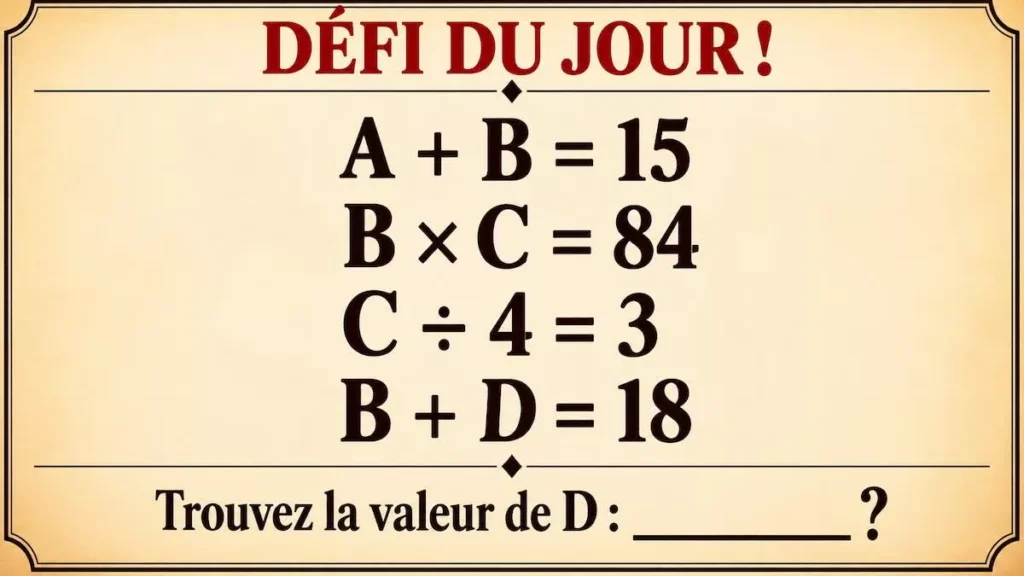
Today, I present to you a new mathematical challenge that could test your logic. Four letters appear on the board: A, B, C, and D. Each represents a number that you must discover using the provided equations.
Find the value of D.
Be careful, all equations are interconnected. Therefore, do not look for values randomly; use each piece of information to progress to the next.
Can you find the correct answer in just 50 seconds?
The Countdown Begins
50…
40…
30…
25…
20…
15…
10…
5…
4…
3…
2…
1…
Time’s up!
What Your Performance May Reveal
If you found the result quickly and correctly, you have excellent logic and good analytical skills.
If you found the result after some thought, you know how to structure your reasoning and verify your steps.
And if your result was incorrect or not found, no worries; this type of exercise is perfect for improving your method and accuracy.
Detailed Solution We Found (Not Necessarily the Only One, Sometimes Even the Right One)
To solve this challenge, one must understand that not all equations hold the same importance initially. Some contain two unknowns, while others allow for an immediate value to be found. The secret is to start with the simplest equation and gradually use the obtained results.
First Step: Find the Value of C.
Let’s examine the third equation:
C ÷ 4 = 3
We know that a number divided by 4 gives 3. To find this number, we need to perform the inverse operation of division, which is multiplication.
We get:
C = 3 × 4
C = 12
We have just discovered our first unknown. This value will now allow us to solve another equation.
Second Step: Determine the Value of B.
Let’s revisit the second equation:
B × C = 84
Now that we know C is 12, let’s replace C with its value.
B × 12 = 84
To isolate B, we divide both sides by 12.
B = 84 ÷ 12
B = 7
We have now found two unknowns:
C = 12
B = 7
We can now continue our reasoning.
Third Step: Calculate the Value of A.
Now, let’s look at the first equation:
A + B = 15
Since we know B is 7, let’s substitute this letter with its value.
A + 7 = 15
To determine A, we subtract 7 from both sides.
A = 15 − 7
A = 8
We now know three of the four letters:
A = 8
B = 7
C = 12
We just need to determine the value of D.
Fourth Step: Find the Value of D.
Let’s revisit the last equation:
B + D = 18