How much protein do you need in a day? The answer is not one number for everyone: it is your body weight multiplied by a figure that depends on how active you are. Here is that multiplier for a desk job, for running and for the gym, with a worked example you can copy using your own weight.
What protein actually does for your body
Protein is part of every tissue in your body, from hair and skin to blood, bone and especially muscle. It is also a fuel: like carbohydrates, every gram of protein supplies about 4 kcal (17 kJ). What makes it different is its building blocks. Your body cannot make nine essential amino acids on its own, so they have to come from food.
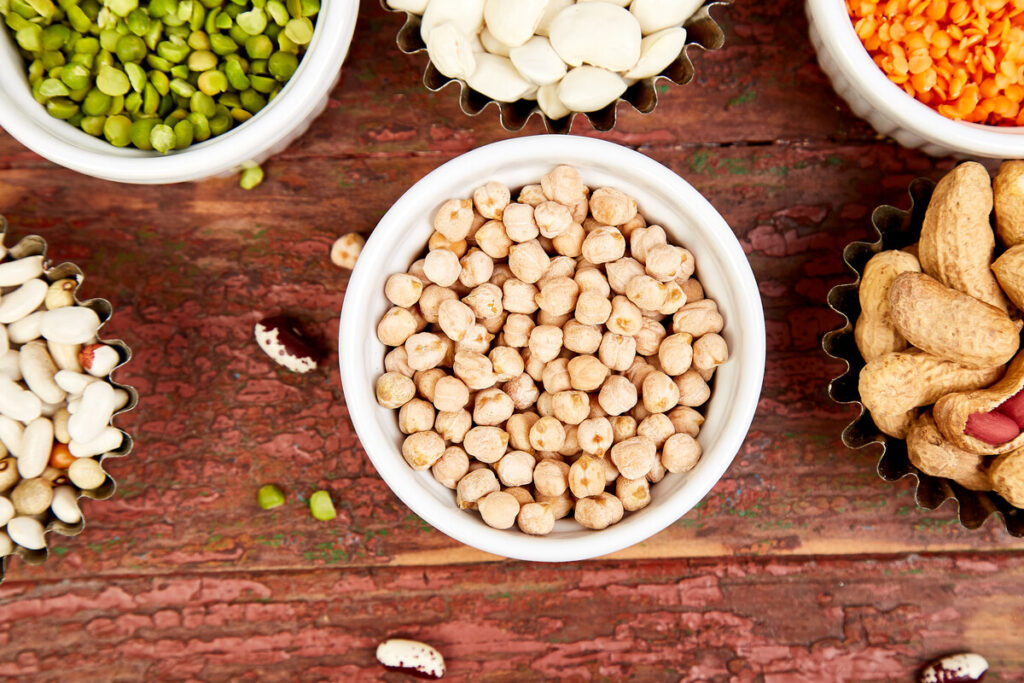
Good sources include grains, legumes, nuts, seeds, dairy, eggs, fish and meat. Worldwide, plant foods supply more than 60% of the protein people eat, and staples such as lentils, chickpeas, mung beans (moong), pigeon peas (toor), oats, millet, rice and wheat all contain more than 7% protein.
The simple formula: body weight times a multiplier
The reference figure comes from the US and Canadian Dietary Reference Intakes. For an adult who does not exercise much, the recommended allowance is 0.8 grams of protein per kilogram of body weight per day. That is where the familiar figures of 46 g a day for women and 56 g a day for men come from: they are simply 0.8 g multiplied by average body weights of 57 kg and 70 kg.
If you think in pounds, Harvard’s summary of the same guideline gives an easy shortcut: a little more than 7 grams of protein for every 20 pounds of body weight.
Activity changes the multiplier. Studies on active people suggest these ranges:
- Mostly sitting, little exercise: 0.8 g per kg
- Endurance exercise (running, cycling, swimming): 1.2 to 1.4 g per kg
- Strength training (weights, gym): 1.6 to 1.8 g per kg
- Older adults: up to 2.0 g per kg
A proposed upper limit sits around 25% of your daily energy needs, which works out to roughly 2 to 2.5 g per kg.
A real example: a 60 kg adult
Take someone who weighs 60 kg. Here is how their daily target changes with their routine:
- Desk job, no workouts: 60 × 0.8 = 48 g of protein a day
- Training for a 10K run: 60 × 1.2 = 72 g, up to 60 × 1.4 = 84 g
- Lifting weights four times a week: 60 × 1.6 = 96 g, up to 60 × 1.8 = 108 g
The same person can need twice as much protein simply by moving from the sofa to the squat rack. In energy terms, the 48 g baseline is only 48 × 4 = 192 kcal, a small slice of a normal day’s calories.
Using the pound shortcut for a 150 lb adult: 150 ÷ 20 = 7.5, and 7.5 × 7 = 52.5 g. Converting properly (150 lb is about 68 kg) gives 68 × 0.8 = about 54 g, which is why the rule says “a little more than” 7 g per 20 pounds.
Mistakes people make with protein math
Confusing the weight of food with the weight of protein
A food that is 7% protein gives you 7 g of protein per 100 g, not 100 g. Your target is grams of protein, not grams of food, so a 48 g goal is never reached by eating 48 g of dal or paneer.
Treating 0.8 g as a goal for everyone
The 0.8 g figure is set for a sedentary adult and covers structural needs only. Children, pregnant and breastfeeding women, and people recovering from illness, injury or surgery all need more.
Assuming you need a supplement
Protein powders exist, but the reference text is blunt: people eating a balanced diet do not need protein supplements. Spreading pulses, grains, dairy or eggs across your meals usually does the job.
Ignoring a kidney condition
There is no conclusive evidence that a high-protein diet causes chronic kidney disease, but there is a consensus that people who already have it should eat less protein. If that applies to you, your number comes from your doctor, not from this formula.
Researchers still debate the exact needs of athletes, so treat these ranges as a starting point, not a prescription. Weigh yourself, pick the line that matches your week, and you will have your daily protein target in under a minute.
This guide is general information, not medical or dietary advice.