Did you know that a young boy, just seven years old, managed to calculate a sum that his teacher thought would take a long time? This boy was Carl Friedrich Gauss, who later became one of the greatest mathematicians in history. According to this famous anecdote, rather than adding the numbers from 1 to 100 one by one, he discovered a clever method to obtain the result instantly: 5,050. This story teaches us a fascinating lesson: mathematics rewards not only those who can calculate quickly but also those who think differently. Thanks to this reasoning ability, mathematicians have contributed to building great things. Often, behind these extraordinary achievements lies a very simple idea: learning to view a problem from the right angle.
I remember when I first encountered these types of small math challenges; I tended to respond immediately without taking the time to analyze the wording. Sometimes, I was well-versed in the rules of calculation, but a simple phrase could make me hesitate. It was by developing the habit of carefully rereading the questions that I realized in mathematics, every word can matter.
Today, I present to you a challenge that seems extremely easy at first glance. However, its wording might lead you to choose an incorrect answer if you rush. So, are you able to find the correct solution in just 30 seconds?
Quote of the Day
“Mathematics is the queen of sciences.” — Carl Friedrich Gauss
This famous quote highlights the fundamental role of mathematics in the development of human knowledge. It teaches us to reason, verify our ideas, and solve problems with precision. Even a basic calculation can become an excellent exercise for developing our intelligence and critical thinking.
What This Challenge Aims to Develop:
This challenge helps develop understanding of instructions, concentration, mental calculation, and logical reasoning. It also encourages distinguishing a simple addition from an operation that requires following a specific order.
Above all, it teaches us not to rush when faced with a seemingly obvious question. In mathematics, a good reading of the statement is often as important as mastering the calculations. This habit is particularly useful in school, during exams, and in everyday situations.
Challenge Presentation
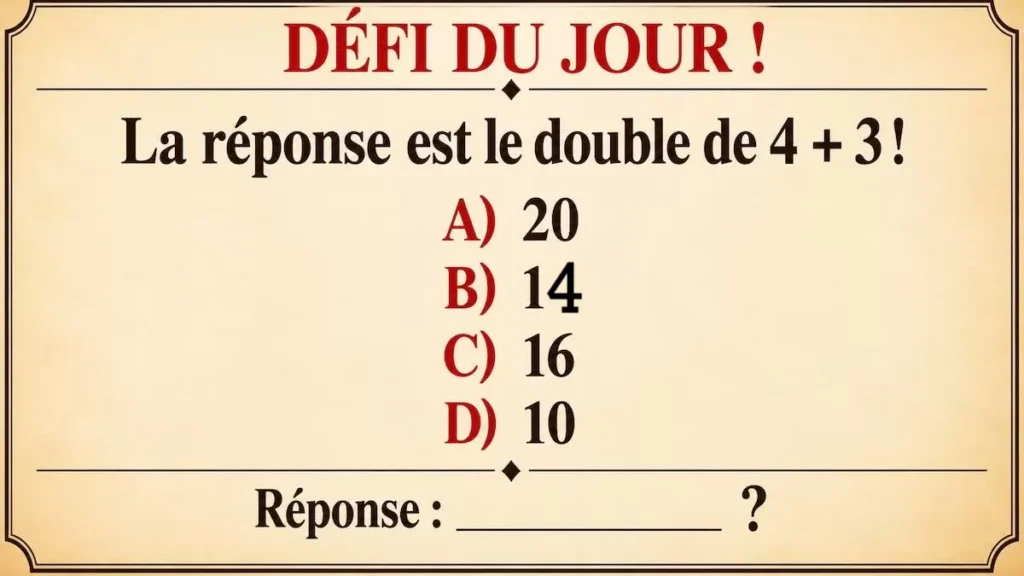
Here is today’s question:
You have four answer options:
- A) 20
- B) 14
- C) 16
- D) 10
Take a few seconds to think about the meaning of this phrase. Should you first calculate 4 + 3, or should you simply double the number 4 before adding 3?
You have 30 seconds to find your answer. Carefully observe the provided choices and try to solve this challenge without a calculator.
The Countdown Starts
30…
25…
20…
15…
10…
5…
4…
3…
2…
1…
Time’s up!
What Your Performance Can Reveal
If you found the result quickly and correctly, you have excellent logic and analysis skills.
If you found the result after some thought, you know how to structure your reasoning and verify your steps.
And if your result was incorrect or not found, no worries; this type of exercise is perfect for improving your method and precision.
Detailed Solution We Found (Not Necessarily the Only One, Sometimes Even the Correct One): Discovering the Trap of This Challenge
This challenge seems very simple at first glance, but it hides a subtlety that can easily mislead us. The difficulty lies not in the calculations, but in how we interpret the phrase: “The answer is double of 4 + 3!” To find the correct answer, we must understand what we are actually doubling.
Step One: Understand the Question
The statement asks us to find the double of 4 + 3. In the interpretation used for this challenge, we must first add the two numbers, then multiply the result by 2. Therefore, we should not rush into performing the operations in a different order.
Step Two: Perform the Addition
We start by calculating the sum of 4 and 3.
4 + 3 = 7
Thus, we obtain 7. Now that we have the result of the addition, we can move on to the next step.
Step Three: Calculate the Double
The double of a number means we need to multiply it by 2. Since we obtained 7, we just need to calculate:
7 × 2 = 14
Therefore, we get 14. This is the result corresponding to the double of the sum of 4 and 3.
Step Four: Verify the Answer
To confirm our reasoning, we can write the complete equation using parentheses:
2 × (4 + 3) = 14
The parentheses clearly indicate that the addition should be performed before the multiplication. We indeed find 14, which corresponds to Answer B.
Final Answer: B) 14
The correct answer is B) 14.
The trap of this challenge lies in the wording of the question. If we only doubled 4 before adding 3, we would get 11, but that is not the intended interpretation here. To avoid any ambiguity, it would be more precise to ask: “What is the double of the sum of 4 and 3?”
This small exercise reminds us that in mathematics, it is essential to read the instructions carefully before starting calculations. A simple parenthesis can change the way we solve an equation, and a good understanding often helps avoid the most common mistakes.
Conclusion: In Mathematics, Understanding is as Important as Calculating!
This challenge reminds us that a question that seems very simple can hide an unexpected difficulty. We have discovered that it is not enough to master additions and multiplications; we must also understand exactly what the statement is asking. An imprecise formulation can lead to multiple interpretations, even when the calculations are perfectly correct. That is precisely what makes mathematics fascinating. They teach us to think rigorously, to question information, and to verify the consistency of our answers. These qualities are essential for solving equations, analyzing complex problems, and making good decisions in everyday life.
So, did you notice that the correct answer was not among the options?
Share this challenge with your friends to see who can spot the trap before the countdown ends.
Join us for the next DAILY CHALLENGE, with a new opportunity to test your logic