Imagine you are an explorer tasked with finding the shortest path between two locations separated by obstacles. You know several distances, can follow different routes, but no one tells you the length of the direct route. This is precisely the kind of problem that geometers and explorers have faced for centuries. Thanks to mathematics, they learned to measure distances without necessarily traversing the entire terrain. Over 2,000 years ago, Greek scholars were already using the properties of triangles to study lengths and distances. The famous Pythagorean theorem became one of the most important tools in geometry, as it allows for the calculation of an unknown distance from two known lengths.
Today, this principle is applied in building construction, mapping, architecture, and numerous navigation systems. Behind a simple geometric figure lies a method that has helped transform the way we measure the world.
Quote of the Day
“Geometry is the knowledge of what exists always.” Plato
This quote reminds us that geometric properties do not depend on how we draw a figure. Whether a triangle is large, small, or tilted, the same mathematical rules continue to apply. It is this universality that makes geometry so valuable for understanding distances, shapes, and dimensions in our environment.
What This Challenge Develops
This challenge helps develop our observational skills, spatial reasoning, and ability to interpret a geometric figure. It teaches us to distinguish between horizontal and vertical movements and to mentally reconstruct a right triangle. It also trains us to correctly use the Pythagorean theorem to calculate an unknown distance. By completing this exercise, we enhance our concentration, logic, and calculation speed. We learn to select useful information without being distracted by the shape of the route. These skills are essential in mathematics but also serve in many practical situations.
Challenge Presentation
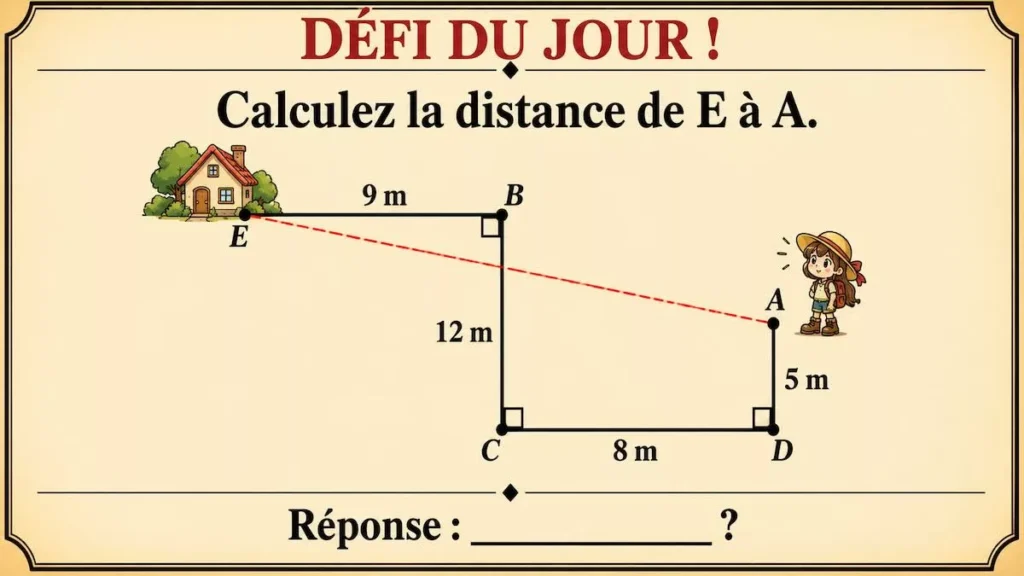
Today, I propose a small geometric adventure where you need to calculate the direct distance between a house and a young explorer. In the drawing, the house is at point E, while the explorer is at point A. Several segments connect the various points of the route, but the direct distance between E and A remains unknown.
Your mission is to determine the straight-line distance between points E and A, represented by the red dashed segment. Be careful, you must not simply add the four lengths of the route. The key is to identify the actual horizontal and vertical distances that separate the two points.
Can you calculate the distance EA in just 60 seconds?
Observe the figure carefully, identify the right angles, and think about the geometric property that could help you. You have all the necessary information to find the solution. Get ready, the timer starts now!
Countdown Begins
60…
50…
40…
30…
25…
20…
15…
10…
5…
4…
3…
2…
1…
Time’s up!
What Your Performance Can Reveal
Result found quickly and correctly, you have excellent logic and good analytical ability.
Result found after reflection, you know how to structure your reasoning and check your steps.
And if the result is incorrect or not found, no worries, this type of exercise is perfect for improving method and precision.
Detailed Solution We Found (Not Necessarily the Only One, Sometimes Even the Right One): Let’s Discover How to Calculate the Distance from E to A
Time is up, and we will now discover how to solve this challenge step by step. At first glance, the four segments seem to form a complicated route between the house and the explorer. However, by observing their directions, we can transform this problem into a simple right triangle.
Step One: Calculate the Horizontal Distance
Let’s start by observing the two horizontal segments in the figure. Segment EB measures 9 meters, while segment CD measures 8 meters. Since these two segments go in the same direction, their lengths add up to give the total horizontal displacement between E and A.
We get the following equation:
Horizontal distance = EB + CD
Horizontal distance = 9 + 8
Horizontal distance = 17 meters
We now know that the young explorer is 17 meters horizontally from the house.
Step Two: Calculate the Height Difference
Now let’s move on to the vertical segments. Segment BC measures 12 meters and represents the descent from the level of the house to point C. Meanwhile, segment DA measures 5 meters and corresponds to the ascent from point D to the explorer’s position.
To find the height difference between E and A, we need to subtract these two measurements:
Height difference = BC − DA
Height difference = 12 − 5
Height difference = 7 meters
We have thus discovered that point A is 7 meters lower than point E.
Step Three: Recognize the Right Triangle
We now possess two essential pieces of information: a horizontal distance of 17 meters and a height difference of 7 meters. These two directions are perpendicular, meaning they form a right angle. By imagining the corresponding segments, we obtain a right triangle whose third side is precisely the distance EA.
The segment EA is thus the hypotenuse of this right triangle. To calculate its length, we can use the famous Pythagorean theorem. This theorem states that in a right triangle, the square of the hypotenuse is equal to the sum of the squares of the other two sides.
Step Four: Apply the Pythagorean Theorem
Since the two perpendicular sides measure 17 meters and 7 meters, we can write the following equation:
EA² = 17² + 7²
Let’s first calculate the two squares:
17² = 289
7² = 49
We then obtain:
EA² = 289 + 49
EA² = 338
To find the length EA, we just need to take the square root of both sides of the equation:
EA = √338
EA ≈ 18.38 meters
We have found the direct distance between the house and the young explorer.
Step Five: Verify Our Result
Let’s take a moment to verify if our answer is consistent. The horizontal distance between the two points is 17 meters, while their height difference is 7 meters. The direct distance EA must therefore be greater