Imagine a world where it would be impossible to accurately measure the height of a building, construct a bridge, or calculate the distance between two planets. For centuries, humans have sought ways to understand the dimensions of the world around them. It is through mathematics that problems once deemed impossible have become remarkable scientific achievements. One of the most fascinating stories is that of Eratosthenes, a Greek scholar who, over 2,200 years ago, managed to estimate the circumference of the Earth. Without satellites, computers, or modern technology, he relied solely on the observation of shadows, measurements, and remarkable geometric reasoning. This discovery demonstrates that with a bit of information and a sound method, extraordinary problems can be solved.
At first, when I encountered these small mathematical challenges requiring the discovery of an unknown measurement from several clues, my instinct was often to seek out a complicated operation, while the solution sometimes relied on two very simple equations. Over time, I learned that mathematics is not just about calculations, but primarily about observation, establishing relationships, and reasoning methodically.
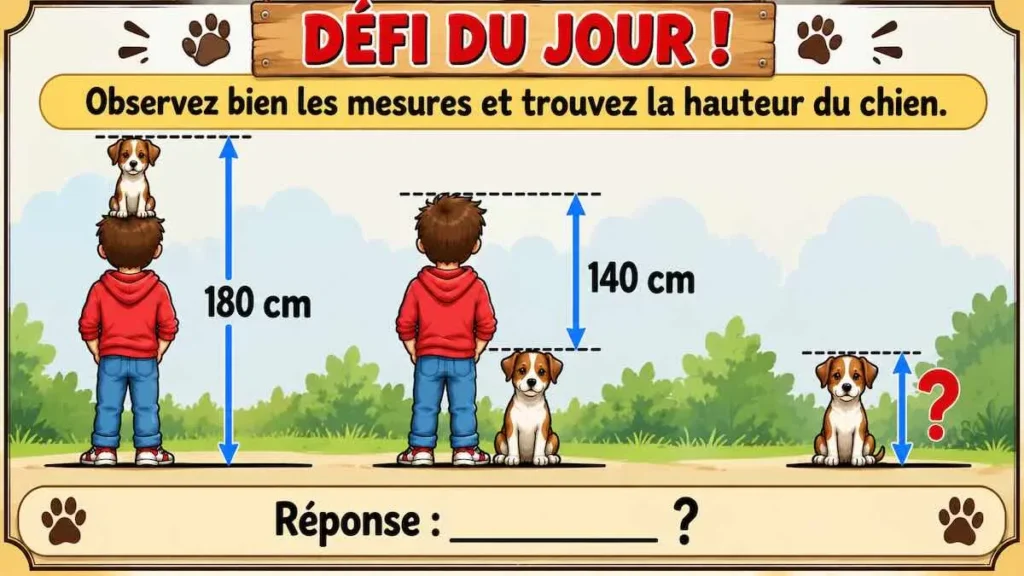
Today, I present a challenge that reflects this very principle. A boy, a small dog, and two measurements will allow you to discover an unknown height. But be careful— the information from the drawing must be interpreted correctly to avoid mistakes!
Quote of the Day
“Mathematics is not about numbers, equations, computations, or algorithms: it is about understanding.” William Paul Thurston
This quote reminds us that mathematics is not just about performing operations. They teach us primarily to understand the relationships between different pieces of information and to construct coherent reasoning. Today’s challenge is an excellent illustration of this.
What This Challenge Helps Develop:
This challenge helps to develop observation skills, logic, concentration, and the ability to interpret measurements. It also encourages translating an illustrated situation into simple equations and using inverse operations to find an unknown value.
It also helps to understand that a measurement indicated on a drawing does not always represent a height taken from the ground. By learning to distinguish between total height and height differences, you improve your precision and problem-solving abilities in mathematics.
Challenge Presentation
Carefully observe the three illustrations on the panel.
In the third illustration, the dog is sitting alone. Your mission is to determine the exact height of the dog based on the two previous pieces of information.
You have 30 seconds to find the correct answer. Take your time to observe the arrows and reflect on what they really measure before you start your calculations.
The Countdown Begins
30…
25…
20…
15…
10…
5…
4…
3…
2…
1…
Time’s up!
What Your Performance Can Reveal
If you found the answer quickly and correctly, you have excellent logic and analytical skills.
If you found the answer after some thought, you know how to structure your reasoning and check your steps.
And if your result was incorrect or you didn’t find one, no worries; this type of exercise is perfect for improving your method and precision.
Detailed Solution We Found (Not Necessarily the Only One, Sometimes Even the Right One)
This challenge is particularly interesting because the two measurements indicated on the panel do not represent the same thing. The first corresponds to a total height, while the second indicates a difference between two heights. To solve the problem correctly, we will use two equations.
First Step: Identify the Unknowns
We will represent the height of the boy with the letter B and that of the dog with the letter D.
When the dog is sitting on the boy’s head, their total height is 180 cm. Thus, we can write the first equation:
B + D = 180
This equation means that the height of the boy plus the height of the dog equals 180 cm.
Second Step: Understand the 140 cm Measurement
In the second illustration, the boy and the dog are placed side by side. The 140 cm arrow starts at the top of the boy’s head and ends at the top of the dog’s head.
This measurement represents the difference between their two heights, not the boy’s height from the ground.
We can write the second equation:
B − D = 140
Now we have two equations that will allow us to find the height of the dog.
Third Step: Add the Two Equations
We have:
B + D = 180
B − D = 140
By adding the two equations, the terms +D and −D cancel each other out.
We obtain:
2B = 320
To find the boy’s height, we divide both sides by 2:
B = 320 ÷ 2
B = 160 cm
We now know that the boy is 160 cm tall.
Fourth Step: Calculate the Height of the Dog
Let’s revisit the first equation:
B + D = 180
We substitute B with 160:
160 + D = 180
To isolate D, we subtract 160 from both sides:
D = 180 − 160
D = 20 cm
We have discovered that the dog is 20 cm tall.
Fifth Step: Verify Our Result
A good mathematical method always involves checking that the obtained values correspond to all the information on the panel.
For the first illustration:
160 + 20 = 180 cm
For the second illustration:
160 − 20 = 140 cm
Both results correspond exactly to the indicated measurements. Our reasoning is therefore correct.
Final Answer: 20 cm