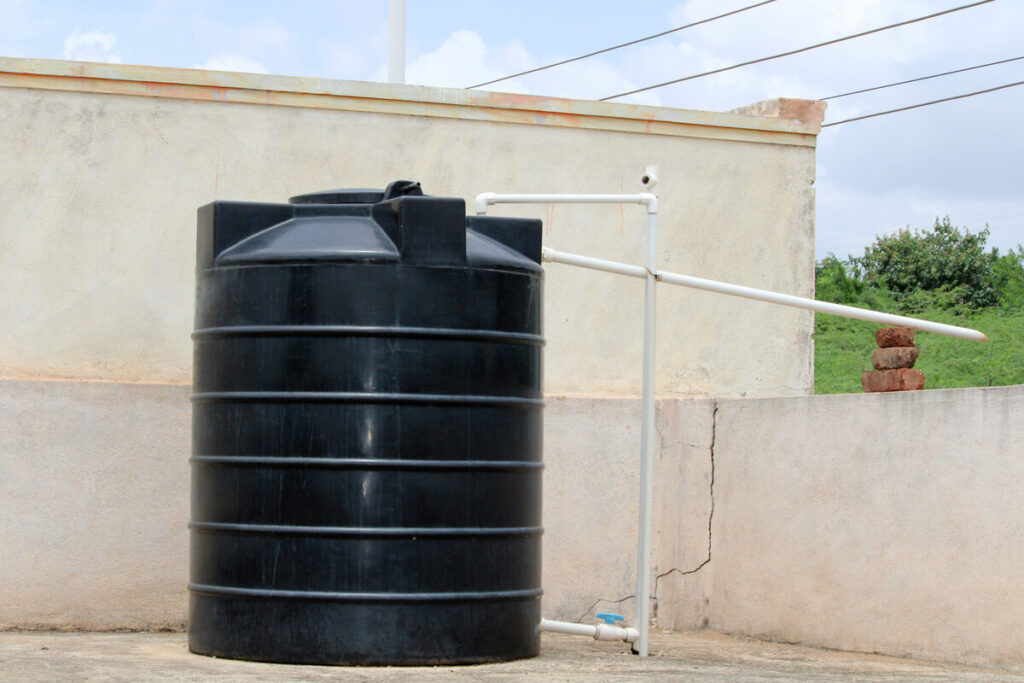
When piped water comes for only an hour or two every few days, your sump or overhead tank does the real work. But how many litres does it actually hold, and is it enough for your family? Here is the math, with real numbers you can reuse on your own tank.
Why the tank size matters so much in India
In many Indian cities, piped water does not run all day. In 2005, none of the 35 Indian cities with more than a million people supplied water for more than a few hours a day, and some towns in Karnataka got water only once every 2 to 15 days before a pilot project changed that. Whatever arrives in that short window has to be stored, so the size of your sump or tank decides how long you can last until the next supply.
The two conversions you need
Everything comes down to measuring the volume of water and turning it into litres. Two exact conversions do the job:
- 1 cubic metre = 1,000 litres. A litre is simply a 10 cm × 10 cm × 10 cm cube.
- 1 cubic foot = 28.32 litres (28.3168 to be precise). As a rough check, 1 cubic metre is about 35 cubic feet.
For a rectangular sump, multiply length × breadth × water depth. If you measured in metres, multiply by 1,000. If you measured in feet, multiply by 28.32.
For a round tank, the base is a circle, so the volume is π (about 3.14) × radius × radius × water height. The radius is half the diameter. Work in metres, then multiply by 1,000.
A real example: a 6 × 5 × 5 ft sump
Say your underground sump measures 6 ft long, 5 ft wide and 5 ft deep on the inside.
- Volume: 6 × 5 × 5 = 150 cubic feet
- Litres: 150 × 28.32 = about 4,247 litres
Now a round plastic tank on the roof, 1 metre across on the inside, filled to a height of 1.3 metres. The radius is 0.5 m, so the volume is 3.14 × 0.5 × 0.5 × 1.3 = 1.021 cubic metres, or about 1,021 litres. That is roughly what a “1,000 litre” tank is.
Is it enough for your family?
A useful benchmark often quoted for India is a family of five on the poverty line using 20 cubic metres of water a month. That is 20,000 litres ÷ 30 days, or about 667 litres a day (roughly 133 litres per person). Treat it as a modest baseline, since many households use more.
If water reaches you every third day, you need at least 3 × 667, or about 2,000 litres in storage. The 4,247 litre sump covers that comfortably. The 1,000 litre roof tank alone covers only about a day and a half, which is why many homes pair a large sump with a smaller overhead tank.
Common mistakes that shrink your real capacity
- Measuring the outside. A sump that is 6 × 5 ft outside with 9 inch walls is only 4.5 × 3.5 ft inside. At 5 ft deep, that is 78.75 cubic feet, about 2,230 litres, barely half the first estimate.
- Using total depth instead of water depth. Water stops at the overflow pipe. If it sits 4 ft high in the 6 × 5 ft sump, you store about 3,398 litres, not 4,247.
- Using the diameter as the radius. On the round tank, 3.14 × 1 × 1 × 1.3 gives about 4,084 litres, four times too much.
- Forgetting the weight. One litre of water weighs almost exactly 1 kg, so a full 1,000 litre tank puts about a tonne on your roof. Have a structural engineer check before you add a bigger one.
Check your own tank in a few seconds
Our brass volume calculator takes length, breadth and height in feet, metres or inches and gives the volume in brass. Since 1 brass is 100 cubic feet, multiply the result by 2,832 to get litres: the 6 × 5 × 5 ft sump comes out at 1.5 brass, or about 4,247 litres. If you are also ordering the sand for the construction, our guide on ordering sand by the brass uses the same unit.