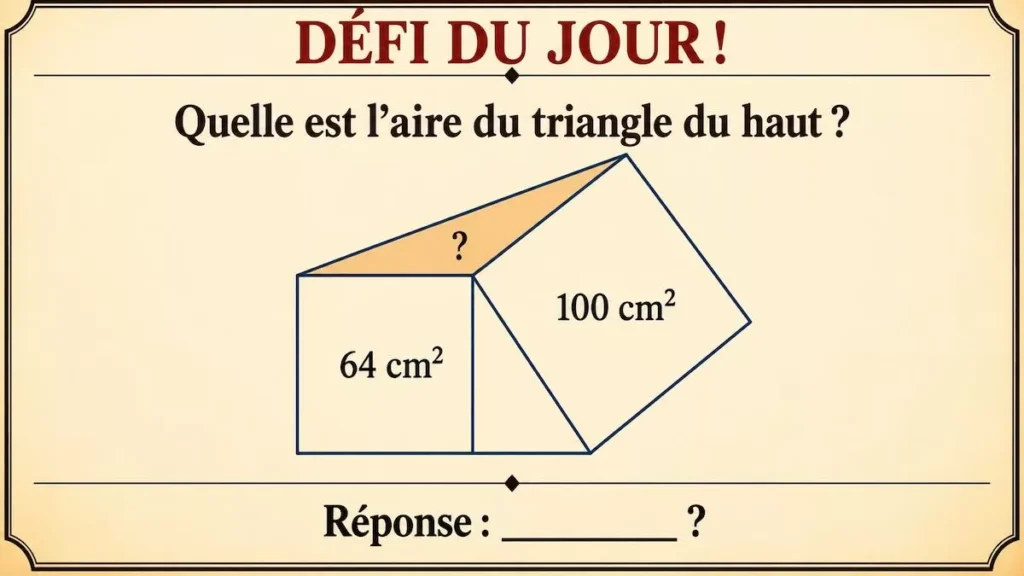
Imagine an old castle whose construction plans have just been discovered in a forgotten library. On one of the documents, an architect had sketched two squares of different sizes, accompanied by a small triangle whose area was not specified anywhere. A strange note mentioned that all the necessary information was already on the drawing. However, no one could figure out how to find the area of this triangle without knowing its dimensions directly. This reminds us that geometry is much more than just a school subject. For centuries, mathematics has allowed us to build cathedrals, design bridges, measure land, and even calculate satellite trajectories.
Architects and engineers use the properties of triangles and squares daily to solve complex problems. Behind an apparently ordinary figure, elegant mathematical relationships can often be hidden.
Sometimes we remember those exercises where several geometric figures seemed to be assembled without any apparent logic. At first, we would try to measure each side, convinced that we needed to know all the lengths to make progress. Then, by observing angles and the relationships between the figures closely, we would discover that a single property could unlock the entire problem. It is often at this moment that we realize that geometry is primarily an art of observation and reasoning.
Quote of the Day
“Mathematics is the queen of the sciences.” Carl Friedrich Gauss
This quote highlights the fundamental place of mathematics in our understanding of the world. It allows us to uncover relationships that are invisible at first glance and to transform complicated problems into accessible reasoning. Each geometry challenge thus becomes an opportunity to learn to see things differently.
What This Challenge Allows You to Work On:
This challenge helps develop our ability to recognize the properties of squares and right triangles. It also trains us to use the Pythagorean theorem, calculate unknown lengths, and properly apply the formula for the area of a triangle. These skills are essential for understanding many situations encountered in geometry. It also strengthens concentration, logic, and spatial reasoning. By observing the relationships between several figures, we learn to select useful information rather than multiplying calculations at random. It is an excellent exercise for improving our speed of thought while maintaining a rigorous method.
Challenge Presentation
Today, I present to you a particularly interesting geometric riddle.
The only measurements indicated are the areas of the two squares. No lengths are directly given for the orange triangle, making the challenge more intriguing. However, by closely observing the arrangement of the figures, it is possible to find the necessary dimensions.
Your mission: calculate the area of the orange triangle located at the top of the figure.
You have only 60 seconds to find the answer. Take the time to observe the squares, their sides, and the triangles connecting them. Are you ready to take on this challenge?
The Countdown Begins
60…
50…
40…
30…
25…
20…
15…
10…
5…
4…
3…
2…
1…
Time’s up!
What Your Performance Can Reveal
If you found the answer quickly and correctly, you have excellent logic and analytical skills.
If you found the answer after some reflection, you know how to structure your reasoning and check your steps.
And if your answer was incorrect or not found, no worries; this type of exercise is perfect for improving method and accuracy.
Detailed Solution We Found (Not Necessarily the Only One, Sometimes Even the Right One): Discovering the Secret of the Orange Triangle
The time is up, and we will now solve this riddle step by step. At first glance, it seems challenging to calculate the area of the orange triangle since none of its dimensions are directly indicated. However, the two squares provide us with essential information about certain lengths in the figure.
First Step: Determine the Side of the First Square.
The square on the left has an area of 64 cm². We know that the area of a square is equal to the square of the length of its side. Thus, we simply need to take the square root of 64 to find this length.
Side = √64
Side = 8 cm
Now we know that each of the four sides of the left square measures 8 centimeters. This length corresponds, in particular, to the base of the orange triangle.
Second Step: Determine the Side of the Second Square.
The inclined square on the right has an area of 100 cm². As before, we can find the length of its sides by taking the square root of its area. This gives us another essential measurement for our reasoning.
Side = √100
Side = 10 cm
Thus, each side of this square measures 10 centimeters. The lower left side of the inclined square also serves as the hypotenuse of the right triangle located below.
Third Step: Calculate the Small Horizontal Length.
Now, let’s observe the right triangle formed under the inclined square. Its vertical side measures 8 cm, corresponding to the right side of the first square, and its hypotenuse measures 10 cm. We can thus use the Pythagorean theorem to determine its horizontal base.
Let’s denote this base (d).
According to the Pythagorean theorem:
10² = 8² + d²
100 = 64 + d²
d² = 100 − 64
d² = 36
d = √36
d = 6 cm
We have just found that the small horizontal segment to the right of the first square measures 6 centimeters.
Fourth Step: Find the Height of the Orange Triangle.
Now comes the most interesting part of our challenge. The inclined square has two consecutive perpendicular sides, and its lower left side forms a right triangle with dimensions 6 cm, 8 cm, and 10 cm. The upper left side of the inclined square is perpendicular to this 10 cm segment.
Using this perpendicularity, we can see that the vertical distance between the left vertex and the upper vertex of the inclined square measures 6 cm. This vertical distance corresponds exactly to the height of the orange triangle, since its base is horizontal.
Height of the orange triangle = 6 cm
We now have the two dimensions needed to calculate its area.
Fifth Step: Calculate the Area of