One morning, in a small town surrounded by forests, a biologist discovers a troubling phenomenon: some species of birds are gradually disappearing, while residents report an increase in respiratory issues. Intrigued, she decides to investigate a potential link between air pollution, biodiversity, and human health. To understand what is happening, she collects thousands of data points and employs mathematics to compare the results. Gradually, her calculations reveal trends that guide new research and propose protective measures.
This story reminds us that mathematics is not just for solving school problems. It allows scientists to predict certain climatic phenomena, study the spread of diseases, and assess the effects of pollution. In hospitals, it contributes to the analysis of medical images and the enhancement of treatments. In the field of ecology, it helps to preserve natural resources and design more efficient energy solutions.
But mathematics also possesses another extraordinary quality. It teaches us to think methodically. A problem that seems complicated can sometimes become very simple when we adhere to the correct rules of calculation. Conversely, an operation that appears easy can lead us to error if we act too quickly. This is exactly what we will discover with today’s challenge.
Quote of the Day
“Nature is written in the language of mathematics.” Galileo, adapted quote
This thought emphasizes the role of mathematics in understanding natural phenomena. Whether studying the movement of planets, the growth of plants, or temperature changes, numbers enable us to describe and analyze our environment. Thus, learning to reason mathematically also means learning to better understand the world we live in.
What This Challenge Allows You to Work On:
This challenge helps reinforce your understanding of operational priorities, especially when multiple operations appear in a single calculation. It also trains you to handle fractions, parentheses, and powers without being intimidated by their appearance. Finally, it develops your concentration, rigor, and ability to break a problem into several simple steps.
Challenge Presentation
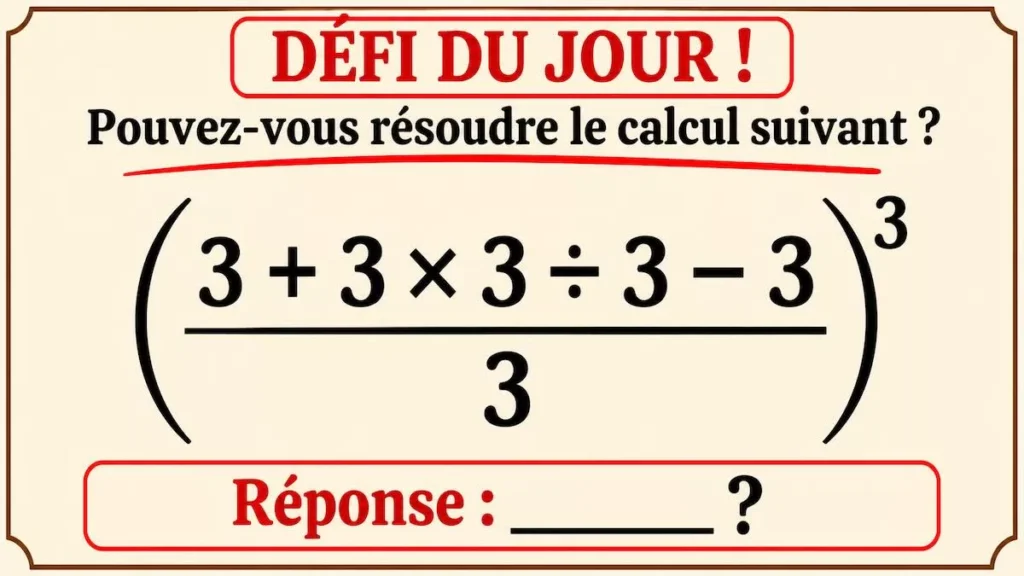
Today, I present you with an equation to complete that might trick the most rushed individuals. It contains only the number 3, but several operations must be performed in a very specific order. Your mission is to find the exact result without forgetting the fundamental rules of mathematics.
Here is today’s calculation:
Carefully observe the multiplications, divisions, additions, and subtractions. Remember that the power placed outside the parentheses must be calculated at the right moment. You have 50 seconds to find the answer before revealing the detailed solution.
The Countdown Begins
50…
40…
30…
25…
20…
15…
10…
5…
4…
3…
2…
1…
Time’s up!
What Your Performance Can Reveal
If you found the result quickly and correctly, you have excellent logic and analytical skills.
If you found the result after some reflection, you know how to structure your reasoning and verify your steps.
And if the result was incorrect or not found, no worries—this type of exercise is perfect for improving your method and accuracy.
Detailed Solution We Found (Not Necessarily the Only One, Sometimes Even the Right One): Let’s Discover the Trap of This Equation
First Step: Understand the Structure of the Calculation
We need to calculate a fraction placed within parentheses, then raise the obtained result to the power of 3. Inside the numerator, multiple operations appear, which requires us to respect mathematical priorities. The fundamental rule is to perform multiplications and divisions before additions and subtractions.
Let’s revisit our equation to complete:
((3 + 3 × 3 ÷ 3 − 3) ÷ 3)³ = ?
Second Step: Perform the Priority Operations
Let’s first examine the numerator: 3 + 3 × 3 ÷ 3 − 3. Multiplication and division hold the same priority level and should be performed from left to right. Thus, we start by multiplying 3 by 3, then dividing the result by 3.
3 × 3 = 9
9 ÷ 3 = 3
Now we can replace this part of the calculation with 3. The numerator becomes much easier to resolve, leaving only additions and subtractions.
Third Step: Calculate the Numerator
After performing the priority operations, we obtain the following calculation:
3 + 3 − 3
We perform the operations from left to right, as they hold the same priority level. We start by adding the first two numbers, then subtracting the last.
3 + 3 = 6
6 − 3 = 3
The numerator of our fraction is thus equal to 3. We have simplified the part that seemed the most complicated of the challenge. Now, let’s move on to calculating the fraction.
Fourth Step: Simplify the Fraction
We now know that the numerator is 3 and that the denominator is also 3. Therefore, our fraction becomes particularly simple to calculate. We just need to divide the numerator by the denominator to obtain its value.
3 ÷ 3 = 1
The result inside the parentheses is therefore equal to 1. However, our challenge is not yet over, as a power of 3 appears outside the parentheses. We now need to perform this final operation.
Fifth Step: Calculate the Power
We now have the following calculation:
1³
Raising a number to the power of 3 means multiplying it three times by itself. Since the obtained number is 1, the calculation becomes immediate. We can write:
1 × 1 × 1 = 1
We ultimately obtain 1. This final step confirms the importance of not forgetting the power located outside the parentheses. Even when a calculation seems complete, it is crucial to check that no operation remains to be performed.
Sixth Step: Verify Our Answer
To confirm our result, let’s revisit the entire calculation while respecting each operational priority. We first perform the multiplication and division of the numerator, then the additions and subtractions. Finally, we simplify the fraction before calculating the power.
Starting Equation:
((3 + 3 × 3 ÷ 3 − 3) ÷ 3)³