Imagine a young scientist working in a laboratory dedicated to environmental protection. Every morning, she analyzes thousands of data points to understand why certain rivers become polluted and how this pollution can affect the health of local residents. Faced with this vast amount of information, she relies on an essential tool: mathematics. Through calculations, she can compare results, assess risks, and contribute to finding solutions to protect communities. Mathematics is not just about solving problems on paper; it enables the monitoring of water quality, the study of climate change, and the improvement of natural resource management.
In the medical field, mathematics also plays a crucial role in analyzing test results, calculating medication dosages, and developing new diagnostic technologies. Behind these advancements are simple operations, as well as complex reasoning that demands precision and method. The future of our planet and advancements in medicine partly depend on our ability to understand and utilize numbers. However, before mastering sophisticated scientific calculations, one must learn to respect the fundamental rules of mathematics. A simple mistake in the order of operations can completely alter a result. This is precisely what we will explore in today’s challenge.
The Quote of the Day
“Mathematics is the queen of the sciences.” — Carl Friedrich Gauss
This famous quote emphasizes the fundamental role of mathematics in understanding the world. It serves as a common language across various disciplines, from physics to medicine to ecology. Above all, it teaches us that rigorous reasoning is often more important than the speed with which we perform a calculation.
What This Challenge Allows You to Work On:
This challenge helps strengthen your mastery of operational priorities and your ability to perform multiple calculations in the correct order. It also develops your concentration, precision, and ability to spot common errors. Finally, it encourages you to adopt a clear problem-solving method, a skill that is particularly useful in scientific studies and everyday life.
Challenge Presentation
Today, I present you with a calculation that seems easy but can quickly become misleading if you do not follow the mathematical rules. You will need to perform an addition, a multiplication, a division, and a subtraction in a specific order. The true challenge lies not in the numbers themselves but in your ability to determine which operation should be performed first.
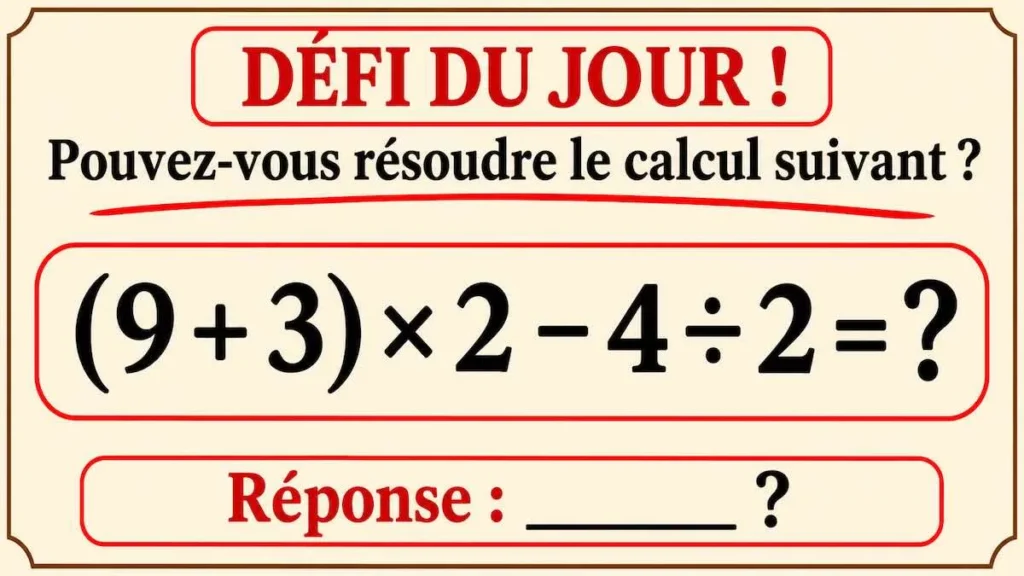
Here is today’s calculation:
What is the correct answer to this calculation? Take the time to observe the parentheses and think about the operational priorities before starting. You have 30 seconds to find the result without a calculator.
The Countdown Begins
30…
25…
20…
15…
10…
5…
4…
3…
2…
1…
Time’s up!
What Your Performance Can Reveal
If you found the result quickly and correctly, you have excellent logic and analytical abilities.
If you found the result after some reflection, you know how to structure your reasoning and check your steps.
And if your result was incorrect or not found, no worries—this type of exercise is perfect for improving your method and precision.
Detailed Solution We Found (Not Necessarily the Only One, Sometimes Even the Right One): Let’s Discover the Trap in This Equation
First Step: Understand the Operational Priorities
To solve this calculation correctly, we must adhere to the fundamental rules of mathematics. Operations within parentheses are always performed first, followed by multiplications and divisions, and then additions and subtractions. When multiple operations share the same level of priority, we perform them from left to right.
Let’s revisit our calculation:
(9 + 3) × 2 − 4 ÷ 2
Now, we will apply these rules step by step to obtain an accurate result. Each step is crucial, as an error in the order of operations could lead us to an incorrect answer. So let’s start with what’s inside the parentheses.
Second Step: Calculate the Parentheses
The first operation to perform is the addition within the parentheses. We need to add 9 and 3, which gives us 12. Once this operation is completed, we can replace the parentheses with their result.
9 + 3 = 12
Our calculation now becomes:
12 × 2 − 4 ÷ 2
We now have a multiplication, a subtraction, and a division. It would be incorrect to immediately perform the subtraction, as multiplication and division take priority. Therefore, we will begin by resolving these two operations.
Third Step: Perform the Multiplication
Multiplication is one of the priority operations in our calculation. We need to multiply 12 by 2, which gives us 24. This step allows us to simplify the calculation further without changing its value.
12 × 2 = 24
We now have:
24 − 4 ÷ 2
There remains a subtraction and a division to perform. Since division takes priority over subtraction, we must first calculate 4 divided by 2. This rule is essential to avoid a common mistake.
Fourth Step: Perform the Division
We will now calculate the division present in our calculation. The number 4 must be divided by 2, which gives us 2. We can then replace this division with its result.
4 ÷ 2 = 2
Our calculation becomes:
24 − 2
All priority operations have now been performed. Only a simple subtraction remains to obtain the final answer. We can now proceed to the last step.
Fifth Step: Complete the Calculation
We obtained 24 after the multiplication and 2 after the division. Now we simply need to subtract 2 from 24 to determine the final result. This last operation is straightforward when the previous steps have been correctly followed.
24 − 2 = 22
Thus, we find 22. This result confirms that we needed to start with the parentheses, then perform the multiplication and division, and finally conclude with the subtraction. We can now verify our reasoning by reviewing the entire calculation.
Sixth Step: Verify the Complete Equation
To ensure our answer is correct, let’s revisit the challenge equation from the beginning. We will progressively replace each operation with its result while adhering to mathematical priorities. This verification method is particularly useful to avoid careless errors.
Starting Equation:
(9 + 3) × 2 − 4 ÷ 2 = ?
After the Parentheses:
12 × 2 −