Imagine a small town where the residents discover that the water in their river is gradually becoming unsafe for consumption. A young scientist decides to study the phenomenon by analyzing the amount of pollutants present in the water. Using mathematics, she calculates the concentrations, compares the results, and identifies the most affected areas. Her calculations ultimately enable the authorities to take measures to protect the health of the residents and preserve the environment. This story perfectly illustrates the importance of mathematics in our daily lives. In hospitals, it helps analyze medical data, adapt certain treatments, and better understand the progression of diseases.
In the field of ecology, mathematics is used to measure greenhouse gas emissions, predict climate changes, and optimize the use of natural resources. Behind these significant applications often lie fundamental operations that we learn as early as school. And what if mathematics also taught us not to rely solely on appearances? A calculation may seem difficult, yet it might have an surprisingly simple solution. Conversely, an equation that appears elementary can hide a formidable trap. This is precisely what we will uncover with today’s challenge.
The Quote of the Day
“Mathematics is the queen of the sciences, and arithmetic is the queen of mathematics.” — Carl Friedrich Gauss
This quote reminds us that numbers play a fundamental role in our understanding of the world. Mastering basic operations allows us to construct much more complex reasoning and solve scientific problems. However, to achieve an accurate result, it is not enough to know how to calculate; we must also adhere to mathematical rules.
What This Challenge Allows You to Work On:
This challenge will help you strengthen your mastery of divisions, subtractions, and fractions. It will also help you understand the importance of the order of operations and recognize situations in which a numerator equals zero. Finally, it will enhance your concentration, vigilance, and ability to verify a result before providing an answer.
Challenge Presentation
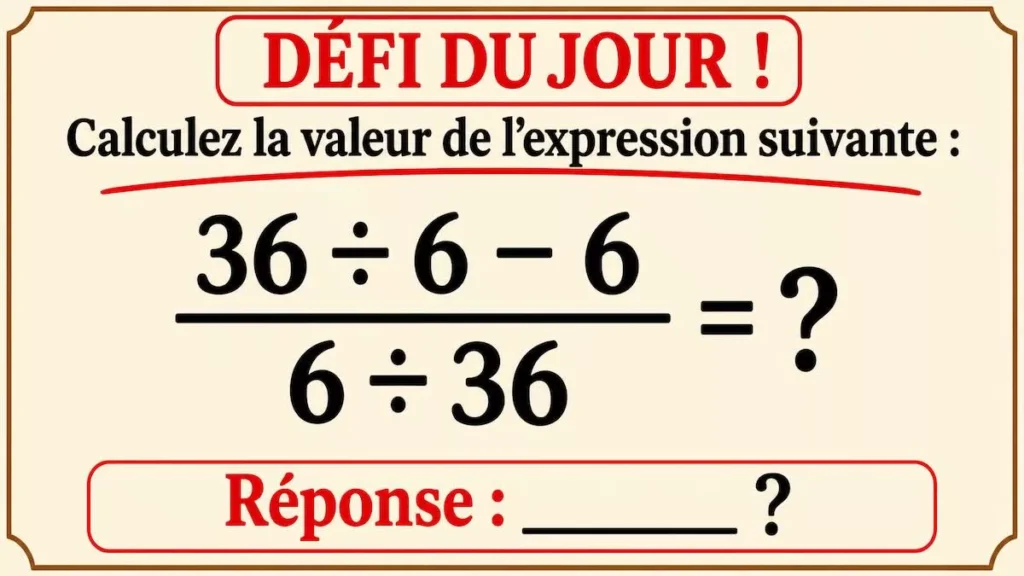
Today, I present to you an equation to complete that may surprise many. The numbers 36 and 6 seem to indicate a relatively simple calculation. However, a small error in the order of operations could completely change your answer.
Here’s the calculation to solve:
Your mission is to find the exact value of this fraction while respecting the order of operations. Take the time to carefully observe the numerator and the denominator before starting.
You have 30 seconds to solve this challenge without a calculator.
The Countdown Begins
30…
25…
20…
15…
10…
5…
4…
3…
2…
1…
Time’s up!
What Your Performance Can Reveal
If you found the correct answer quickly, you have excellent logic and analytical skills.
If you found the answer after some thought, you know how to structure your reasoning and check your steps.
And if your answer was incorrect or you couldn’t find it, no worries—this type of exercise is perfect for improving your method and accuracy.
Detailed Solution We Found (Not Necessarily the Only One, Sometimes Even the Correct One): Let’s Uncover the Trap of This Equation
First Step: Understand the Structure of the Calculation
We face a fraction made up of two distinct parts: a numerator and a denominator. The numerator contains a division followed by a subtraction, while the denominator contains only a division. To avoid any mistakes, we should calculate these two parts separately before performing the final division.
Our equation to complete is:
(36 ÷ 6 − 6) / (6 ÷ 36) = ?
Second Step: Calculate the Numerator
Let’s start with the upper part of the fraction, which corresponds to 36 ÷ 6 − 6. According to the order of operations, the division must be performed before the subtraction. Therefore, we first calculate 36 divided by 6.
36 ÷ 6 = 6
We then replace this division with its result, which gives us:
6 − 6 = 0
Thus, the numerator equals 0. This discovery is crucial because a fraction with a zero numerator has a particular property. However, we still need to check that its denominator is not equal to zero.
Third Step: Calculate the Denominator
Now let’s move on to the lower part of the fraction, which corresponds to 6 ÷ 36. This division can be expressed as a fraction that we will simplify. Since both 6 and 36 are divisible by 6, we obtain:
6 ÷ 36 = 6/36 = 1/6
Therefore, the denominator equals 1/6, which is approximately 0.1667. It’s important to note that this value is not equal to zero. We can therefore perform the final division without any mathematical issues.
Fourth Step: Perform the Final Calculation
Now that we know the two elements necessary to solve our challenge, we can replace each part with its value. The numerator is 0 and the denominator is 1/6.
0 ÷ (1/6) = 0
Indeed, zero divided by any non-zero number always yields zero. This property remains valid even when the denominator is a fraction or a decimal number. Thus, we arrive at our final result.
Fifth Step: Verify Our Answer
To confirm our reasoning, let’s revisit the complete calculation while adhering to each operation. We start by performing the divisions, then we calculate the subtraction in the numerator. Finally, we divide the resulting value by the denominator.
(36 ÷ 6 − 6) / (6 ÷ 36)
= (6 − 6) / (1/6)
= 0 / (1/6)
= 0
Our verification confirms that the result is indeed equal to zero. The trap in this challenge was to be intimidated by the fraction or to perform the operations in the wrong order. By proceeding methodically, we discover that this calculation is much simpler than it seems.
Final Answer: 0
The correct answer is 0.
(36 ÷ 6 − 6) / (6 ÷ 36) = 0
The key to this challenge was noticing that 36 divided by 6 gives 6, and then that 6 minus 6 gives zero. Once this step is completed, the calculation becomes immediate since the denominator is not equal to zero. This is an excellent example of the importance of the order of operations and the