Mathematics has always been a way to organize problems. From the earliest calculations made to measure land, facilitate trade, or observe celestial bodies, a common idea persists: when a problem seems complicated, it often becomes much simpler when we know the order in which to act. Even today, this logic is omnipresent. It plays a crucial role in the sciences, computer science, engineering, economics, and many everyday situations. Thus, the rules of priority are not just academic conventions; they enable everyone to interpret the same calculation in the same way and arrive at an unambiguous result.
“The essence of mathematics is freedom.” Georg Cantor
Over time, we often notice that calculation errors do not stem from complex operations. They typically occur when we rush and perform operations in the order they are written. Taking a moment to identify the parentheses, then the multiplications and divisions can completely change the outcome.
What This Challenge Allows You to Work On:
- Order of operations;
- The role of parentheses;
- Implicit multiplication;
- Division and multiplication;
- Mental calculation;
- Attention to mathematical conventions;
- Speed of reasoning;
- Verification of results.
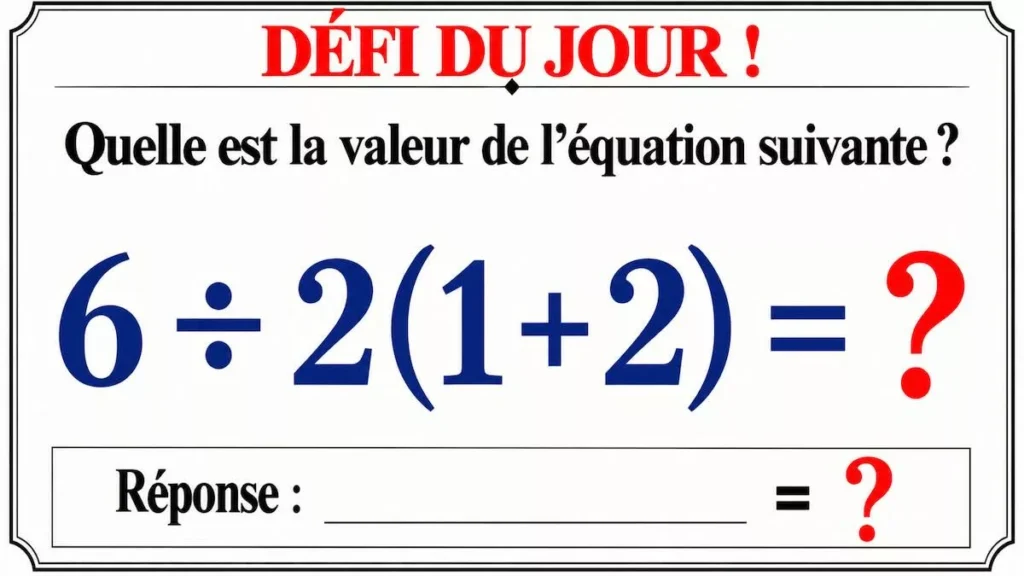
CHALLENGE OF THE DAY!
What is the value of the following equation?
Caution: This challenge can easily lead to an error if you rush.
You have 10 seconds.
The Countdown Begins
10…
9…
8…
7…
6…
5…
4…
3…
2…
1 and a half…
1…
Time’s up!
What Your Performance May Reveal
If you found the result quickly and correctly, you have excellent logic and analytical skills.
If you found the result after some thought, you know how to structure your reasoning and verify your steps.
If the result was incorrect or not found, no worries; this type of exercise is perfect for enhancing method and precision.
Detailed Solution We Found (Not Necessarily the Only or Correct One)
We must start with the parentheses:
1 + 2 = 3
The calculation then becomes:
6 ÷ 2 × 3
Multiplication and division have the same priority. When they follow one another, we perform them from left to right.
So we begin with:
6 ÷ 2 = 3
Then:
3 × 3 = 9
Answer: 9
Conclusion
This challenge is interesting because the numbers are extremely simple, yet their arrangement requires a precise understanding of order of operations. The real trap lies in automatically considering 2(1 + 2) as a unit to compute before the division.
With the usual convention where multiplication and division have the same priority and are processed from left to right, the result is therefore 9.
However, there is an additional lesson to remember: a notation like 6 ÷ 2(1 + 2) can be misleading. In true mathematical work, it is better to use parentheses or a fraction bar to clearly indicate whether one seeks to obtain 9 or 1.
The challenge thus tests not only your speed but also reminds you that in mathematics, clear notation is as important as accurate calculation.
And before getting lost in the depths of the internet, explore more games and tests by clicking here.