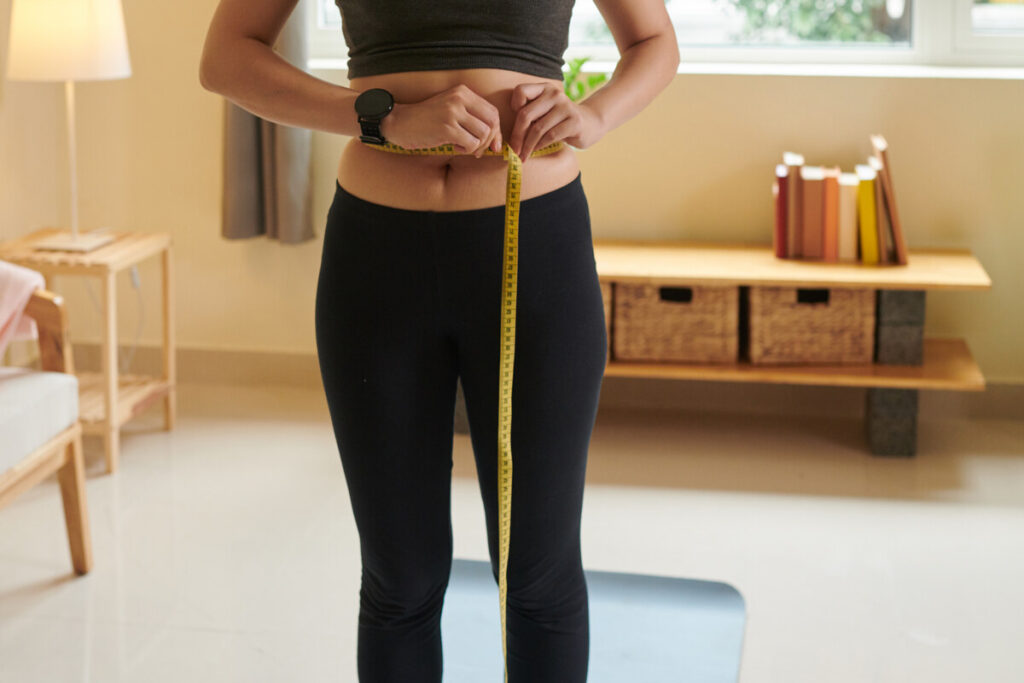
Your waist-hip ratio is just two tape measurements and one division, yet it tells you something your weight on the scale never will: where your body stores fat. Here is the simple formula, how to measure properly, and what the 0.90 and 0.85 lines actually mean.
The formula in one line
Waist-hip ratio (WHR) is your waist circumference divided by your hip circumference, with both numbers in the same unit. Centimetres or inches, it does not matter, because the units cancel out.
WHR = waist ÷ hips
Example: a 75 cm waist and 95 cm hips give 75 ÷ 95 = 0.79. In inches, a 30-inch waist and 38-inch hips give the same 0.79.
How to measure it the right way
The World Health Organization protocol is precise, and small shortcuts change the result:
- Waist: halfway between the bottom of your last palpable rib and the top of your hip bone (the iliac crest).
- Hips: around the widest part of your buttocks, with the tape parallel to the floor.
- Posture: stand with feet together, arms relaxed, and measure at the end of a normal breath out.
- Twice, not once: repeat each measurement. If the two readings are within 1 cm, take the average. If not, measure again.
Measuring at the navel is the common home shortcut, but research suggests it can underestimate your true waist. If your belly is rounded rather than curved inwards, measure about 2.5 cm (1 inch) above the navel.
What the numbers mean
The WHO defines abdominal obesity as a WHR above 0.90 for men and above 0.85 for women (or a BMI above 30). Another health body, the US NIDDK, links higher cholesterol to a WHR of 0.8 or more in women and 1.0 or more in men, so thresholds differ depending on who you ask.
Two worked examples
These are illustrative numbers, not data from a study:
- A man with a 92 cm waist and 100 cm hips: 92 ÷ 100 = 0.92. That is above the 0.90 line.
- A woman with an 80 cm waist and 92 cm hips: 80 ÷ 92 = 0.87. That is above the 0.85 line.
To find your own target, flip the formula: maximum waist = hips × threshold. For the woman above, 92 × 0.85 = 78.2 cm, so her waist would need to be about 2 cm smaller to fall under the line.
Where WHR falls short
- It can be less accurate when BMI is 35 or higher.
- A high ratio can come from more belly fat or from less muscle around the hips, and the ratio alone cannot tell which.
- Some studies find waist circumference, especially waist divided by height, a better signal of cardiovascular risk factors than WHR.
That last point is covered in our guide to the waist-to-height math your BMI misses. Using both ratios gives a fuller picture than either alone.
The takeaway
Measure waist and hips the same way each time, divide, and compare with the 0.90 or 0.85 line. It is a screening number, not a diagnosis, so if yours comes out high, treat it as a prompt to talk to a doctor rather than a verdict.