In mathematics, there are problems that have puzzled researchers for centuries. Among them is the Goldbach conjecture, formulated in 1742, which asserts that every even number greater than 2 can be expressed as the sum of two prime numbers. Despite scientific advancements and the power of computers, no one has yet managed to prove this assertion in all cases. This illustrates that a seemingly simple question can conceal a vast mystery. Mathematics also plays a crucial role in our daily lives and in understanding nature. It enables scientists to predict certain phenomena, study animal populations, and better understand ecological balances. Through equations, researchers can track animal movements, estimate populations of endangered species, and anticipate the consequences of climate change. Thus, mathematics becomes an invaluable tool for protecting wildlife and preserving biodiversity.
As mathematician David Hilbert once stated: “We must know. We shall know.”
This quote reminds us that research progresses through curiosity, perseverance, and reasoning. When faced with a puzzle, we should not only seek a quick answer but also understand the logic that leads to it. This is precisely what we will do today.
What This Challenge Allows You to Work On:
This challenge helps develop observation skills, logic, and the recognition of numerical patterns. It teaches us to search for a common rule across several equations and verify that it holds true in all cases. It also encourages concentration and the ability to clearly explain reasoning.
These skills are beneficial far beyond school exercises. In the natural sciences, researchers must also analyze data and discover relationships between different values. Equations then allow them to build models to better understand and protect animal populations.
Today’s Challenge
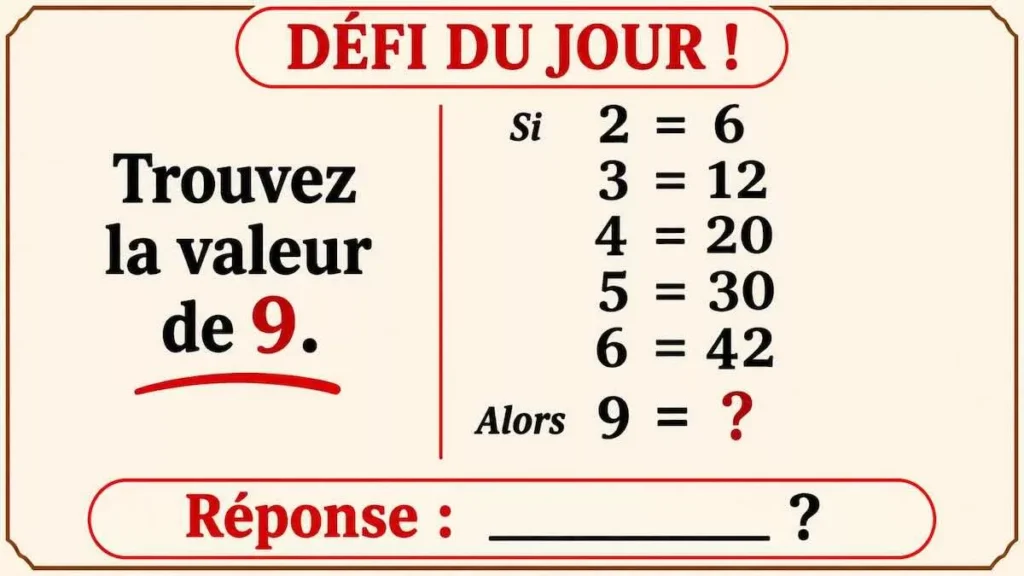
Today, I present you with a puzzle where several numbers are linked to surprising results. These equations do not seem to follow the usual operations. However, they all adhere to the same mathematical rule that you will need to uncover.
Here are the equations:
Carefully observe each line and compare the numbers. Look for an operation that could explain all the results without exception. You have a few seconds to find the missing value before revealing the solution.
The Countdown Begins
20…
15…
10…
9…
8…
7…
6…
5…
4…
3…
2…
1…
Time’s up!
What Your Performance Can Reveal
If you found the answer quickly and correctly, you have excellent logic and analytical skills.
If you found the answer after some thought, you know how to structure your reasoning and verify your steps.
And if your answer was incorrect or you couldn’t find it, no worries; this type of exercise is perfect for improving your method and precision.
Detailed Solution We Found (Not Necessarily the Only One, Sometimes Even the Right One):
The Solution Explained Step by Step
Let’s begin with the first equation, where the number 2 results in 6. We notice that 2 multiplied by 3 gives exactly 6. Here, 3 is the integer that immediately follows 2. This gives us a first clue to uncover the rule.
Now, let’s look at the second equation: 3 results in 12. If we multiply 3 by the next number, which is 4, we indeed get 12. Our hypothesis appears to hold, but we need to verify it with the other numbers.
For the number 4, we multiply 4 by 5, giving us 20. For the number 5, we multiply 5 by 6, resulting in 30. Finally, for the number 6, we multiply 6 by 7, resulting in 42. All equations thus follow exactly the same principle.
We have discovered the rule: each number must be multiplied by the integer that immediately follows it. This relationship can be represented by an equation where each number is multiplied by itself plus one. We can now apply this rule to the number in question.
The number we are looking for is 9, and the number that follows it is 10. Therefore, we multiply 9 by 10. The calculation gives us 9 × 10 = 90.
The Answer to the Challenge
The correct answer is 90.
This answer adheres to the rule observed in all the previous equations. First, we formulated a hypothesis and then verified that it worked for each number. It is this method that allows us to claim that our result is consistent.
Conclusion
This challenge reminds us once again that mathematics is not just about performing calculations. It teaches us to observe, compare, and discover the rules hidden behind numbers. An equation then becomes a tool to explain a situation and verify our reasoning.
This way of thinking is also fundamental for scientists studying wildlife. By analyzing data on births, movements, or the disappearance of certain species, they can identify significant trends. Equations help them better understand these developments and implement appropriate conservation measures. Each puzzle solved is thus a small exercise in scientific thinking. Even a challenge as simple as this encourages us to seek connections, test our ideas, and not settle for the first impression. These habits are valuable for better understanding the world and contributing to its preservation.
Did you find 90 before the countdown ended? Feel free to challenge your friends with this puzzle to compare your reasoning.
See you soon for a new CHALLENGE OF THE DAY!
And before you get lost in the depths of the web, explore other games and tests by clicking here.