In 2024, a remarkable mathematical breakthrough solved the Kelley-Meka conjecture in a neighboring field, demonstrating the Marton conjecture, also known as the polynomial conjecture of Freiman-Ruzsa, which was announced at the end of 2023. This conjecture pertained to hidden structures within certain mathematical sets and the relationships among their elements. Its resolution, achieved by a team including the mathematician Terence Tao, marks a significant advancement in additive combinatorics. It serves as a reminder that behind seemingly disordered numbers, there can lie structures that mathematics allows us to uncover. However, mathematics is not solely reserved for major scientific discoveries; it also aids in solving everyday problems, understanding natural phenomena, and anticipating certain changes in our environment.
In the field of wildlife protection, researchers utilize equations to estimate animal populations, study their movements, and assess the implications of habitat loss. This knowledge is essential for developing effective conservation strategies for threatened species.
As mathematician Joseph Fourier once said:
“The thorough study of nature is the most fruitful source of mathematical discoveries.”
This quote emphasizes the close connections between mathematics and the living world. Observing nature often leads us to seek relationships among various quantities and to construct equations to explain them. Today, we will put our reasoning skills to the test by seeking the value of an unknown.
What This Challenge Allows You to Work On:
This challenge reinforces knowledge in algebra and mastery of solving first-degree equations. It teaches us to isolate an unknown, use inverse operations, and maintain balance between both sides of an equation. It also develops concentration, rigor, and the ability to verify results. The resolution of equations is an essential skill in many scientific and professional fields. When information is unknown, mathematics often enables us to retrieve it from available data. This approach is notably used by biologists to study animal populations and better understand the relationships between species and their environment.
Today’s Challenge
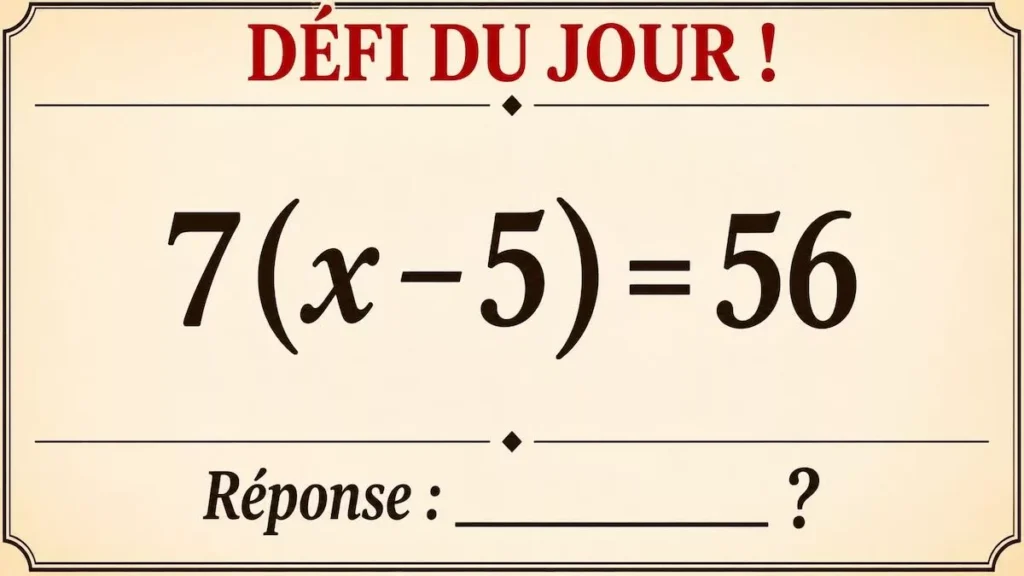
Today, I present you with an equation that appears relatively simple but requires a solid understanding of fundamental algebra rules. An unknown represented by the letter x is found within parentheses, accompanied by a subtraction and a multiplication. Your goal is to determine the exact value of this unknown.
Here is the equation to solve:
What value should we assign to x for this equality to hold true? You will need to perform the correct operations in the right order, without disrupting the balance of the equation. Several methods are possible, but some allow for a much quicker solution.
Try to solve this equation mentally, without using a calculator. Take the time to analyze the different operations before beginning your reasoning. Will you manage to find the correct answer before the countdown ends?
The Countdown Begins
30…
25…
20…
15…
10…
5…
4…
3…
2…
1…
Time’s up!
Step-by-Step Solution
To solve this equation, we need to determine the value of x that makes both sides equal. The fundamental principle is to perform the same operation on both sides of the equal sign to maintain balance. We will begin by simplifying the equation before gradually isolating our unknown.
First Step: Eliminate the Multiplication by 7
Let’s revisit our initial equation:
7(x − 5) = 56
The number 7 multiplies all elements within the parentheses. To eliminate this multiplication, we need to use its inverse operation, which is division. We will divide both sides of the equation by 7.
7(x − 5) ÷ 7 = 56 ÷ 7
On the left side, the multiplication and division by 7 cancel out. On the right side, 56 divided by 7 results in exactly 8. Our equation thus becomes much simpler.
x − 5 = 8
Second Step: Isolate the Unknown x
We now have an equation where 5 is subtracted from our unknown. To isolate x, we must perform the inverse operation of subtraction, which is addition. Therefore, we will add 5 to both sides of the equation.
x − 5 + 5 = 8 + 5
On the left side, −5 and +5 cancel each other out. On the right side, we simply add 8 and 5. Thus, we obtain the sought value.
x = 13
Third Step: Verify Our Result
Before confirming our answer, it is crucial to check that the obtained value satisfies the original equation. To do this, we will replace x with 13 in the initial equation. This will allow us to ensure that both sides have exactly the same value.
7(13 − 5) = 56
We will start by performing the subtraction within the parentheses. We find 13 − 5 = 8, and then we multiply this result by 7. The calculation gives us: 7 × 8 = 56
56 = 56
Both sides of the equation are perfectly equal. Our verification confirms that the value of x is indeed 13. Hence, we can validate our result without any approximation.
A Second Method of Resolution
It is also possible to solve this equation using the distributive property. This method consists of multiplying each term inside the parentheses by the number 7. We thus obtain an equation without parentheses.
7(x − 5) = 56
7x − 35 = 56
To isolate the term containing our unknown, we now need to add 35 to both sides of the equation. This operation eliminates the subtraction present on the left side. We then obtain:
7x = 56 + 35
7x = 91
Finally, we divide both sides of the equation by 7. This last operation fully isolates our unknown. We arrive at exactly the same result as with the first method.
x = 91 ÷ 7
x = 13
Both methods are perfectly valid and lead to the same solution. However, the first is faster in this challenge, as it allows for the immediate cancellation of the multiplication by 7. This illustrates that in mathematics, choosing an appropriate method can significantly simplify a problem.
The Answer to the Challenge
The correct answer is x = 13.
By dividing both sides of the equation by