In 2023, mathematics made a remarkable advancement with the discovery of a geometric shape capable of completely covering a surface without ever forming a periodic pattern. This problem, studied for several decades, found an answer thanks to a figure dubbed “the hat,” discovered by David Smith and explored with various mathematicians. This finding provided a solution to a famous question regarding aperiodic tilings made with a single shape. It demonstrates that in mathematics, even the oldest problems can see unexpected advancements. Geometry, however, is not solely used to solve theoretical puzzles. It allows for measuring distances, calculating areas, and precisely organizing space. In the field of wildlife protection, scientists use it to measure natural habitats, study animal territories, and determine the areas necessary for the preservation of certain species. Thus, mathematics becomes a valuable tool for understanding ecosystems and better protecting biodiversity.
As mathematician Georg Cantor once said:
“The essence of mathematics lies in its freedom.”
Mathematics allows us to explore different methods to understand a situation. A figure that appears complex can sometimes be analyzed using a few simple geometric properties. This is precisely what we will discover with our challenge of the day.
What This Challenge Helps To Improve:
This challenge helps develop observational skills, geometric reasoning, and the ability to interpret a figure. It teaches us to recognize the properties of squares, use a diagonal, and calculate the area of a right triangle. It also encourages organizing available information to construct a clear resolution method. These skills are useful in many real-world situations. When a biologist seeks to measure the area of a natural habitat, they often need to decompose a territory into simpler geometric shapes. Equations then allow for calculating areas and comparing available spaces for different animal species.
Today’s Challenge
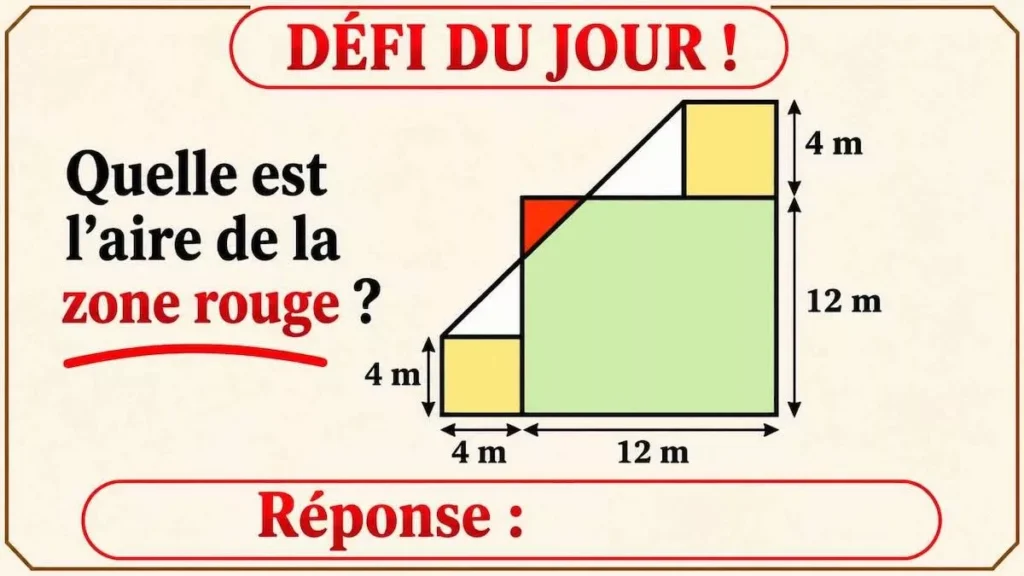
Today, I present you with a geometry puzzle where several squares are associated with an oblique line. The figure comprises various areas, but we are interested in just one: the red triangle. Your mission, should you choose to accept it, is to determine its area using only the indicated measurements.
A line traverses part of the large square and delineates a red triangular area in its upper left corner. The question is: what is the exact area of this red zone? Take your time to observe the alignments and dimensions before starting your calculations.
You don’t need to measure the figure with a ruler. All the necessary information is already present in the drawing. You just need to figure out how to use it to find the dimensions of the red triangle.
The Countdown Begins
50…
40…
30…
25…
20…
15…
10…
5…
4…
3…
2…
1…
Time’s up!
What Your Performance May Reveal
If you found the result quickly and correctly, you have excellent logic and strong analytical skills.
If you found the result after some thought, you know how to structure your reasoning and verify your steps.
And if your result was incorrect or not found, no worries; this type of exercise is perfect for improving method and precision.
Detailed Solution We Found (Not Necessarily the Only One, Sometimes Even the Right One):
Solution Explained Step by Step
To solve this challenge, let’s start by identifying the important elements of the figure. The large green square measures 12 meters on each side, and the two small yellow squares each measure 4 meters on each side. The oblique line passes through the upper left corners of the two small squares.
We will use a coordinate system to understand the precise position of this line. Let’s place the bottom left corner of the large green square at the coordinates (0; 0). Its upper left corner is then at (0; 12), since its height is 12 meters.
The bottom small square is immediately to the left of the large square. Its upper left corner thus has the coordinates (−4; 4). The top small square is located in the upper right corner of the large square, and its upper left corner is at (8; 16).
The oblique line thus passes through two known points: (−4; 4) and (8; 16). Between these two points, the horizontal distance is 12 meters, while the height difference is also 12 meters. This means that the line rises one meter for every meter it advances horizontally.
We can therefore write the equation of this line:
y = x + 8
Let’s verify this equation with the first point. When x is −4, we get y = −4 + 8 = 4, which corresponds to the height of the bottom small square. When x is 8, we find y = 8 + 8 = 16, which also corresponds to the point on the top small square.
First Step: Finding the Height of the Red Triangle
The red triangle is located in the upper left corner of the large square. To find its height, we need to determine where the oblique line intersects the left side of the large square. On this side, the horizontal coordinate x is equal to zero.
We thus use the previous equation:
y = 0 + 8 = 8
The line intersects the left side of the large square at a height of 8 meters from the bottom. The total height of the large square is 12 meters. Therefore, the height of the red triangle corresponds to the difference between these two values.
12 − 8 = 4 meters
We have thus found the first dimension of the red triangle: its height is 4 meters. Now we need to determine its horizontal base. To do this, we will find the point where the line intersects the top side of the large square.
Second Step: Finding the Base of the Red Triangle
The top side of the large square is at a height of 12 meters. We must then find the value of x for which the line reaches this height. We again use the equation of the line.
12 = x + 8
To isolate x, we subtract 8 from both sides:
x = 12 − 8
x = 4
The line thus intersects the top side of the large square at 4 meters from its upper left corner. This distance corresponds exactly to