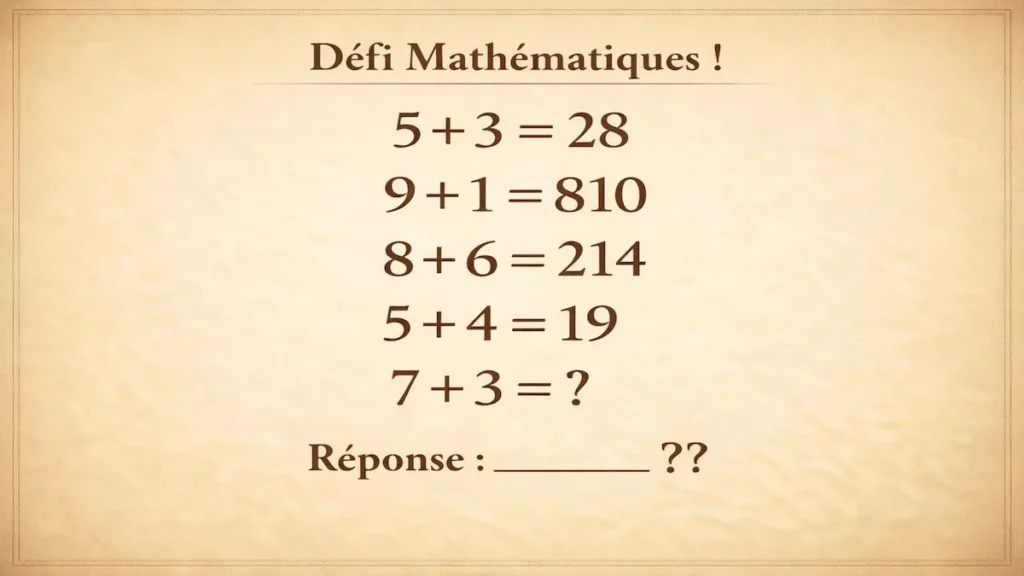
Some equations may seem completely unsettling at first glance, as they do not adhere to the usual rules of calculation. However, in mathematics, this type of exercise is always based on a precise logic that must be identified before one can respond correctly. Therefore, the main challenge is not the calculation itself, but the ability to understand the hidden mechanism behind each equation.
In France, assessments in mathematics regularly show that success heavily relies on the method used and the ability to analyze a problem rather than mechanically applying an operation. Such challenges are useful for developing logical reasoning, concentration, and rigor in data interpretation.
As Georg Cantor said:
“The essence of mathematics lies in its freedom.”
This serves as a reminder that certain structures may appear unusual, yet they still follow a coherent rule.
What This Challenge Allows You to Work On:
- Identifying logic in unusual equations
- Observation and deduction skills
- Constructing a mathematical rule
- Rigor in step-by-step analysis
- Verifying the coherence of results
Challenge of the Day
Answer: ______ ??
Take the time to carefully analyze the relationships between the numbers before responding.
The difficulty arises from having to abandon the conventional rules of addition to uncover a hidden logic.
The Countdown Begins:
40…
30…
20…
10…
5…
3…
2…
1…
Time’s Up!
So, What Is Your Answer?
What Your Performance Reveals:
A correct and quick response indicates excellent analytical and deductive abilities.
A correct answer after reflection reflects a good mastery of logic and method.
An incorrect or unanswered response? No problem, these exercises are meant for improvement.
So, What Is Your Answer?
Detailed Solution We Found: (Not Necessarily the Only One, Sometimes Even the Right One)
Finding the Rule
We can observe a clear pattern:
First, we write the difference (a − b).
Then, we write the sum (a + b).
Verification
5 + 3 → 5 − 3 = 2 and 5 + 3 = 8 → 28
9 + 1 → 9 − 1 = 8 and 9 + 1 = 10 → 810
8 + 6 → 8 − 6 = 2 and 8 + 6 = 14 → 214
5 + 4 → 5 − 4 = 1 and 5 + 4 = 9 → 19
The rule works perfectly.
Application to the Last Case
7 + 3
- 7 − 3 = 4
- 7 + 3 = 10
We combine: 410
Final Answer:
7 + 3 = 410
Conclusion
The rule becomes evident when we observe the structure of the results: it is not a simple addition but a two-step transformation that combines the difference and the sum of the numbers. By identifying this repetitive pattern in each line, we understand that the logic remains consistent and allows us to determine the missing result easily.
And before you get lost in the depths of the web, explore other games and tests by clicking here.