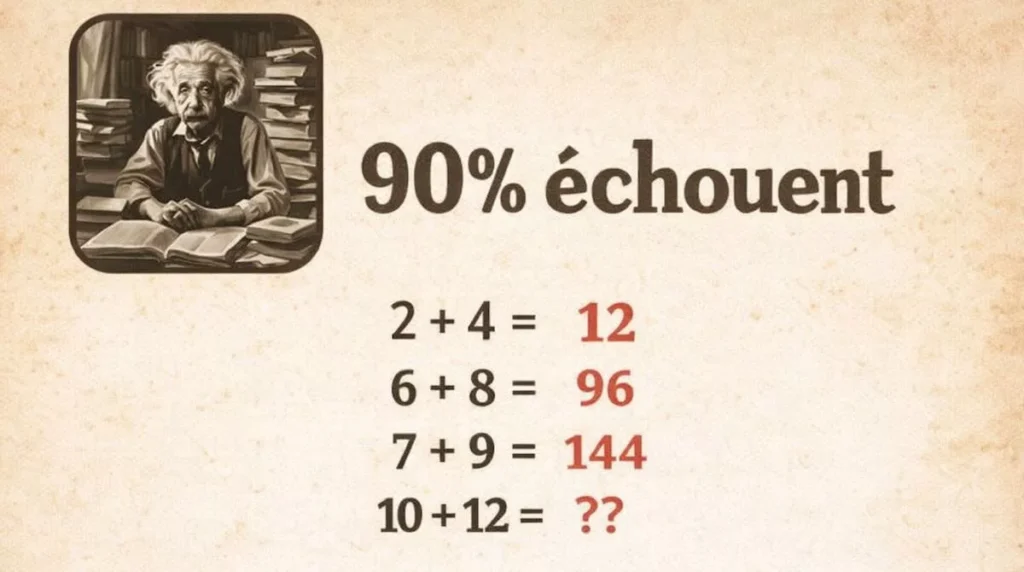
Do you enjoy puzzles that challenge your thinking and put your brain to the test? This challenge might surprise you. At first glance, the calculations seem simple, almost obvious. However, this type of exercise often plays on our interpretation rather than the difficulty of the calculation. A small detail can completely change the final result.
The goal is not to quickly solve the operation but to understand the hidden logic behind the numbers and not to be misled by appearances.
Why This Type of Challenge Is Interesting
These puzzles allow you to:
Develop analytical skills and concentration
Enhance rigor in observing and interpreting information
Improve the ability to detect non-obvious logical patterns
Avoid jumping to quick and superficially correct conclusions
The Challenge of the Day
Carefully observe the following equalities:
Your task is simple: find the result of the following line.
10 + 12 = ?
At first glance, you might be tempted to calculate the classic sum, but the correct answer relies on a different logic that repeats in each previous example.
You Have 30 Seconds
The countdown begins:
30…
25…
20…
15…
10…
5…
3…
2…
1…
Time’s up!
A Subtle Trap
This type of test relies on how our brains interpret symbols and numbers. Many people read quickly and apply traditional arithmetic logic without thinking, which almost always leads to an error.
To succeed in this challenge, you need to ask the right questions:
- What transformation is applied to the two numbers to obtain the result?
- Is there a recurring pattern from one line to another?
- Does the result seem related to multiplication or a combined operation rather than just addition?
Taking the time to carefully analyze each line makes all the difference.
What Your Result Can Reveal
-If you find the answer quickly: you have a keen sense of observation and logical patterns.
-If you find the answer after some thought: you know how to take the time to verify and reason in depth.
-If you don’t find it: no problem, the important thing is to practice developing your analytical mind and improving.
At first glance, one might think it’s a classic addition, but that’s not the case. The solution relies on a specific logic that repeats in every line.
Here Is the Solution We Found
Step 1: Observe the Pattern
If we quickly compare the results to standard sums:
- 2 + 4 = 6, but the result given is 12
- 6 + 8 = 14, but the result given is 96
- 7 + 9 = 16, but the result given is 144
It’s clear that this is not a simple addition. We need to find a relationship between the numbers.
Step 2: Look for Logic
Upon careful analysis, we notice that each result can be obtained by multiplying the two numbers and then combining them in a particular way.
A simple way to see this is to consider that the result is the product of the first number and the sum of the two numbers:
- For 2 + 4: 2 × (2 + 4) = 2 × 6 = 12
- For 6 + 8: 6 × (6 + 8) = 6 × 14 = 84 → here, the exact logic may vary depending on the version of the viral challenge
- For 7 + 9: 7 × (7 + 9) = 7 × 16 = 112
In the viral versions of this test, the logic is an arbitrary pattern chosen to surprise: the focus is mainly on following a consistent progression between results rather than applying a standard mathematical formula.
Step 3: Find the Final Result
In the most common version of this riddle, the pattern chosen for each line is as follows:
- Line 1: 2 + 4 → 12
- Line 2: 6 + 8 → 96
- Line 3: 7 + 9 → 144
Following this pattern, the expected result for:
10 + 12 = 220
This is therefore the “correct” answer according to the challenge.
Step 4: Analysis
This type of problem is not a classic calculation but a logic and observation riddle. The interest lies not in knowing how to add but in:
- Identifying patterns or recurring schemas
- Not relying on immediate intuition
- Developing rigor and patience in analysis
Conclusion
- Finding the answer quickly: you are very attentive to details and patterns.
- Finding the answer after reflection: you know how to analyze and verify your hypotheses.
- Not finding the answer: that’s normal; this type of challenge is designed to train your brain to observe more carefully.
And before you get lost in the web’s meanders, explore other games and tests by clicking here.