Letters have not always been part of mathematics. For a long time, problems were explained almost entirely with words. Gradually, mathematicians developed a symbolic writing system that allowed them to represent unknown numbers with letters. This evolution profoundly transformed algebra: instead of solving just a particular problem, it became possible to construct methods applicable to thousands of different situations.
Today, this mathematical language is essential. It can be found in engineering, computer science, physics, economics, astronomy, and even in the programs that allow satellites to calculate their trajectories. Behind a simple letter like A, B, or C, there can be a whole reasoning process.
Initially, I tended to look at all the equations at once, making the problem seem complicated. Then I understood a very simple method: start with the equation that easily provides the first value, and then use that value in the next one. Everything then becomes like a chain of dominoes.
Quote of the day
“It is impossible to be a mathematician without having a poet’s soul.” — Sofia Kovalevskaya
This quote reminds us that mathematics requires not only rigor but also imagination: sometimes, you need to look at a problem from a different angle to discover the simplest path.
What this challenge allows you to work on:
- solving several successive equations;
- substitution;
- mental calculation;
- order of operations;
- multiplication before addition;
- logical reasoning;
- concentration and organization of steps.
Challenge of the day!
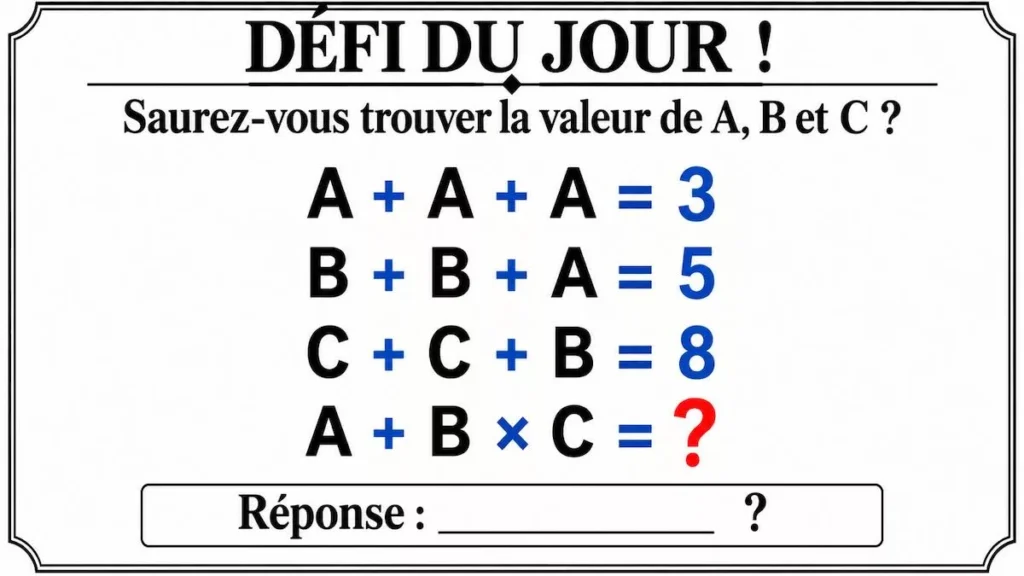
Today, three letters hide three numbers.
Here are the equations:
A + B × C = ?
Your mission is to successively find A, B, and C, and then correctly use their values in the final equation.
Be careful with the last line, multiplication must be performed before addition.
Will you find the result before the countdown ends?
The countdown begins
50…
40…
30…
25…
20…
15…
10…
5…
4…
3…
2…
1…
Time’s up!
What your performance can reveal
If you found the result quickly and correctly, you have excellent logic and good analytical skills.
If you found the result after some thought, you know how to structure your reasoning and check your steps.
If your result is incorrect or you didn’t find it, no worries; this type of exercise is perfect for improving method and precision.
Detailed solution we found (not necessarily the only or even the correct one)
Let’s start with the first equation: A + A + A = 3
This means: 3A = 3
Thus: A = 1
Now let’s move to the second equation: B + B + A = 5
Since A = 1, we get:
B + B + 1 = 5
Therefore:
2B + 1 = 5
2B = 4
So: B = 2
Now let’s look at the third equation: C + C + B = 8
We now know that B = 2.
Thus:
C + C + 2 = 8
This gives:
2C + 2 = 8
2C = 6
Hence:
C = 3
Now we have all the values:
A = 1
B = 2
C = 3
It’s time to solve the last equation: A + B × C
Let’s replace the letters: 1 + 2 × 3
Be mindful of order of operations: we must perform the multiplication before addition.
2 × 3 = 6
Then:
1 + 6 = 7
Answer: 7
Conclusion
This challenge had two different difficulties. The first was to gradually determine the values of A, B, and C. The second was more subtle: you also had to respect the order of operations in the final equation.
It is a good illustration of how many mathematical problems are solved: one piece of information allows you to discover a second, which allows you to uncover a third, until the final solution is reached.
If you found 7 before the countdown ended, congratulations! You combined substitution, logic, and order of operations without falling into the final trap.
And before you get lost in the web’s maze, explore more games and tests by clicking here.