In a small mountainous region, a team of researchers has been observing a concerning decline in the number of bees for several years. These insects play a crucial role in pollinating plants and maintaining biodiversity. To understand this gradual disappearance, a young mathematician decides to analyze the data collected on temperatures, pesticides, and insect populations. Through the study of numbers and mathematical sequences, she manages to identify trends that guide research towards new solutions. This story illustrates a fascinating reality: mathematics can become a true ally in environmental protection. They allow scientists to study the evolution of species, predict certain climate changes, and assess the consequences of pollution.
In the field of health, mathematics is also used to analyze the spread of diseases, interpret medical data, and improve prevention strategies. Behind these applications often lie simple principles, such as observing regularities and searching for relationships between numbers.
Number sequences hold a significant place in this scientific approach. They help represent evolutions, understand repetitive phenomena, and sometimes anticipate certain trends. However, to uncover the logic of a sequence, one must be attentive and avoid rushing to the first answer that comes to mind. It is this capacity for reflection that we will put to the test today.
Quote of the Day
“The essence of mathematics is freedom.” Georg Cantor
This quote reminds us that mathematics is not merely about applying memorized rules. It invites us to explore different avenues, imagine relationships, and discover original solutions. When faced with a numerical sequence, this freedom of thought becomes particularly valuable, as multiple observations can lead us to the same logic.
What This Challenge Allows You to Work On:
This challenge helps develop your observational skills, logic, and ability to recognize numerical regularities. It also trains you to compare the differences between several numbers, identify a formation rule, and use an equation to verify your reasoning. Finally, it strengthens your concentration, patience, and problem-solving skills without being intimidated by numbers.
Challenge Presentation
Today, I present to you a sequence of numbers that seems relatively simple. However, to discover the missing number, you will need to identify the relationship that connects each term to the next. The secret lies not in complicated calculations, but in your ability to observe a very particular progression.
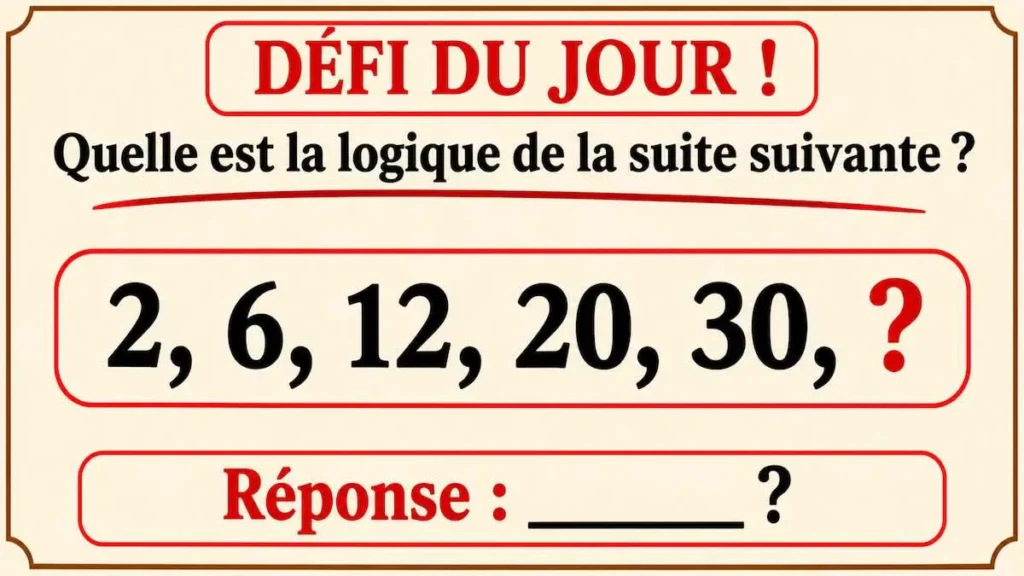
Here is today’s sequence:
What number should replace the question mark to respect the logic of this sequence? Take a moment to compare the numbers and search for a rule that works at each step. You have 30 seconds to find the correct answer before discovering the detailed solution.
The Countdown Begins
30…
25…
20…
15…
10…
5…
4…
3…
2…
1…
Time’s up!
What Your Performance Can Reveal
If you found the result quickly and correctly, you have excellent logic and analytical skills.
If you found the result after some reflection, you know how to structure your reasoning and check your steps.
And if the result was incorrect or not found, no worries, this type of exercise is perfect for improving method and precision.
Detailed Solution We Found (Not Necessarily the Only One, Sometimes Even the Right One): Discovering the Trap of This Equation
First Step: Observe the Numbers Carefully
We need to find the next term in the sequence 2, 6, 12, 20, 30. At first glance, we notice that the numbers progressively increase, but they do not all grow by the same amount. To understand this progression, we will start by calculating the differences between two consecutive terms.
Let’s revisit our sequence:
2, 6, 12, 20, 30, ?
Second Step: Calculate the Differences
Let’s subtract each number from the next to discover how the sequence evolves. This method is particularly effective when a numerical sequence presents a regular but non-constant increase. We will examine each interval separately.
6 − 2 = 4
12 − 6 = 6
20 − 12 = 8
30 − 20 = 10
We thus obtain a new sequence composed of the differences between the terms. These differences are 4, 6, 8, and 10, revealing a particularly interesting progression. Each difference increases exactly by 2 compared to the previous one.
Third Step: Discover the Hidden Rule
Now let’s observe the sequence of differences: 4, 6, 8, 10. We see that these are consecutive even numbers, each greater by 2 than the previous one. To continue this logic, the next difference must therefore be equal to 12.
We can write:
4, 6, 8, 10, 12
The rule then becomes very clear: we successively add 4, then 6, then 8, then 10, and finally 12. We only need to apply this last addition to the number 30 to determine the missing term.
Fourth Step: Calculate the Next Number
We now know that the next difference is equal to 12. The last known number in our sequence is 30, which means we need to add 12 to it. This operation gives us the sought value directly.
30 + 12 = 42
Thus, the missing number is 42. Our sequence is now complete and perfectly respects the observed progression. We can, however, verify our result using a second mathematical method.
Fifth Step: Discover Another Method
There is another particularly elegant way to understand this numerical sequence. Each term can be obtained by multiplying two consecutive integers. This property allows us to construct a general equation that explains all the numbers in the sequence.
Let’s observe:
1 × 2 = 2
2 × 3 = 6
3 × 4 = 12
4 × 5 = 20
5 × 6 = 30
We notice that each term corresponds to the product of an integer and the number that immediately follows it. To find the sixth term, we simply need to multiply 6 by 7. We thus arrive at the result obtained with the method of differences.
6 × 7 = 42