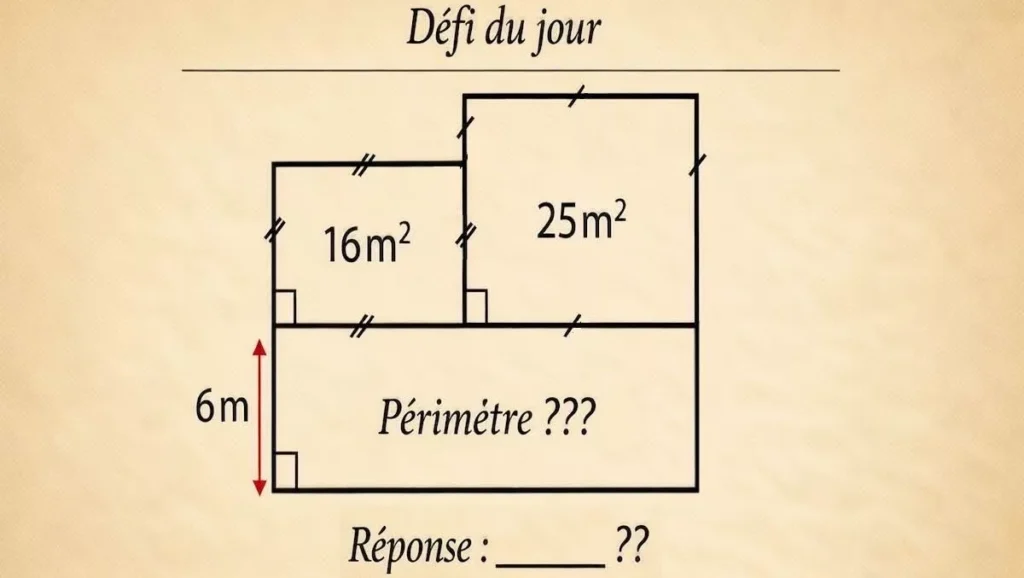
I enjoy geometry challenges because they remind me that in mathematics, lengthy calculations are not always necessary to find the right answer. Often, it’s enough to observe the information, understand the relationships between figures, and proceed methodically. With each puzzle, I discover a new way of reasoning, and that motivates me to take on such challenges. Mathematics helps us develop our logic, observational skills, and problem-solving abilities.
They also teach us to be rigorous, to verify our reasoning, and to construct a solution step by step. Geometry is an excellent exercise for training our brains to visualize shapes and make connections between dimensions and measurements.
In this challenge, we will need to use the properties of squares and rectangles to determine the requested perimeter. Each piece of information serves as a clue that will bring you closer to the solution.
What This Challenge Allows You to Work On:
- The properties of squares
- Calculating lengths from areas
- Calculating the perimeter of a rectangle
- Geometric reasoning
- Logic and observation
The Challenge of the Day
What is the perimeter of the rectangle?
Answer: ______ ??
Take your time to observe the information before starting your calculations.
The countdown begins:
40…
30…
20…
10…
5…
4…
3…
2…
1…
Time’s up!
What Your Performance Can Reveal
If you found the result quickly and correctly, you have excellent logic and good analytical skills.
If you found the result after some thought, you know how to structure your reasoning and verify your steps.
And if the result was incorrect or not found, no worries—this type of exercise is perfect for improving your methodology and accuracy.
Detailed Solution We Found (Not Necessarily the Only One, Sometimes Even the Correct One)
We start by determining the sides of the two squares.
Square of 16 m²:
Side = √16 = 4 m
Square of 25 m²:
Side = √25 = 5 m
The rectangle located beneath the two squares has a width of 6 m and a length equal to the total width of the two squares:
4 m + 5 m = 9 m
The perimeter of a rectangle is:
2 × (length + width)
Therefore:
2 × (9 + 6)
= 2 × 15
= 30 m
Final Answer:
30 m
Conclusion
This challenge illustrates that in geometry, a simple area can provide all the necessary information to find lengths and solve a problem.
Mathematics teaches us to observe, connect data, and build logical reasoning. With method and a bit of thought, figures that seem complex become much simpler to understand.
And before you get lost in the depths of the web, explore other games and tests by clicking here.