History is always fascinating. Imagine a young boy, just seven years old, sitting in a classroom in Germany at the end of the 18th century. His teacher asks the students to add all the numbers from 1 to 100, thinking it will keep them occupied for a long time. However, just moments later, the young Carl Friedrich Gauss would have already found the answer: 5,050. According to this famous anecdote, instead of adding the numbers one by one, Gauss noticed an extraordinary pattern. By pairing the first number with the last, then the second with the second-to-last, he always arrived at the same sum: 101. He simply needed to realize that there were 50 pairs to immediately discover the result.
This story illustrates a fascinating idea: in mathematics, thinking intelligently can be far more effective than calculating quickly. This principle has contributed to countless scientific and technological advancements. Today, mathematics enables the design of airplanes, programming of computers, prediction of certain space trajectories, and development of medical technologies.
One can find this same satisfaction in very ordinary situations. Imagine a person trying to mentally calculate the total of several purchases and discovering that by grouping certain numbers, they can arrive at the result much more easily. This little moment of discovery shows that mathematics is not just a school subject but also a way to simplify our daily lives.
And this is precisely the spirit of our challenge today. We will be working with similar numbers, but the operations must be performed in a very specific order. A single error in the order of operations can completely alter the final result.
Quote of the Day
“Mathematics is the art of giving the same name to different things.” – Henri Poincaré
This reflection reminds us that mathematics allows us to discover common relationships between situations that seem different. Behind numbers, shapes, or equations often lie general rules that facilitate our understanding. Learning to recognize these rules can save time and enable us to solve problems with greater precision.
What This Challenge Aims to Develop:
- Mental calculation: Quickly perform simple operations without a calculator.
- Order of operations: Know the correct order for performing multiplications, divisions, additions, and subtractions.
- Concentration: Stay attentive to signs and numbers.
- Logical reasoning: Organize steps to avoid mistakes.
- Speed of thought: Find an efficient method within a limited time.
- Mathematical rigor: Check each operation before providing an answer.
- Self-confidence: Improve through regular practice of mathematical challenges.
Challenge Presentation
Welcome to our CHALLENGE OF THE DAY!
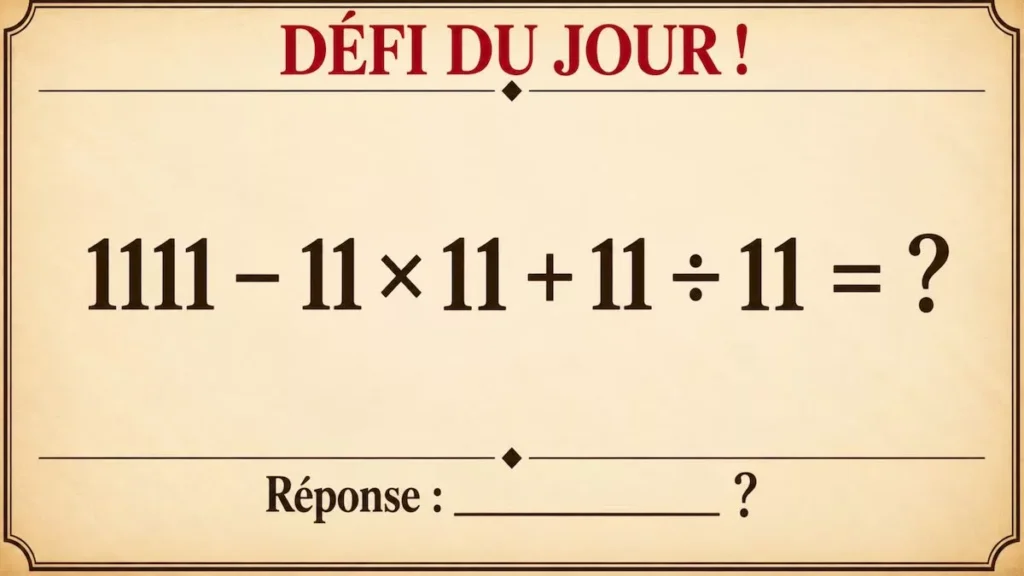
Today, we will test your mental calculation skills with a numerical equation consisting of several operations. At first glance, the numbers seem easy to manipulate, but beware: this challenge requires adherence to the fundamental rules of mathematics. It is not enough to calculate from left to right to arrive at the correct answer.
Here is the calculation to solve:
Carefully observe this equation and ask yourself which operations should be performed first. Multiplication and division play a crucial role here. Your goal is to find the correct result without using a calculator.
You have 30 seconds to take on this challenge. Take a moment to organize your reasoning before starting the calculations. Are you ready to test your speed and accuracy?
Countdown Begins
30…
25…
20…
15…
10…
5…
4…
3…
2…
1…
Time’s up!
What Your Performance Can Reveal
If you found the result quickly and correctly, you have excellent logic and analytical skills.
If you found the result after some thought, you know how to structure your reasoning and check your steps.
And if the result was incorrect or not found, no worries; this type of exercise is perfect for improving method and precision.
Detailed Solution We Found (not necessarily the only or the correct one)
Now, let’s solve this calculation step by step. To arrive at the correct result, we must respect the order of operations. Multiplications and divisions must be performed before additions and subtractions.
Step 1: Observe the Equation
Our starting calculation is:
1111 − 11 × 11 + 11 ÷ 11 = ?
We notice four different operations: one subtraction, one multiplication, one addition, and one division. It would be incorrect to immediately start by subtracting 11 from 1111. We must first address the priority operations.
Step 2: Perform the Multiplication
Let’s start with the multiplication:
11 × 11 = 121
We then replace this multiplication with its result. The equation now becomes easier to read. There is still one division to perform before addressing the other operations.
1111 − 121 + 11 ÷ 11 = ?
Step 3: Perform the Division
The division present in our calculation is:
11 ÷ 11 = 1
Any non-zero number divided by itself gives 1. We can therefore replace this division with its result. Our calculation now contains only two operations.
1111 − 121 + 1 = ?
Step 4: Perform the Subtraction
Now that the multiplication and division have been performed, we can calculate from left to right. So we start by subtracting 121 from 1111. This operation gives us:
1111 − 121 = 990
Now there is only one addition left to perform. We are very close to discovering the final answer. Let’s just check that we haven’t missed any numbers.
Step 5: Perform the Final Addition
We take the previous result:
990 + 1 = 991
All operations have now been carried out in the correct order. We respected the order of operations without altering the original numbers. The final result is therefore confirmed.
Final Answer
1111 − 11 × 11 + 11 ÷ 11 = 991
The correct answer is 991.
Why This Challenge Can Lead to Errors?
The main difficulty of this challenge does not stem from