Mathematics has always been about discovering patterns. Long before our modern calculation methods emerged, people observed numbers, shapes, and movements to identify regularities. This ability to spot hidden rules gradually led to the development of arithmetic, geometry, and later algebra. The quest for regularities remains vital today, influencing fields such as computer programming, data analysis, cryptography, artificial intelligence, and various scientific domains. Mathematics teaches us to look beyond isolated numbers and to seek the relationships that connect them.
I recall facing challenges where I immediately sought complicated additions among all the numbers. I would test one equation after another without making progress. Over time, I realized that it was often more effective to begin by observing the position of the numbers in the figure. Sometimes, the solution isn’t hidden in a complex calculation but simply lies in a visual relationship.
Quote of the Day
“Knowledge is acquired through experience; everything else is just information.” — Albert Einstein
This quote perfectly illustrates this type of challenge: it is through trying, comparing, and verifying different hypotheses that we develop our reasoning. A rule becomes convincing when it consistently works across the entire figure.
What This Challenge Helps To Develop:
This challenge helps to develop:
- careful observation of a figure;
- recognition of a regularity;
- mental calculation;
- comparison of numbers located in opposite sectors;
- formulation and verification of a rule;
- logical reasoning;
- speed and concentration.
Challenge of the Day
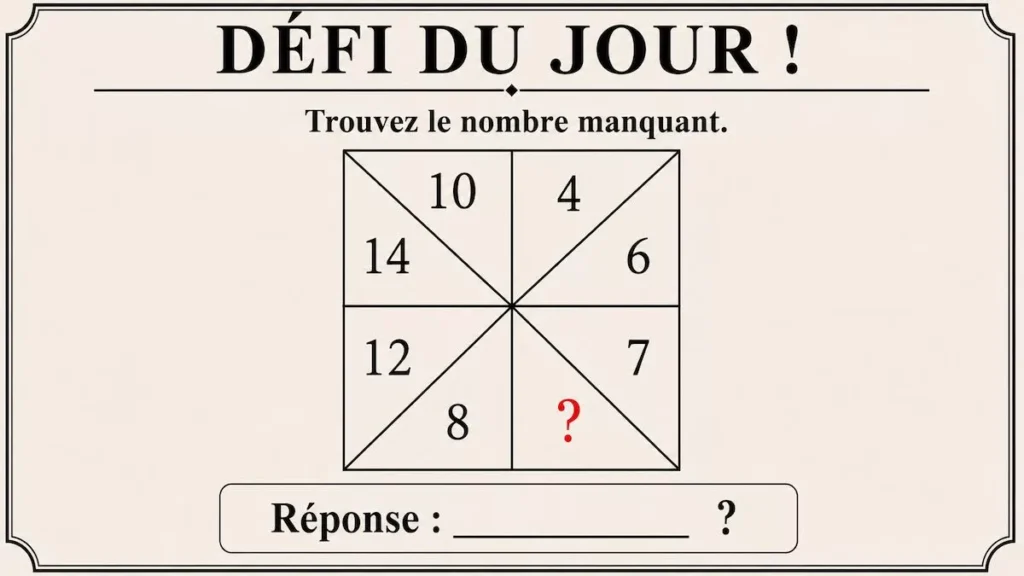
Carefully observe the numbers placed in the eight sectors:
Your goal is to discover the rule that connects the numbers and then determine the missing number.
What value should replace the question mark?
Try to find the rule before the countdown ends.
The Countdown Begins
40…
30…
25…
20…
15…
10…
5…
4…
3…
2…
1…
Time’s up!
What Your Performance May Reveal
If you found the result quickly and correctly, you have excellent logical reasoning and analytical skills.
If you arrived at the result after some thought, you know how to structure your reasoning and verify your steps.
And if your result was incorrect or not found, no worries; this type of exercise is perfect for improving methods and accuracy.
Detailed Solution We Found (Not Necessarily the Only One, or Even the Correct One)
The key is not to compare adjacent numbers around the figure.
Instead, look at the opposite sectors.
Let’s start with 4.
The number in the opposite sector is 8.
We have:
4 × 2 = 8
Now let’s look at 6 and its opposite 12:
6 × 2 = 12
The same rule applies.
Continuing with 7 and 14:
7 × 2 = 14
A clear regularity emerges: the number in the opposite sector is double the first.
Now we are left with the last pair:
10 and ?
We apply the same rule:
10 × 2 = 20
Thus, the missing number is:
20
Verification
The four opposite pairs are:
4 → 8
6 → 12
7 → 14
10 → 20
The same rule holds for all pairs.
Final Answer
? = 20
Conclusion
This challenge perfectly illustrates why observation should sometimes precede calculation. The numbers may seem scattered throughout the figure, but their positions provided the essential clue: we needed to compare opposite sectors. Once this organization was recognized, the rule became very simple: each number has its double in the opposite sector. This is exactly what mathematical logic challenges aim to develop: learning to seek structure, formulate a rule, and then verify it across multiple examples before finalizing an answer. If you identified 20 before the countdown ended, you had grasped the correct logic.
And before you get lost in the depths of the web, explore more games and tests by clicking here.