Geometry is one of the oldest branches of mathematics. Long before modern tools, humans needed to measure land, construct buildings, chart roads, and observe the stars. The Egyptians, the Greeks, and many other civilizations developed geometric methods that profoundly influenced science and architecture. Even today, angles and shapes are everywhere: in an architect’s plans, the design of a bridge, cartography, digital imaging, and the trajectories used in aeronautics. Geometry teaches us one crucial lesson: information located at one point in a figure can help deduce another much further away.
I recall certain problems where I immediately sought to calculate the requested angle. However, the best approach was to first forget that angle and complete the two triangles surrounding it. Once the missing angles were found, the answer seemed to reveal itself almost effortlessly. This is precisely the spirit of today’s challenge.
Quote of the Day
“There is no royal road to geometry.” — Euclid
This famous phrase reminds us that understanding mathematics requires reasoning and practice. There aren’t always shortcuts; sometimes, we must advance step by step to uncover a solution that ultimately becomes clear.
What This Challenge Allows You to Work On:
This challenge allows you to work on:
- the sum of the angles in a triangle;
- calculating unknown angles;
- observing a geometric figure;
- the angles formed by two intersecting lines;
- breaking down a problem into multiple steps;
- mental calculation;
- logic and precision in reasoning.
Challenge of the Day
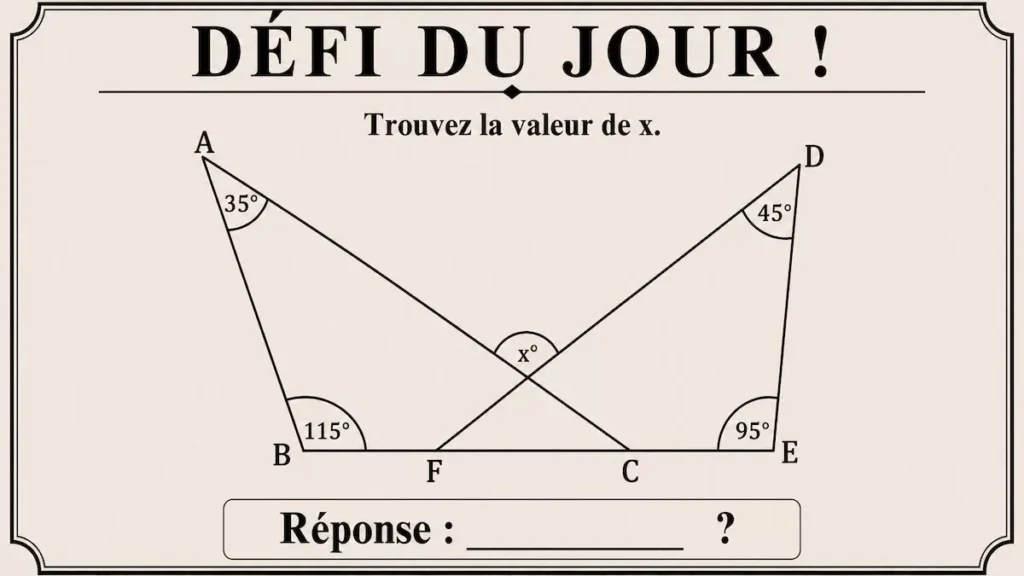
Carefully observe the figure.
We know four angles:
The two diagonal segments intersect and form the angle x.
Your mission is to find:
x = ?
Do not rely solely on the appearance of the drawing. Use the properties of triangles to determine the precise value of the angle.
The Countdown Begins
40…
30…
25…
20…
15…
10…
5…
4…
3…
2…
1…
Time’s up!
What Your Performance Can Reveal
If you found the answer quickly and correctly, you have excellent logic and analytical skills.
If you found the answer after some thought, you know how to structure your reasoning and verify your steps.
And if you found the result incorrect or couldn’t find it, no worries; this type of exercise is perfect for improving your method and accuracy.
Detailed Solution We Found (Not Necessarily the Only One, Sometimes Even the Right One)
Let’s start with the triangle on the left.
We know two of its angles:
35° and 115°
The sum of the angles in a triangle is always equal to 180°.
Therefore, the angle at C is:
180° − 115° − 35° = 30°
The segment from C to A thus forms an angle of 30° with the horizontal line on the left side.
Now, let’s move on to the triangle on the right.
We know the angles:
45° and 95°
Thus, the angle at F is:
180° − 95° − 45° = 40°
Now we have the two necessary inclinations:
30° on the left
and
40° on the right.
To find the angle x above the intersection point, observe the imaginary horizontal half-line passing through this point.
The flat angle measures:
180°
It is divided into three angles:
30° + x + 40° = 180°
We can thus write the equation:
x = 180° − 30° − 40°
x = 110°
Final Answer
x = 110°
Conclusion
This challenge is interesting because the angle sought is not accompanied by any direct measurement. First, we must exploit the two triangles to discover the angles of 30° and 40°, then combine this information at the intersection point.
This is an excellent illustration of geometric reasoning: each piece of information has its utility, and the information gradually transmits from one part of the figure to another. By proceeding methodically, the four given angles lead us to a single answer:
x = 110°.
And before you get lost in the web’s maze, explore other games and tests by clicking here.