
Geometry originated from a very tangible need: to measure the world. From the earliest surveyors to modern engineers, angles have been used to determine distances, orient constructions, create maps, and even calculate positions without being able to measure everything directly. What makes geometry particularly fascinating is that a figure can appear complex while just a few fundamental properties are enough to comprehend it. Right angles, supplementary angles, and angles formed by intersecting lines become true clues.
I remember certain challenges where I would immediately try to calculate the requested angle. Then I developed the habit of starting by identifying the easiest angles to determine. Very often, a small initial deduction triggers the entire solution. Today’s challenge works exactly this way.
Quote of the Day
“Geometry is the art of reasoning correctly about incorrect figures.” — Henri Poincaré
This quote is particularly fitting for this challenge: a drawing helps to understand the situation, but one should never determine an angle solely based on its appearance. The geometric properties and given measurements should guide our reasoning.
What This Challenge Allows You to Work On:
This challenge allows you to work on:
- the precise reading of a geometric figure;
- complementary and supplementary angles;
- the property of a right angle;
- the interpretation of an exterior angle;
- angles formed by intersecting lines;
- mental calculation;
- logic and the sequence of deductions;
- verification of a result.
Challenge of the Day: Figure Not to Scale
Observe the figure carefully.
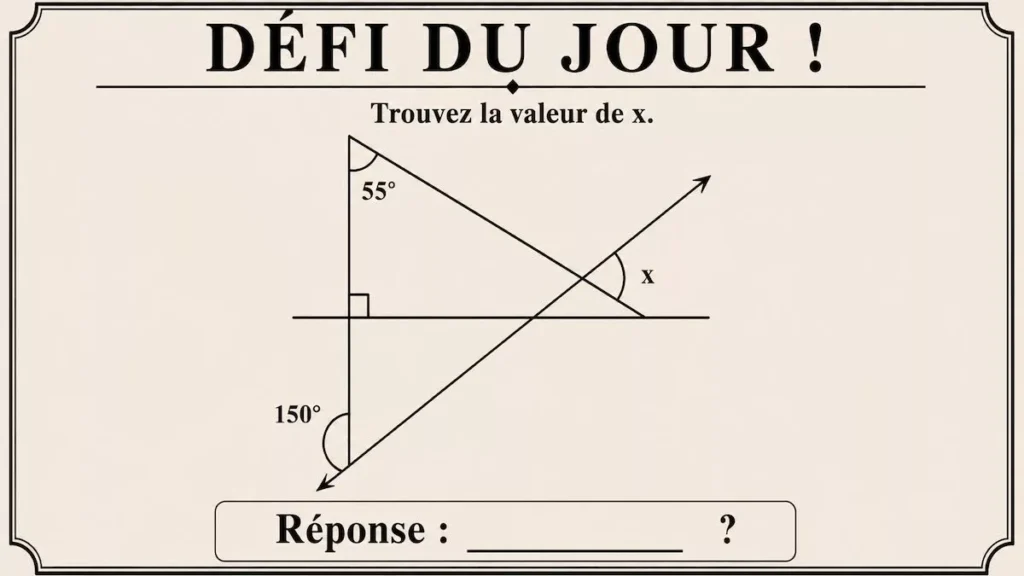
Two oblique lines intersect and form the angle x.
Your task is to determine:
x = ?
Note: the angle of 150° is particularly important. You must first deduce the small angle formed with the vertical line.
The Countdown Begins
40…
30…
25…
20…
15…
10…
5…
4…
3…
2…
1…
Time’s Up!
What Your Performance Can Reveal
If you found the result quickly and correctly, you have excellent logic and analytical skills.
If you found the result after some reflection, you know how to structure your reasoning and check your steps.
And if the result was incorrect or not found, no worries, this type of exercise is perfect for improving method and precision.
Detailed Solution We Found (Not Necessarily the Only One, Sometimes Even the Correct One)
Let’s begin with the 150° angle at the bottom.
This angle and the small angle on the other side of the vertical line together form a flat angle of 180°.
Thus, the small angle is:
180° − 150° = 30°
The vertical line is perpendicular to the horizontal line. Therefore, they form an angle of:
90°
The ascending oblique line forms an angle of 30° with the vertical. Thus, it forms with the horizontal:
90° − 30° = 60°
Now let’s look at the descending oblique line.
At the top of the figure, it forms an angle of 55° with the vertical.
Therefore, it forms an angle of:
90° − 55° = 35°
with the horizontal.
We now know the inclinations of the two intersecting lines:
60° for the ascending line,
and 35° for the descending line.
The angle x located to the right of their intersection is therefore the sum of these two angles:
x = 60° + 35°
x = 95°
Final Answer
x = 95°
Conclusion
This challenge perfectly illustrates that in geometry, the answer is often constructed from several small deductions. The angle of 150° allows us to obtain 30°, the right angle then helps us determine 60°, while the angle of 55° gives us 35°.
All that remains is to combine this information with one last equation:
x = 60° + 35° = 95°
This type of challenge develops an essential skill: not seeking the answer immediately, but first identifying the intermediate information that allows you to reach it. Thus, the sought value is indeed 95°.
And before you get lost in the maze of the web, explore more games and tests by clicking here.