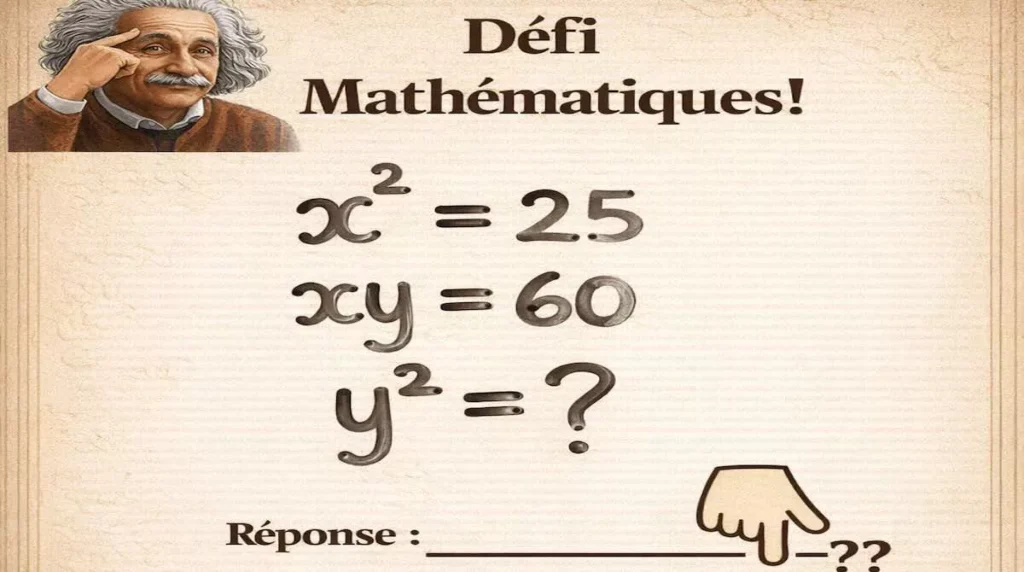
Dear friends who love mathematics. As I mentioned yesterday, I read an article in the Parisien that quoted the words: “There is an urgent need to react,” an appeal from the head of Thales, Patrice Caine, for France to improve its level in mathematics. This reflection highlights a well-known reality: mathematics is not just a school subject, but a true tool for reasoning, logic, and understanding the world. It teaches us to structure our thoughts, analyze situations, and solve problems methodically.
Thus, it is quite timely that today, like many other days, we are presenting you with a challenge that will test your analytical skills, rigor, and ability to intelligently utilize the information provided.
At first glance, the exercise that follows may seem very simple. It contains only a few pieces of data, yet it requires deep reflection. This type of problem is particularly interesting because it does not rely on lengthy or complex calculations, but on the ability to establish logical connections between elements.
Why This Challenge Is Interesting
This type of exercise is very educational because it allows you to:
- Develop a structured logical reasoning
- Learn to effectively utilize the relationships between different variables
- Reinforce the understanding of simple equations and their implications
- Avoid errors due to hasty interpretations of data
- Improve the ability to solve a problem with limited information
In mathematics, it is not always the quantity of data that determines the difficulty, but rather how that data is used.
The Math Challenge of the Day
Here are the pieces of information you have:
Based on these elements, you need to answer the following question:
What is the value of y²?
The Countdown
Take a moment to think, but don’t take too long:
45…
30…
20…
10…
5…
3…
2…
1…
Time’s up.
Analysis and Reflection
Before rushing to an answer, take the time to ask yourself the right questions:
What can we deduce from x² = 25?
How can we use the relation xy = 60 to find information about y?
Is there a method to directly relate these two equations?
Is the result unique, or should we consider multiple cases?
Each step of your reasoning is important. A good approach is to leverage what you already know to deduce what you are seeking.
And You?
What result did you obtain?
Did you find it quickly, or did you need time to structure your reasoning?
This type of challenge shows that in mathematics, apparent simplicity can conceal genuine logical richness. With a bit of method and reflection, it becomes possible to transform a few pieces of information into a clear and precise solution.
Here Is the Solution We Found:
We start from the following two pieces of information:
x² = 25
xy = 60
Step 1: Determine the Possible Values of x
If x² = 25, then:
x = 5 or x = −5
Step 2: Use the Relation xy = 60
If x = 5:
5y = 60 → y = 12
If x = −5:
−5y = 60 → y = −12
Step 3: Calculate y²
In both cases:
y = 12 → y² = 144
y = −12 → y² = 144
Final Result
The value of y² is:
144
Conclusion
Even though x and y can take on positive or negative values, their squares remain the same. This type of exercise illustrates that it is often possible to obtain a unique result, even when multiple intermediate solutions exist.
And before you get lost in the depths of the web, explore other games and tests by clicking here.