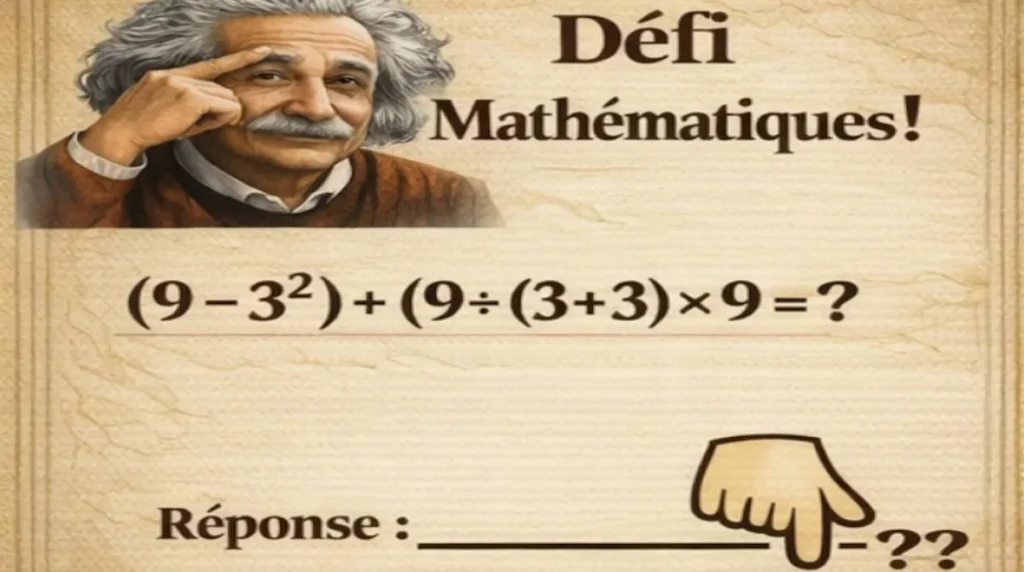
Some equations may seem straightforward but can quickly become misleading if the fundamental rules of calculation are not strictly followed. Take a moment to examine this equation. Before you begin, it’s crucial not to give in to the temptation of calculating in the order of reading. In mathematics, each operation follows a specific order, and failing to adhere to it almost always leads to an error.
An Approach Inspired by Henri Poincaré
As Henri Poincaré once said:
“Thought is but an éclair in the midst of a long night, but it is that éclair that matters most.”
This quote serves as a reminder that understanding does not stem from speed, but from the accuracy of reasoning.
Why This Challenge is Interesting
This type of exercise allows you to:
- Reinforce mastery of the order of operations
- Cultivate rigor and precision
- Avoid errors stemming from hasty reading
- Structure your thinking step by step
- Understand that even a short equation may require special attention
Here is the Challenge:
The Countdown
To add a bit of pressure and test your speed:
30…
20…
10…
5…
3…
2…
1…
Time’s up.
Analysis and Reflection
Before providing your answer, ask yourself the right questions:
Did you start with the innermost parentheses?
Did you properly handle divisions before additions?
Did you take into account powers before multiplication?
Every detail counts, and a single mistake in the order of operations can completely alter the final result.
And You?
What result did you obtain?
Did you find it quickly, or did you have to go back and verify each step?
Regardless of your level, this type of challenge is an excellent way to strengthen your mathematical rigor and logic.
Here is the Solution We Found
Explained Solution
To correctly solve this equation, it is essential to follow the order of operations:
- Parentheses
- Powers
- Multiplications and divisions (from left to right)
- Additions and subtractions
Every step must be followed carefully.
Let’s start with the priority calculations:
- 3² = 9
- (9 − 9) = 0
Next:
- (3 + 3) = 6
- 9 ÷ 6 = 1.5
- 1.5 × 9 = 13.5
Finally:
0 + 13.5 = 13.5
Result
The result of this equation is therefore: 13.5
Conclusion
This challenge shows that an apparently simple equation can become tricky if the basic rules are not followed. The key lies in the method: taking the time, following the steps in the correct order, and double-checking each calculation.
It is this rigor that helps avoid mistakes and fosters effective progress in mathematics.