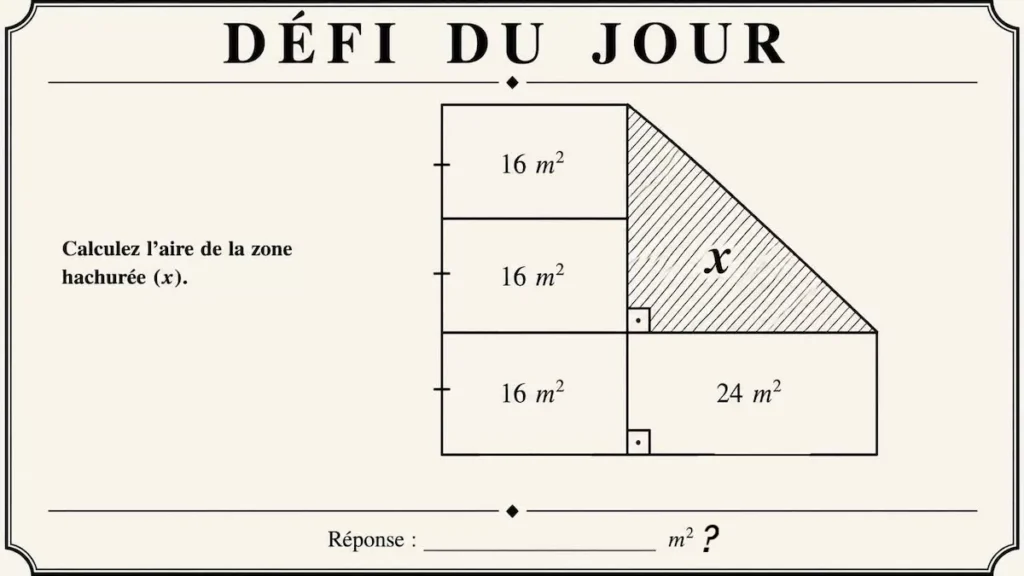
I have often looked at a figure filled with numbers and thought that finding the solution would require a lot of calculations. However, by observing the shapes one by one, I realized that each area actually reveals a hidden dimension. This is what I love about this kind of challenge. We are not directly given the lengths we need, but mathematics allows us to reconstruct them.
Since ancient times, calculating areas has been one of the most practical applications of mathematics. It has enabled the measurement of land, the construction of monuments, the drawing of plans, and the development of architecture. Today, these same principles are still used in engineering, construction, cartography, and digital design. Mathematics teaches us to transform indirect information into usable data.
“Geometry is the art of reasoning correctly about incorrect figures.” — Henri Poincaré
This quote is particularly fitting for this challenge: one must not rely solely on the appearance of the drawing but on the geometric properties and the given data.
What This Challenge Allows You to Work On:
- Calculating areas
- Properties of squares and rectangles
- Finding missing dimensions
- Area of a triangle
- Multiplication and division
- Interpreting a geometric figure
- Reasoning in multiple steps
- Logic and concentration
Challenge of the Day
Calculate the area of the shaded region x.
What is the area of the shaded triangular region x?
Answer: __________ m²
All the necessary lengths are hidden in the indicated areas. It’s up to you to find them.
The Countdown Begins
40…
30…
20…
10…
5…
4…
3…
2…
1…
Time’s up!
What Your Performance May Reveal
If you found the result quickly and correctly, you have excellent logic and analytical skills.
If you found the result after some thought, you know how to structure your reasoning and check your steps.
If your result was incorrect or you didn’t find it, no worries; this type of exercise is perfect for improving method and accuracy.
Detailed Solution We Found (Not Necessarily the Only One, Sometimes Even the Correct One)
Let’s start with the three squares.
Each has an area of:
16 m²
Let’s call a the length of a side of a square.
We set up the equation:
a² = 16
Since a length is positive:
a = 4 m
Each square therefore measures 4 m × 4 m.
Now, let’s move on to the rectangle of 24 m².
Its height is the same as the side of a square, so:
4 m
Let’s call b its width.
We set up the equation:
4b = 24
Dividing by 4:
b = 6 m
We now have the base of the shaded triangle:
6 m
Next, we need to find its height.
The triangle starts at the top of the 24 m² rectangle and rises to the top of the three squares.
Thus, it corresponds to the height of two squares:
h = 4 + 4
h = 8 m
Now we know:
base = 6 m
height = 8 m
To find the area x, we write the equation:
2x = 6 × 8
2x = 48
Dividing both sides by 2:
x = 24
Final Answer
x = 24 m²
Verification
The base of the triangle measures:
24 ÷ 4 = 6 m
Its height measures:
4 + 4 = 8 m
So:
2 × 24 = 6 × 8
48 = 48
Conclusion
This challenge demonstrates that an area can be used to find a length, which can then become the key to another calculation. The 16 m² allows us to obtain 4 m, the 24 m² then allows us to find 6 m, and the two squares above give a height of 8 m. A final equation leads us to x = 24 m².
This is precisely one of the interests of geometry: connecting several simple pieces of information to discover a value that was never directly indicated on the figure.
And before you get lost in the depths of the web, explore other games and tests by clicking here.