In the history of mathematics, some of the most significant discoveries did not arise from endless calculations, but from a much simpler idea: organizing reasoning. As mathematicians gradually established common conventions for performing calculations, they enabled everyone to interpret the same equation in the same way. This rigor is now ubiquitous, playing a role in computer programming, scientific calculations, engineering, finance, and navigation systems.
A simple rule like the priority of multiplication and division may seem trivial, but without common rules, two people could arrive at two different results from the same calculation.
I remember little challenges like this one where my first instinct was to calculate simply from left to right. The result seemed perfectly logical… until I realized I had forgotten about the order of operations. Since then, whenever I encounter multiple operations in the same equation, I always start by asking myself: “Which operation should I perform first?”
Quote of the Day
“Mathematics is the music of reason.” — James Joseph Sylvester
A beautiful reminder that, like in music, order and rules matter. A single step placed incorrectly can alter the entire outcome.
What This Challenge Helps To Develop:
- Order of operations;
- Multiplication and division;
- Mental calculation;
- Attention to detail;
- Speed of reasoning;
- Rigor;
- Ability to resist a too-obvious answer.
CHALLENGE OF THE DAY!
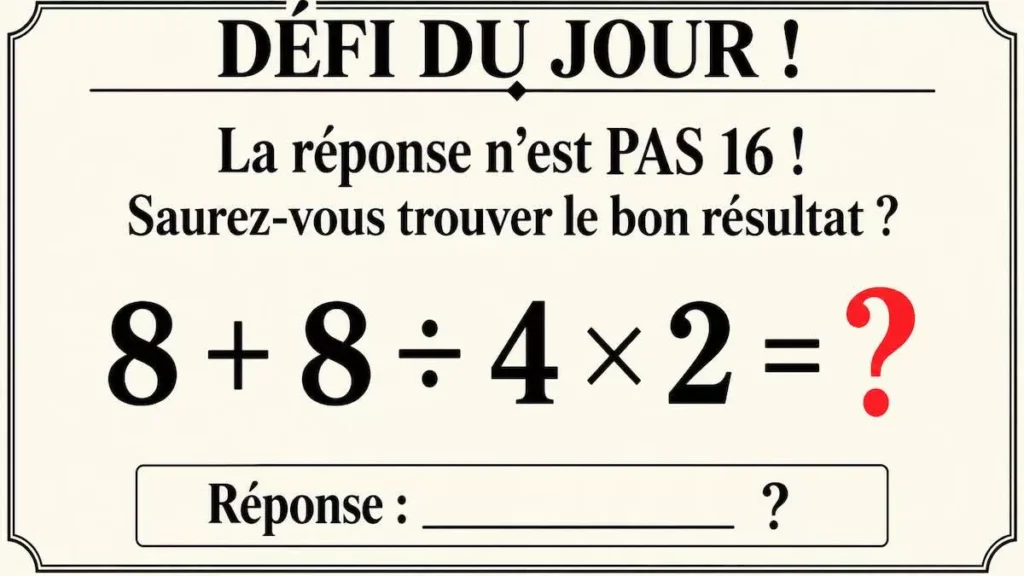
Today, a very short equation might easily trick you:
And be careful: the answer is not 16!
At first glance, several methods may seem possible. But in mathematics, we must respect the order of operations.
So, will you be able to find the correct result before time runs out?
The Countdown Begins
10…
9…
8…
7…
6…
5…
4…
3…
2…
1…
Time’s up!
What Your Performance Can Reveal
If you found the result quickly and correctly, you have excellent logic and good analytical skills.
If you found the result after some thought, you know how to structure your reasoning and check your steps.
And if your result was incorrect or you couldn’t find it, no worries, this type of exercise is perfect for improving your method and precision.
Detailed Solution We Found (Not Necessarily the Only One, and Sometimes Even the Right One)
Multiplication and division have the same priority. When they appear together, we perform them from left to right.
We have:
8 + 8 ÷ 4 × 2
Addition is not a priority. Therefore, we start with division and multiplication.
Since they have the same priority, we move from left to right.
First:
8 ÷ 4 = 2
The equation becomes:
8 + 2 × 2
Next, we perform the multiplication:
2 × 2 = 4
So we are left with:
8 + 4
And finally:
8 + 4 = 12
Answer: 12
Why Is 16 a Trap?
One might be tempted to calculate:
4 × 2 = 8
Then:
8 ÷ 8 = 1
Leading to a different result.
However, this method is incorrect because multiplication is not prioritized over division. Both operations are at the same level of priority and should be treated from left to right.
Conclusion
This challenge proves that a calculation involving only four numbers can test much more than our ability to compute. It primarily checks our knowledge of the rules that organize an equation.
Speed is useful, but it never replaces method. When faced with a calculation, taking a few seconds to identify the priority operations can easily prevent a mistake.
If you found 12, congratulations! You successfully avoided the trap and correctly respected the order of operations.
And remember: in mathematics, it’s not always the fastest calculator who wins, but the one who calculates in the correct order.
Before you get lost in the depths of the web, explore more games and tests by clicking here.