For centuries, mathematicians have sought to understand the hidden relationships between numbers. Long before calculators existed, they observed sequences, compared results, and searched for rules that could explain multiple examples at once. This quest for patterns has played a crucial role in the development of algebra and logical reasoning. Today, this way of thinking remains immensely useful. It is applied in computer science, programming, data analysis, the sciences, and even in certain everyday decisions. Recognizing a common rule among several calculations often allows for quicker problem-solving than calculating each case separately.
I remember an exercise where several calculations seemed completely different. I initially attempted to find complicated additions between the results, but to no avail. Then I simply compared each number with the outcome obtained. I noticed that a consistent transformation occurred in each line. Since then, whenever I see multiple examples, I always ask myself: what identical rule connects each calculation to its result?
Quote of the Day
“What is asserted without proof can be denied without proof.” — Euclid
This quote serves as a reminder that in mathematics, finding an answer is not enough. One must also be able to explain the rule used and verify that it works for all examples.
What This Challenge Allows You to Work On:
This challenge allows you to work on:
- Attentive observation;
- Searching for regularities;
- Mental calculation;
- Operations with numbers;
- Multiplication and addition;
- Formulating a general rule;
- Verifying a hypothesis;
- Logical reasoning;
- Concentration and speed.
Challenge of the Day
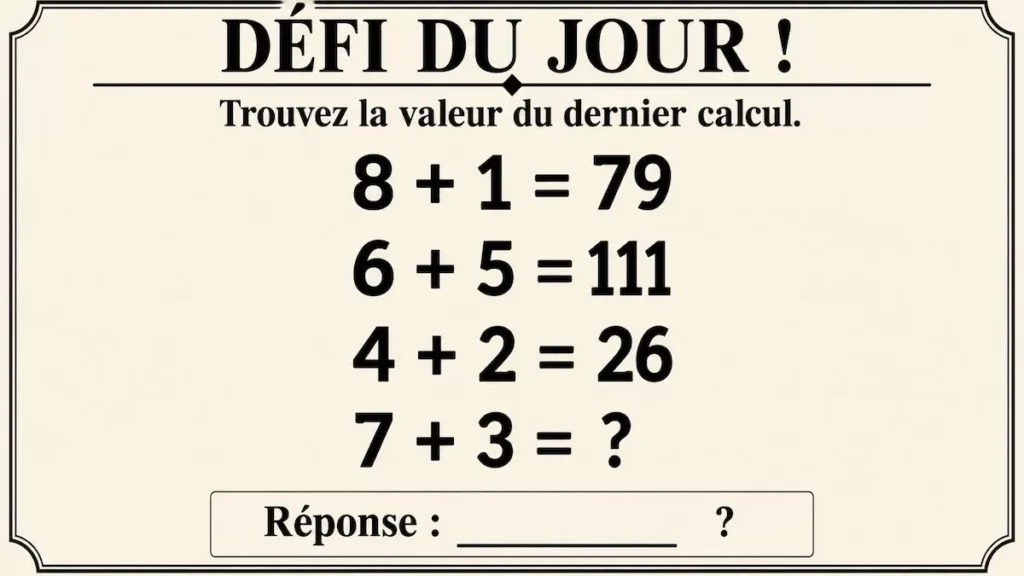
Carefully observe the following calculations:
Your mission is to discover the rule used to transform the two numbers on the left into the result.
Note: This is not a standard addition. Look for a consistent logic that applies to the first three lines before using it on the last one.
What value should replace the question mark?
The Countdown Begins
20…
15…
10…
9…
8…
7…
6…
5…
4…
3…
2…
1…
Time’s up!
What Your Performance May Reveal
If you found the result quickly and accurately, you possess excellent logic and analytical skills.
If you arrived at the correct result after some thought, you know how to structure your reasoning and verify your steps.
And if your result was incorrect or not found, no worries; this type of exercise is perfect for improving your methodology and accuracy.
Detailed Solution We Found (Not Necessarily the Only or Even the Correct One)
The rule consists of writing two results next to each other.
We start by calculating the difference between the two numbers, then their sum.
Let’s look at the first line: 8 and 1.
The difference is: 8 − 1 = 7
The sum is: 8 + 1 = 9
By writing these two results side by side, we get:
79
This corresponds correctly to the first line.
Let’s check the second one: 6 and 5.
The difference is: 6 − 5 = 1
The sum is: 6 + 5 = 11
By placing them together, we get:
111
The rule still holds.
Now let’s test the third: 4 and 2.
The difference is:
4 − 2 = 2
The sum is: 4 + 2 = 6
We get: 26
The rule is thus confirmed. Now let’s apply it to the last line.
7 and 3.
The difference is: 7 − 3 = 4
The sum is: 7 + 3 = 10
By writing the two results next to each other, we obtain:
410
Final Answer
7 + 3 = 410
Conclusion
This challenge illustrates that an unusual result is not necessarily indicative of a complicated calculation. It simply required understanding that the result was formed by two numbers placed side by side: the difference, followed by the sum.
Once this rule was discovered, the first three lines became coherent, and the last one could be solved immediately.
This type of challenge fosters a very useful skill in mathematics: searching for a general rule, testing it on multiple examples, and then applying it to find the missing value.
Thus, the answer to today’s challenge is 410.
And before you get lost in the depths of the web, explore other games and tests by clicking here.