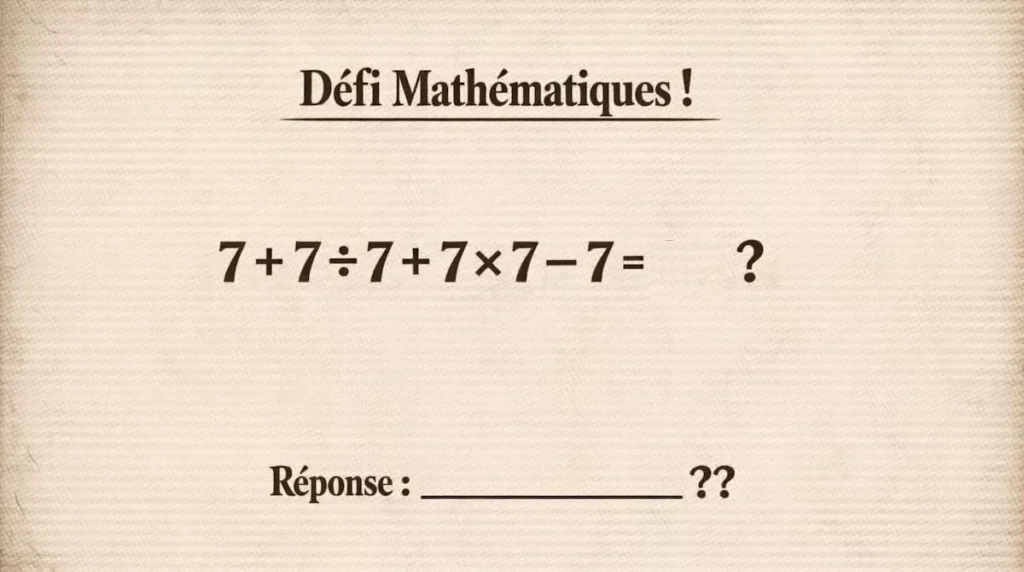
Behind a seemingly simple equation lies a real trap. Without careful analysis, it’s easy to make mistakes, especially when multiple operations are involved. Many people solve equations in the order they read them, neglecting the order of operations, which often leads to errors.
This type of challenge is an excellent opportunity to strengthen logical thinking, review the basics, and improve in mathematics. Here, the challenge is not just about speed, but also about method and precision.
As René Descartes once said:
“To reach the truth, one must once in their life rid themselves of all received opinions.”
In mathematics, this means that one must always verify each step rigorously, even when the equation appears simple.
What This Challenge Helps Improve
- Respect for the order of operations
- Management of multiplications in an equation
- Precision in calculations
- Verification of the final result
- Accuracy in analysis
Today’s Challenge
Answer: ______ ??
Take your time to carefully observe the equation before responding. A simple oversight can drastically change the outcome.
The Countdown
20…
10…
5…
3…
2…
1…
Time’s up!
So, what is your answer?
What Your Performance Reveals
If you found the correct answer quickly, you have a strong grasp of the order of operations.
If you arrived at the answer after some reflection, you are capable of analyzing and structuring your reasoning.
If your answer was incorrect or you couldn’t find one, no worries—these exercises are designed to help you progress.
Here Is The Solution We Found:
Method to Follow
To correctly solve this equation, you should:
– First, perform the multiplication
– Then, keep the additions and subtractions
– Calculate step by step
– Verify the result obtained
Step 1: Respect the Order of Operations
In this equation, divisions and multiplications must be performed before subtraction.
So, we need to calculate:
4 ÷ 2 × 3
Divisions and multiplications are performed from left to right.
Step 2: Calculate from Left to Right
4 ÷ 2 = 2
Then:
2 × 3 = 6
The equation then becomes:
12 − 6
Step 3: Perform the Subtraction
12 − 6 = 6
Result
Answer: 6
Conclusion
This equation demonstrates that a calculation that seems very simple can become tricky if the order of operations is not respected. The key is to follow a rigorous method and verify each step before providing the final answer.
And before you get lost in the depths of the web, explore other games and quizzes by clicking here.