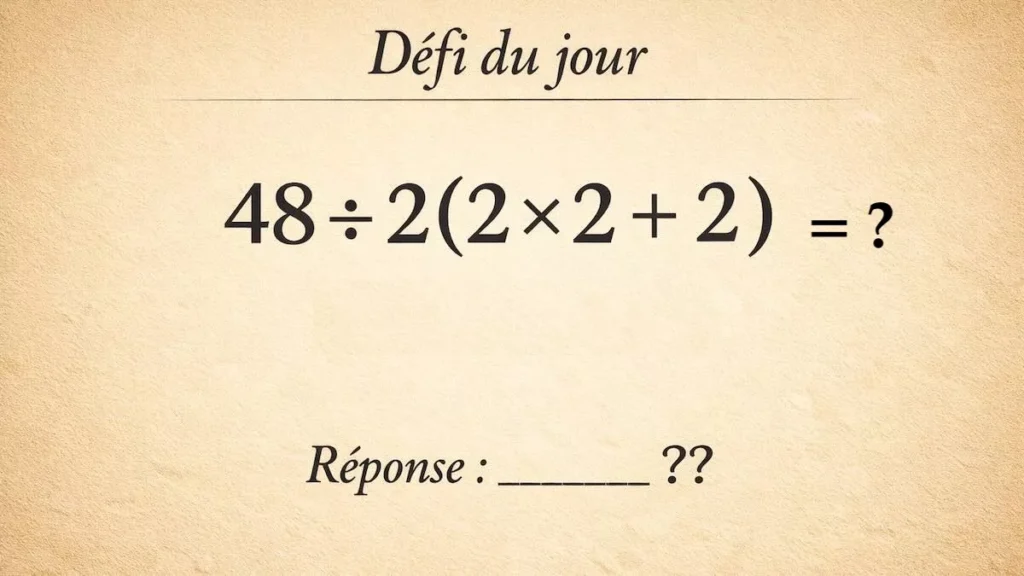
I remember a rather amusing debate surrounding an equation like this: two individuals arrived at different results while firmly believing they were correct. In reality, the discrepancy stemmed solely from their adherence to the order of operations. This is precisely the type of challenge that illustrates how a seemingly minor forgotten rule can drastically alter the outcome.
In this kind of equation, the challenge lies not in the numbers themselves but in the sequence of operations. A misinterpretation can quickly lead to an incorrect answer, even with a straightforward calculation.
Mathematics here requires rigor and constant attention to priorities.
As René Descartes said:
“Method is more important than chance.”
This reminds us that in mathematics, the correct approach is essential for obtaining a reliable result.
What This Challenge Allows You to Work On:
- Order of operations
- Rigor in calculations
- Multiplication and division
- Analysis of an ambiguous equation
- Verification of results
Challenge of the Day
Answer: ______ ??
Take your time to analyze each step before responding.
A misinterpretation of priorities can completely change the final result.
The countdown begins:
40…
30…
20…
10…
5…
4…
3…
2…
1…
Time’s up!
What Your Performance Can Reveal
If you found the result quickly and correctly, you have excellent logic and analytical skills.
If you arrived at the result after some thought, you know how to structure your reasoning and verify your steps.
And if you found an incorrect result or none at all, no worries; this type of exercise is perfect for improving your methodology and precision.
Detailed Solution We Found (not necessarily the only one, and sometimes not even the right one)
Step 1: Parentheses
(2 × 2 + 2) = 4 + 2 = 6
The equation becomes:
48 ÷ 2 × 6
Step 2: Priorities (division and multiplication from left to right)
48 ÷ 2 = 24
24 × 6 = 144
Final Answer:
144
Conclusion
This challenge demonstrates that certain equations can be misleading if the order of operations is not strictly followed. By applying a clear and rigorous method, one can avoid misinterpretations and arrive at a correct and logical solution.
And before you get lost in the depths of the web, explore other games and tests by clicking here.