What I love about number sequences is that they compel us to view numbers in a different light. We are very familiar with addition, but suddenly an equation like 31 + 31 = 6 forces us to abandon our automatic thinking. It’s no longer just a matter of calculation; we need to uncover the hidden rule. I remember certain challenges where my initial reaction was to think, “This equation must be false.” Then I realized that the plus sign could simply be part of the trick and that I needed to observe the results before making a judgment. This is precisely what makes these puzzles interesting: they enhance our ability to seek a different logic.
For centuries, mathematicians have studied patterns and sequences to understand how a rule can generate an entire series of numbers. This search for patterns is now essential in computer science, algorithms, statistics, the sciences, and many predictive systems.
“It is not knowledge, but the act of learning that brings the greatest pleasure.” — Carl Friedrich Gauss
So today, don’t perform a regular addition. Look for what the numbers are trying to reveal to you.
What This Challenge Allows You to Work On:
- Observation
- Searching for a numerical rule
- Logical sequences
- Mental calculation
- Multiplication
- Pattern recognition
- Ability to move beyond automatic thinking
- Verification of a hypothesis
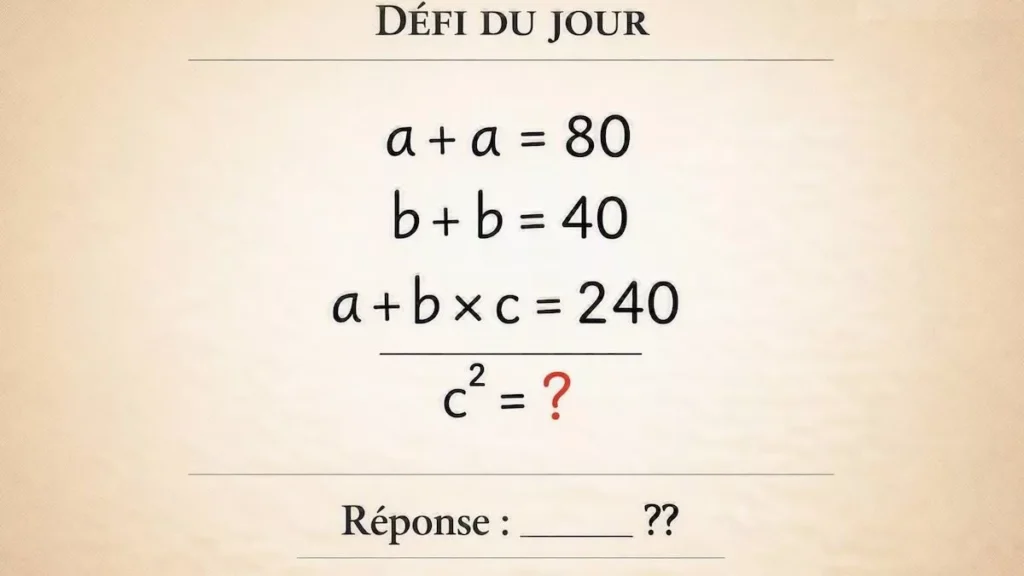
CHALLENGE OF THE DAY
Find the Missing Value.
Answer: __________
The Countdown Begins
30…
20…
10…
5…
4…
3…
2…
1…
Time’s Up!
What Your Performance Can Reveal
If you found the answer quickly and correctly, you have excellent logic and good analytical skills.
If you found the answer after some thought, you know how to structure your reasoning and verify your steps.
And if your answer was incorrect or not found, no worries; this type of exercise is perfect for improving method and accuracy.
Detailed Solution We Found (Not Necessarily the Only or the Correct One)
Here, we should not interpret the lines as ordinary additions.
Let’s look at the results:
31 + 31 = 6
32 + 32 = 12
33 + 33 = 18
With each new line, the result increases by 6:
6 → 12 → 18 → ?
We continue the progression:
18 + 6 = 24
We can also find a consistent rule based on the second digit.
For 31:
3 × 1 × 2 = 6
For 32:
3 × 2 × 2 = 12
For 33:
3 × 3 × 2 = 18
And for 34:
3 × 4 × 2 = 24
Answer: 24
Conclusion
This challenge reminds us that in recreational mathematics, the symbol presented does not always have to be interpreted as a traditional operation. Here, the first three lines mainly serve to reveal a common rule.
The transition from 6 to 12 then to 18 helps to identify a consistent increase of 6, and the rule 3 × second digit × 2 confirms the result.
Therefore, the answer is 24.
And that’s the essence of this type of challenge: sometimes, knowing how to calculate is not enough; we must first understand the rules of the game.
And before you get lost in the depths of the web, explore other games and tests by clicking here.