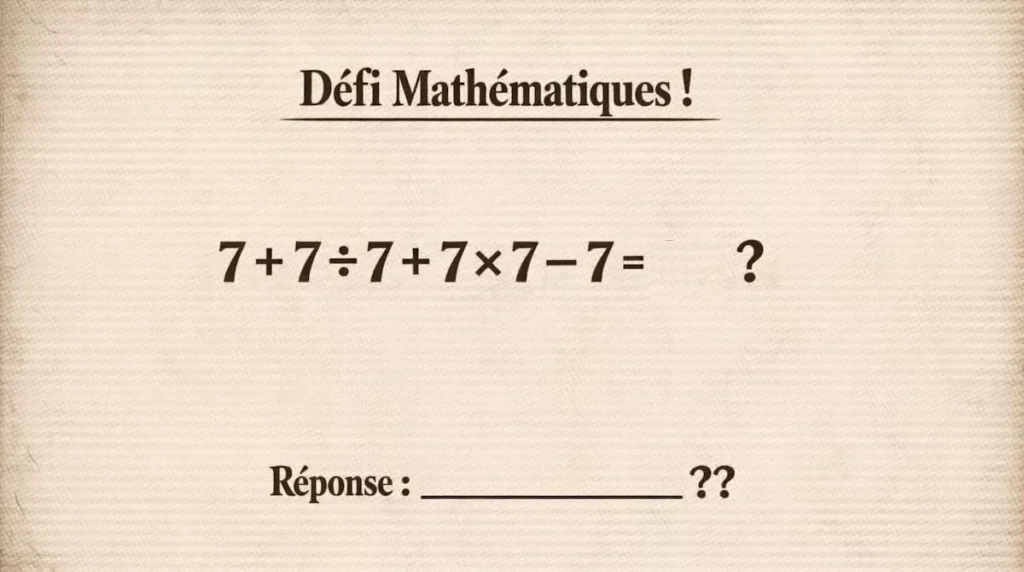
Behind a seemingly simple equation can lie a classic trap. Without careful attention to the rules of calculation, it’s easy to make mistakes. Many people perform operations in the order they read them, disregarding the order of operations, which often leads to errors.
As René Descartes said:
“To examine the truth, it is necessary, once in your life, to put everything in doubt.”
In mathematics, this means that one must verify each step and never rely on hasty intuition.
Why This Challenge Is Interesting
This type of exercise allows you to:
- Strengthen mastery of the order of operations
- Avoid errors related to automatism
- Develop rigor in calculations
- Understand that a simple equation can be misleading
The Challenge of the Day
Carefully observe the following expression:
The question is straightforward: what is the final result?
But be careful, don’t rush. The presence of multiplication and division can easily lead to mistakes if they are not handled with priority.
The Countdown Begins
30…
20…
10…
5…
3…
2…
1…
Time’s up!
So, what is your answer?
What Your Performance Reveals
If you found the result quickly and correctly, you have a strong grasp of the order of operations.
If you found the result after some thought, you know how to analyze and structure your reasoning.
If your result was incorrect or you didn’t find one, no problem; these exercises are meant for improvement.
Here Is The Solution We Found:
Step 1: Apply the Order of Operations
In the equation:
5 × 5 − 5 ÷ 5 + 5
We start with multiplication and division:
5 × 5 = 25
5 ÷ 5 = 1
Step 2: Continue the Calculation
We replace in the equation:
25 − 1 + 5
Then we calculate from left to right:
25 − 1 = 24
24 + 5 = 29
Result
Answer: 29
Conclusion
This challenge demonstrates that a very simple equation can become tricky if the rules of calculation are not followed. The key is to adhere to a rigorous method and to verify each step.
And before you get lost in the depths of the web, explore other games and tests by clicking here.