I recall a logic challenge where several people were searching for a complicated formula, while the real challenge was simply recognizing the relationship between the numbers. This type of exercise highlights an important truth: in mathematics, speed isn’t always the key. It’s crucial to observe, analyze, and construct a solid reasoning process. Mathematics plays a vital role in developing our thinking. It enhances concentration, logic, memory, and our problem-solving abilities. Each mathematical puzzle serves as practice for learning to seek solutions methodically and accurately.
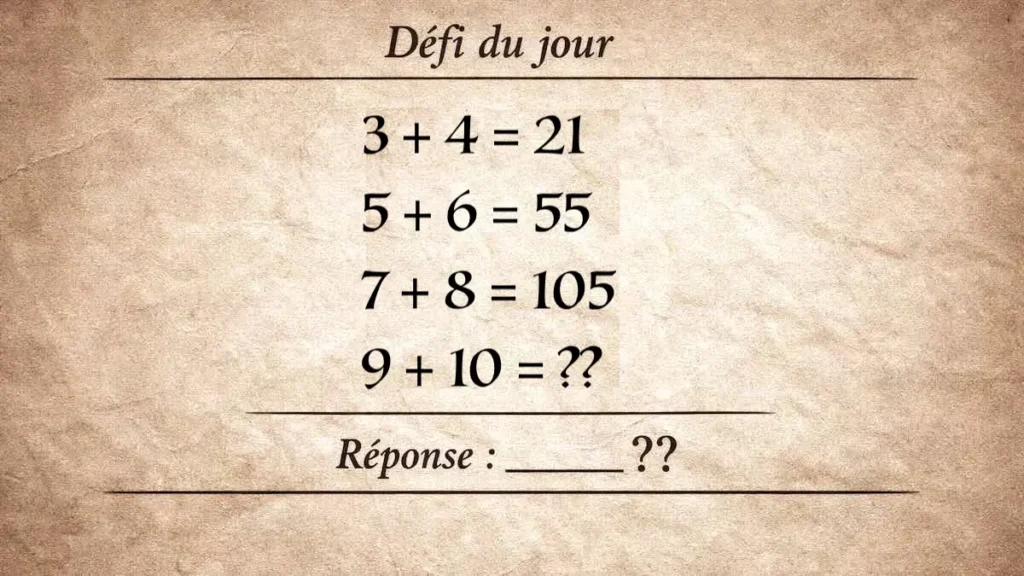
In this challenge, the hidden additions actually follow a specific rule. It requires comparing each line, looking for similarities, and understanding how the initial numbers influence the final result.
What This Challenge Helps To Develop:
- Observation of patterns
- Mathematical logic
- Pattern recognition
- Analytical skills
- Step-by-step reasoning
Today’s Challenge

Answer: ______ ??
Take your time to observe each equality.
The trap is often to search for a classic operation when a hidden pattern may lie behind the results.
The countdown begins:
- 40…
- 30…
- 20…
- 10…
- 5…
- 4…
- 3…
- 2…
- 1…
Time’s up!
What Your Performance May Reveal
Result found quickly and correctly: you have excellent logic and strong analytical skills.
Result found after some reflection: you know how to structure your reasoning and verify your steps.
And if the result is incorrect or not found, don’t worry; this type of exercise is perfect for improving method and precision.
Detailed Solution We Found (Not Necessarily the Only One, Sometimes Even the Correct One)
The pattern is:
First number × (first number + second number)
Verification:
3 + 4
3 × (3 + 4)
3 × 7 = 21
5 + 6
5 × (5 + 6)
5 × 11 = 55
7 + 8
7 × (7 + 8)
7 × 15 = 105
Applying the same rule:
9 + 10
9 × (9 + 10)
9 × 19 = 171
Final Answer: 171
This challenge helps to work on logic, observation of patterns, and the ability to find a hidden rule behind a series of equations.
Conclusion
This challenge serves as a reminder of an important rule in mathematics: a good solution must always be based on verifiable logic. Sometimes, the best reasoning isn’t to find a quick result, but to recognize that a problem lacks information. Mathematics teaches us to be rigorous, to verify our hypotheses, and to construct solid answers.
And before you get lost in the depths of the web, explore other games and tests by clicking here.