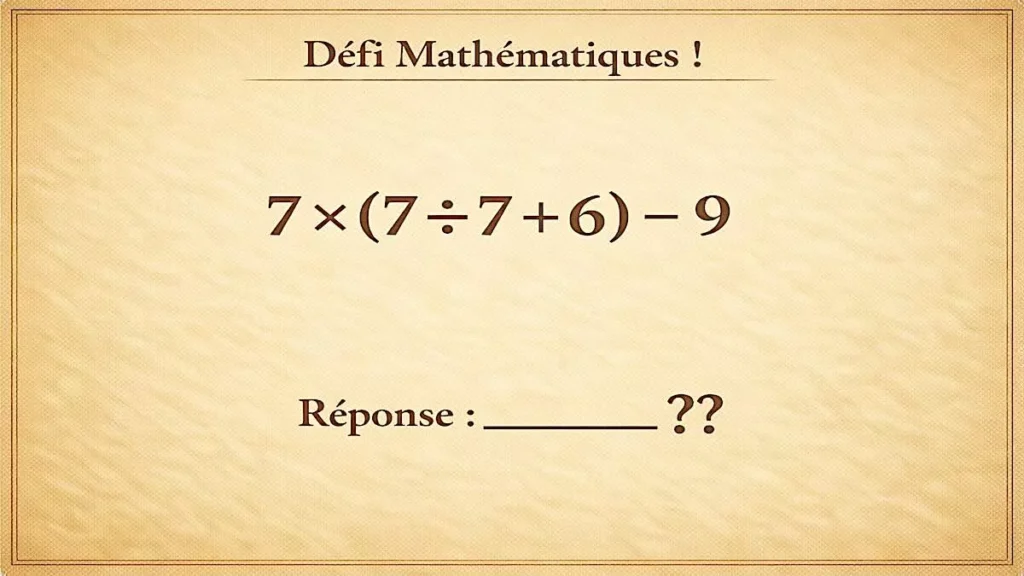
Some equations may seem simple or not, but they always require a rigorous application of the order of operations. In this type of challenge, the difficulty arises not only from the calculations themselves but especially from the sequence in which they are performed. It’s not just about calculating; it’s about adhering to a precise and structured method to avoid any mistakes. In mathematics, every step counts and must be executed in the correct order to ensure an accurate result. But rest assured, no one is infallible—not even me, nor the best of the best.
In France, mathematics assessments regularly show that mastering the fundamentals remains an important challenge. These exercises present an excellent opportunity to practice, solidify your foundation, and develop a reliable calculation method. Here, the key is not speed, but the proper application of mathematical rules. Plus, there’s nothing healthier and more natural than exercising your brain.
As Galileo once said:
“Mathematics is the language in which God has written the universe.”
This serves as a reminder that every equation is based on a precise logic that must be respected.
What This Challenge Helps to Develop:
- Respect for the order of operations
- Rigor in solving an equation
- Ability to concentrate
- Step-by-step logical reasoning
- Verification of results
Today’s Challenge
Answer: ______ ??
Take your time to analyze each step of the equation before responding.
A mistake in the order of operations can completely change the final result.
The countdown begins:
40…
30…
20…
10…
5…
3…
2…
1…
Time’s up!
So, what is your answer?
What Your Performance Reveals
Quick and correct answer: you have excellent analytical skills.
Answer found after some thought: you know how to structure your reasoning.
Incorrect or unanswered result: no problem, these challenges are meant for growth.
Detailed Solution We Found (Not Necessarily the Only One, or Even the Correct One)
Step 1: Division Inside the Parenthesis
12 ÷ 3 = 4
The equation becomes:
(4 + 4) × 2 − 5
Step 2: Addition Inside the Parenthesis
4 + 4 = 8
The equation becomes:
8 × 2 − 5
Step 3: Multiplication
8 × 2 = 16
The equation becomes:
16 − 5
Step 4: Final Subtraction
16 − 5 = 11
Final Answer:
11
Conclusion
This challenge highlights the importance of respecting the order of operations in an equation. By following each step in the correct sequence, it becomes easier to avoid mistakes and achieve a correct result. Rigor and method remain essential for effectively solving this type of calculation.
And before you get lost in the depths of the web, explore other games and tests by clicking here.